Environment
The irreversible course of damage
The Ken–Betwa river-linking project is being pushed through with no apparent concern for the environment or the people it will displace
Imagine receiving Rs 16 as compensation for your home. That’s the amount offered to a tribal family as part of the rehabilitation package for the Rs 45,000 crore Ken–Betwa project. Another family was given the princely sum of Rs 200.
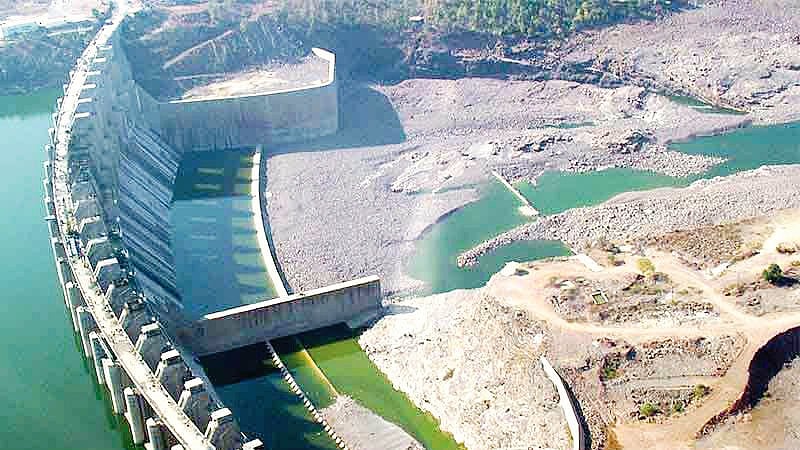
The foundation stone for the controversial interlinking of the two rivers in drought-prone Bundelkhand was laid on 25 December 2024 amidst a big publicity drive. It involves building the Daudhan dam to store water and a 221 km long canal to transfer water from the Ken to the Betwa.
While the government promised compensation of Rs 12.5 lakh per acre and Rs 6 lakh for a house, a large number of families have been offered tuppence or nothing at all. In despair, people from the 40 villages that will be submerged by the dam’s reservoir staged a week-long protest (5–16 April) in Dhodhan village.
Their ‘Panch Tatva Satyagraha’ began with a symbolic protest of lying down on funeral pyres (chita). Their fast or ‘Akash Andolan’ was followed by a ‘Mitti Andolan’ where they smeared soil from their village on their bodies. It culminated with the ‘Jal Andolan’ when they entered the water, wearing nooses around their necks — demanding justice or death.
On 16 April, a joint team of the Chhatarpur district administration reached the protest site to hold talks with the villagers who agreed to defer the protests until a new compensation package was announced.
Amit Bhatnagar, a former AAP member who is leading them under the banner of the Jai Kisan Sangathan, maintains that “sarkari assurances carry little weight with the villagers. Sixty thousand families, in one of the poorest regions in the country, are being affected by this river-linking project.”
No wonder the protest songs that resound in these villages speak of how the Ken-Betwa dam will provide water and electricity to distant villages while they will be evicted and denied even these basic facilities.
Most of the them belong to the indigenous Gond and Kol tribes, who live along the edge of forests and depend on farming for a living. “Our livelihoods are tied to this land — we don’t know what the future holds for us anymore,” said Phoolwati, a tribal woman among the thousands protesting against the project.
According to information supplied by the Ken Betwa Link Project Authority, the 77 metre high Daudhan dam will displace 5,288 families in Chhatarpur district and 1,400 families in Panna district due to land submergence and dam-related land acquisition.
The dam will not only bifurcate the Panna Tiger Reserve, it will also submerge 5,578 hectares of forest land. The project will submerge nearly 98 sq. km (38 sq. miles) of the 543 sq. km sanctuary that successfully brought tigers back from the brink of local extinction in 2009.
This could undo years of conservation efforts. Wildlife scientist Dr Raghu Chindawat has been living in Panna from 1995. He points out, “With 70 per cent of the tiger reserve habitat submerged, it will mean the end of the Panna Tiger Reserve and also of the 55-plus tigers and other animals living in it. Using the core area of a tiger reserve park for such a large-scale infrastructure project is unprecedented. If we go ahead, it will be a complete mockery of our institutions and our laws, our Forest Conservation Act, our Wildlife Biodiversity Act.”
Eminent conservationist M.K. Ranjitsinh, who has been involved in shaping wildlife conservation policies for the last five decades, opposed this project tooth-and-nail. He resigned from the Madhya Pradesh Wildlife Board in 2015, saying, “You can have either the interlinking project or the Panna Tiger Reserve. You cannot have both.”
Ranjitsinh, who helped notify nine new national parks and 14 new sanctuaries in Madhya Pradesh, is a disenchanted man. “All our protected areas are going to suffer and the most unfortunate aspect is most of these development projects do not even deliver [what they promise].”
From the start, environmentalists have questioned the modus operandi of the ministry of environment and forests. The Mumbai-based company contracted by the ministry to conduct the Environment Impact Assessment for this project was not on its approved list of agencies and had little knowledge of the ecology of the region.
The assessment report incorrectly stated that there were sal forests in the reserve, and declared that it was home to the Manipur brown antler deer (found only on the India–Burma border).
Aquatic ecology experts also question the statistics provided by the National Development Water Agency. Dr Brij Gopal of the Centre for Inland Waters in South Asia refutes the National Water Development Agency’s claim that the Ken river has an extra 1,074 million cubic of water to share. Gopal says the NWDA relied more on modelling than on-ground observations.
If the Panna river did have surplus water, why were the villagers struggling to find drinking water in summer? Meanwhile, sand mining in the Ken has made a bad water situation worse.
Gopal has suggested reviving the one lakh traditional water bodies in Bundelkhand which would yield more water storage and avoid massive displacement — at a fraction of the present cost.
The most shocking aspect of this project is that water flow calculations are based on data that is 30-40 years old. Chindawat said, “The government has refused to put the data in the public domain, insisting it’s a security risk. As both rivers flow into the Ganges which enters Bangladesh, they claim it is ‘international flow data’ and cannot be revealed.”
The government also chose to ignore the adverse report of the central empowered committee of the Supreme Court. Water experts, including Magsaysay awardee Rajendra Singh, have been vehemently critical. “Each river has its own geological character, different flora and fauna. By interlinking river basins, their unique aquatic life will be destroyed,” said Singh.
Ranjitsinh believes our present sanctuaries and tiger reserves are the “last havens of hope” for the survival of our natural heritage. “Why should Panna and Kaziranga be less sacrosanct than the Taj Mahal and Ajanta-Ellora?” he asks. “We have tiny havens left — only four per cent of India’s landmass. This is a Rubicon that should not have been crossed.”
Regardless of criticism, the ministry of water (‘jal shakti’, if you please) is carrying on, drawing up plans to connect 37 more rivers including the Godavari and Cauvery.
Bihar, Punjab, Karnataka, Kerala and Sikkim are among the states that have expressed reservations. From the start, Kerala has taken the stand that long-distance inter-basin water transfer will not work. Bihar’s rivers originate in Nepal, so diverting them would require the permission of a neighbouring nation.
As the first of a series of projects, the stakes are very high for the government and the powerful construction lobby. Who cares if the damages are irreversible?
Join our official telegram channel (@nationalherald) and stay updated with the latest headlines