Environment
The perils of ‘greenwashing’
‘Green’ is not a licence to do away with rigorous environmental assessment
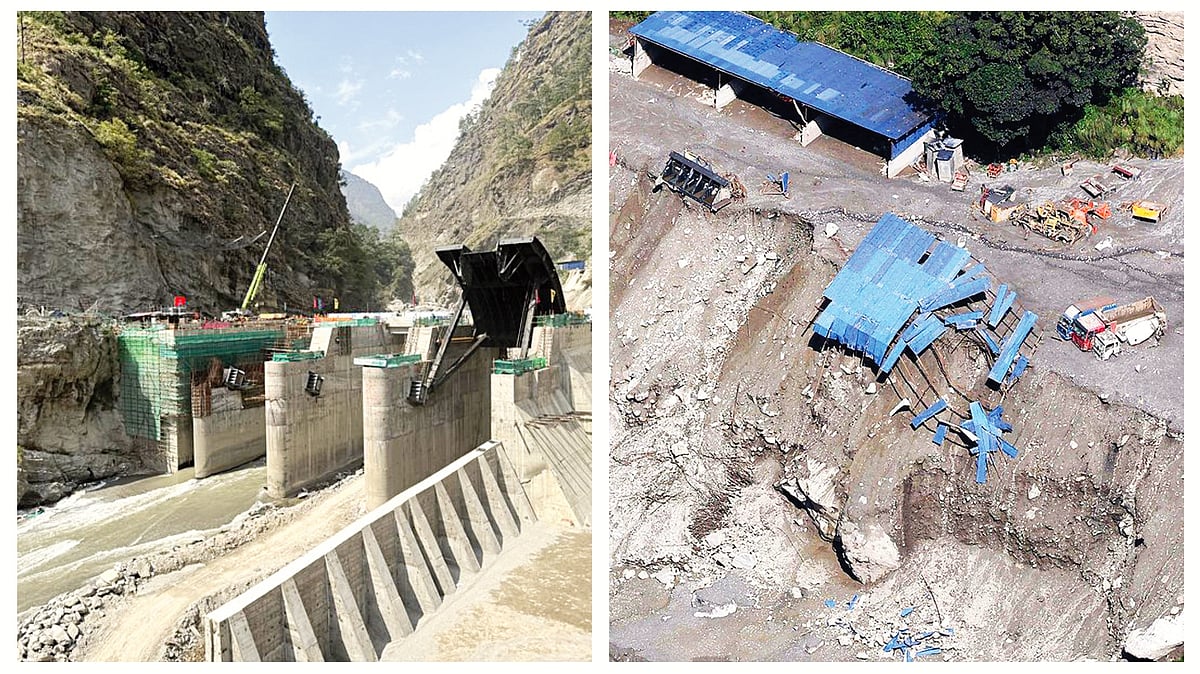
On the morning of 26 August, the Himalaya delivered another warning. A cascade of geological triggers — their exact sequence still a subject of scientific debate — near the Langtang Lirung mountain, on the Nepal-Tibet border, sent a tsunami of ice, rock, water and debris down the Bhote Koshi and Trishuli valleys.
Settlements disappeared. Roads and bridges were swallowed. More than a dozen hydropower projects were damaged or destroyed, and hundreds of workers trapped at project sites.
Scientists now agree on the initial trigger for the cataclysmic event: a massive vertical section of a glacier (est. 100-200 million cubic metres) sheared off at an elevation of 5,200 metres and fell 1,200 metres into the valley below.
At Upper Trishuli-1, a 216 MW hydropower project under construction, workers had barely 40 seconds to run for higher ground after the flood wave arrived. The entrances to tunnels were sealed by debris. At one point, Nepal government data put the number of missing people at project sites at 934, though different agencies reported different figures as rescue operations progressed.
Parineeta Dandekar, senior researcher at the South Asia Network on Dams, Rivers and People (SANDRP), points out that nobody even knows how many people are working at these sites. There is no official count of contract labourers, casual workers and job seekers — an omission that looks really stark when disaster strikes — and yet the glossily produced environmental impact assessment reports usually paper over this detail.
The avalanche was a natural event, but the scale of human exposure and the loss of life and property and infrastructure built at great cost was not.
Only a year ago, on 8 July 2025, the Bhote Koshi-Trishuli valley was devastated by a major flood that damaged more than 10 hydropower projects. A year later, the same landscape was heaving under an even greater concentration of infrastructure when disaster struck again.
The question, therefore, is not only why glaciers are collapsing or why there are extreme flood events. Climate change is indeed a reality, but let that not obscure our death wish in ignoring the signs and the need to hold off on runaway ‘development’ projects in the mountains. We have to ask why we are continuing to build downstream in the path of known risks, seemingly oblivious to all the scientific advice to desist.
****
Hydropower has long enjoyed a privileged place in the climate conversation. It does not burn coal or oil to generate electricity. ‘Run-of-the-river’ projects, in particular, are presented as relatively low-impact alternatives to fossil-fuel power. But ‘renewable’ is not ‘risk-free’.
Large hydropower projects alter sediment and water flows, disturb riverine ecosystems and need roads, tunnels, transmission lines, blasting and construction sites. And all this is happening at great scale in the Himalaya, which is a young mountain system and known to be a geologically unstable landscape.
A hydropower project can produce low-carbon electricity and still pose an ecological threat. This is where ‘greenwashing’ enters the picture.
Greenwashing refers to the practice of presenting certain development activities as environmentally sound while eliding or understating or deliberately ignoring the ecological costs. The environmental impact assessment (EIA) process is where this tendency is most dangerously manifest.
Dandekar points out that there isn’t a single instance of permission being denied for a dam or hydropower plant in the Himalayan region because it was considered environmentally risky or the site geologically fragile. EIAs are, in fact, often commissioned by the people who propose the projects to certify their environmental viability.
The Nepal disaster is a case in point. The multilateral institutions involved in financing and supporting Upper Trishuli-1 — including the Asian Development Bank and the World Bank’s IFC — had commissioned environmental and cumulative impact assessments.
SANDRP researchers argue that the lenders were aware of the extreme vulnerability of the basin and still funding continued, couched in the language of ‘climate and disaster resilience’.
For instance, the possibility of glacial lake outburst floods (GLOFs) is missing from the assessment of the Trishuli basin, when glaciers and glacial lakes are fundamental components of the hydrological system in this landscape. That cannot be an inadvertent omission.
Nepal is not alone. In Uttarakhand, the 2021 glacier-related disaster devastated the Tapovan-Vishnugad and Rishiganga hydropower projects, killing more than 200 people. Joshimath became a case study in Himalayan instability, with more than 850 houses declared uninhabitable after developing cracks.
Studies have underlined ground deformation and reiterate concerns over the impact of tunnelling and hydropower construction in an already fragile landscape.
In October 2023, the collapse and caving in of the South Lhonak glacier triggered a GLOF in north Sikkim. The Teesta rose 15-20 metres within hours. Villages, roads, bridges, farmland and infrastructure were swept away, and the 1,200 MW Chungthang hydropower project was destroyed. The estimated damage exceeded Rs 25,000 crore.
A hydropower plant means roads, transmission corridors, worker settlements, tunnels, muck dumping, blasting and forest clearance. Even projects described as ‘run-of-the-river’ can involve extensive tunnelling and alteration of mountain slopes. Research indicates that such construction can destabilise slope geology, increase soil erosion and trigger landslides while also affecting natural mountain springs.
The same pattern is visible beyond hydropower. Roads and tunnels are being built across Trans-Himalayan landscapes in the name of better connectivity, national security and of course the magic word ‘vikas’.
At Zoji La, for example, extensive blasting has destabilised geological structures not to mention the noise and air pollution in a fragile biodiverse region.
The language may change — from ‘clean energy’ to ‘all-weather connectivity’ to ‘green development’ — but the underlying assumption remains the same: the mountain must accommodate the project.
****
The greenwashing is not confined to river projects. Consider the proposed renewable energy development in Ladakh’s Changthang region. Solar and wind power on a cold desert plateau may sound like the perfect climate solution. But it’s not that simple.
The land around Pang includes critical summer pasture used by Changpa pastoralists. The cold desert ecosystem is extremely fragile, and the landscape supports species such as the black-necked crane and snow leopard. A big renewable energy installation can be disastrous for biodiversity, involve unsustainable water use and threaten traditional livelihoods.
Pitted against fossil fuel sources, solar, wind and water may appear ‘green’ alternatives but ‘renewable’ is not a feature to be considered in isolation; ‘green’ is not a licence, it does not obviate rigorous environmental assessment.
If a hydropower project is supposedly ‘climate resilient’ but its assessment does not account for glacier instability, GLOFs, changing rainfall patterns and cascading disasters, the label is meaningless. If a project destabilises slopes, destroys forests but compensates with a plantation somewhere else, all that is ‘green’ about it is the gloss.
Join our official telegram channel (@nationalherald) and stay updated with the latest headlines