Environment
UN climate chief warns climate culture war could trigger ‘economic disaster’
Simon Stiell says Europe’s deadly summer heat has become an economic security emergency, with extreme weather disrupting infrastructure, agriculture, trade and businesses
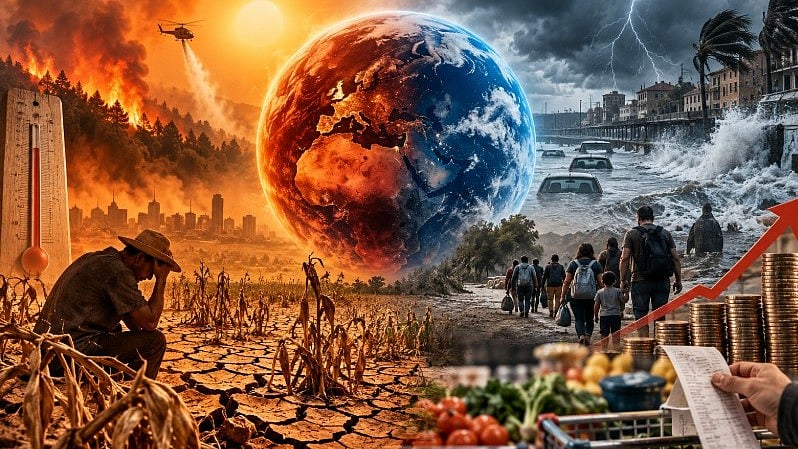
Attempts to turn climate action into a culture-war issue must be rejected or the world risks facing an “economic disaster”, UN climate chief Simon Stiell has warned, as record global temperatures fuel deadly heatwaves, wildfires, crop losses and disruption to businesses and infrastructure.
Stiell, executive secretary of the UN Framework Convention on Climate Change (UNFCCC), said this summer’s extreme heat had killed tens of thousands of people in Europe alone and caused an estimated €180 billion (£155 billion) in economic damage.
“The climate crisis is now a continent-wide economic security emergency,” Stiell told a committee of the European Parliament on Thursday.
“We’ve seen mass evacuations. Power stations closed. And trade routes choked. Crops lost. Yields down. And food prices up – and set to rise further,” he said.
Stiell warned that political polarisation over climate policies was not in the interests of voters, arguing that the effects of climate change cut across political divisions.
“Climate is sometimes seen as a partisan issue, as territory in the culture wars,” he said. “That is palpably false.”
He said climate change was directly affecting issues including family health, community safety and economic stability, as well as food and water availability, jobs, business costs and household bills.
With populist parties in the European Union and elsewhere calling for a rollback of policies aimed at reducing greenhouse gas emissions, Stiell also rejected arguments that stronger climate action would worsen other social and economic problems.
“To be soft on climate action is to be soft on inflation, and the cost of living, soft on sovereignty and security, and soft on economic growth and jobs,” he said.
He added that the fossil fuel crisis was also increasing government borrowing costs, leaving governments with less fiscal space to provide essential public services.
Stiell's remarks came as the EU’s Copernicus Climate Change Service reported that August 2026 was jointly the hottest August ever recorded globally.
Global temperatures during the month were 1.65C above pre-industrial levels, matching the record set in July 2023. Sea surface temperatures also reached their highest level on record for August, according to Copernicus.
The extreme temperatures were recorded before the expected full impact of the latest El Niño weather system, which is forecast to strengthen towards the end of the year and could potentially become the most intense on record.
El Niño is a naturally recurring climate phenomenon in which changes in Pacific winds raise ocean temperatures and transfer large amounts of heat into the atmosphere, affecting weather patterns worldwide.
Scientists have warned, however, that climate change is making the effects of El Niño more severe.
Friederike Otto, a professor of climate science at Imperial College London, said the underlying driver of this year’s extreme temperatures remained the continued burning of fossil fuels.
“Climate change makes every El Niño hotter, and until we stop burning coal, oil and gas, these record-shattering months will simply keep on coming,” she said.
The consequences of this year’s extreme heat are continuing to be felt in several countries, following devastating wildfires, damage to crops, excess deaths and disruptions to transport, businesses and public services.
Stiell also warned that extreme weather was contributing to rising migration, while weaker climate action could further exacerbate inflation and the cost of living.
Food prices are also expected to rise as reduced harvests put pressure on domestic markets and increase the cost of imports.
The UN climate chief said the scale of the economic and social disruption meant climate policy could no longer be treated as a narrow environmental issue, warning that failure to address the crisis would deepen existing pressures on economies and societies.
Join our official telegram channel (@nationalherald) and stay updated with the latest headlines