World
Bangladesh: Journalists protest against attacks on offices of media outlets
In Gazipur, hundreds of journalists formed a human chain to protest attacks on media outlets and senior journalist Nurul Kabir
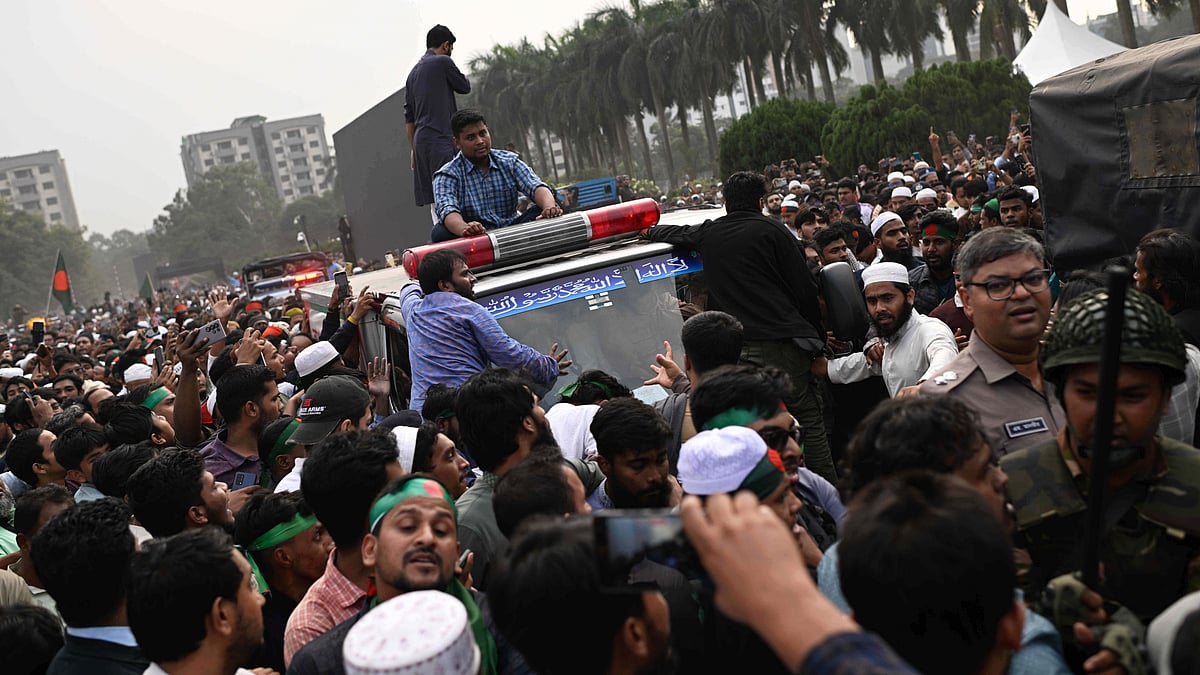
Journalists across Bangladesh poured onto the streets in protest after a wave of arson and vandalism targeted some of the country’s most prominent media houses, raising grave concerns over press freedom and public safety.
Demonstrators demanded the immediate arrest and exemplary punishment of those behind the attacks on the offices of Prothom Alo and The Daily Star, warning that continued impunity would imperil the very foundations of independent journalism.
In Gazipur, hundreds of journalists formed a human chain, their silent protest speaking volumes against the assault on media institutions and the attack on senior journalist Nurul Kabir.
Speakers issued a 24-hour ultimatum to the authorities, vowing to launch more aggressive protests if swift action was not taken, The Daily Star reported.
Similar scenes unfolded in Satkhira, where journalists again linked arms in solidarity, demanding justice not only for the attacks on media outlets but also for the killing of Dumuria Sholua Press Club president Imdadul Haque in Khulna — an act that has sent shockwaves through the journalistic fraternity.
Condemnation poured in from professional bodies as well. The Electronic Media Journalists Association (EMJA) in Sylhet denounced the attacks in the strongest terms, with its president Ashraful Kabir and general secretary Sakib Ahmed Mithu condemning the vandalism of media offices, the killing of a journalist in Khulna, and the harassment of journalists from 71 Television in Sylhet.
The unrest erupted in the aftermath of the death of Sharif Osman Hadi, spokesperson of the radical group Inqilab Mancha, following which a trail of violence swept across the country. Media houses, cultural institutions and diplomatic missions became targets, plunging Bangladesh into a fresh cycle of chaos and fear.
Among the sites attacked were the offices of the country’s leading newspapers Prothom Alo and The Daily Star; the national cultural institution Chhayanaut; the Indian Assistant High Commission offices in Chattogram and Khulna; the Indian Cultural Centre; and the remnants of the Bangabandhu Memorial Museum — an enduring symbol of Bangladesh’s history and identity. Several other media organisations, cultural spaces and diplomatic establishments were also vandalised nationwide.
On 20 December, the Awami League sharply condemned what it described as a “planned terrorist attack” aimed at destabilising the country. The party warned that the spate of violence underscored the erosion of the basic attributes of a modern, civilised state.
“These barbaric attacks and killings represent a direct and extreme assault on Bangladesh’s secular ethos, the ideals of the Liberation War, pluralism, cultural heritage and media freedom,” the Awami League said in a statement. It alleged that Bangladesh had been reduced to a safe haven for terrorists, adding that attacks on cultural institutions and foreign diplomatic missions constituted a grave violation of state security, diplomatic norms and international law.
Taking direct aim at the Muhammad Yunus-led interim government, the party accused the administration of presiding over a state apparatus consumed by extremist frenzy. “The entire state machinery has sunk into the filth of communal extremism,” the statement said, alleging that the body calling itself a government had become an active patron of such forces.
With IANS inputs
Join our official telegram channel (@nationalherald) and stay updated with the latest headlines