World
Dhaka and Delhi: Caught between rhetoric and reality
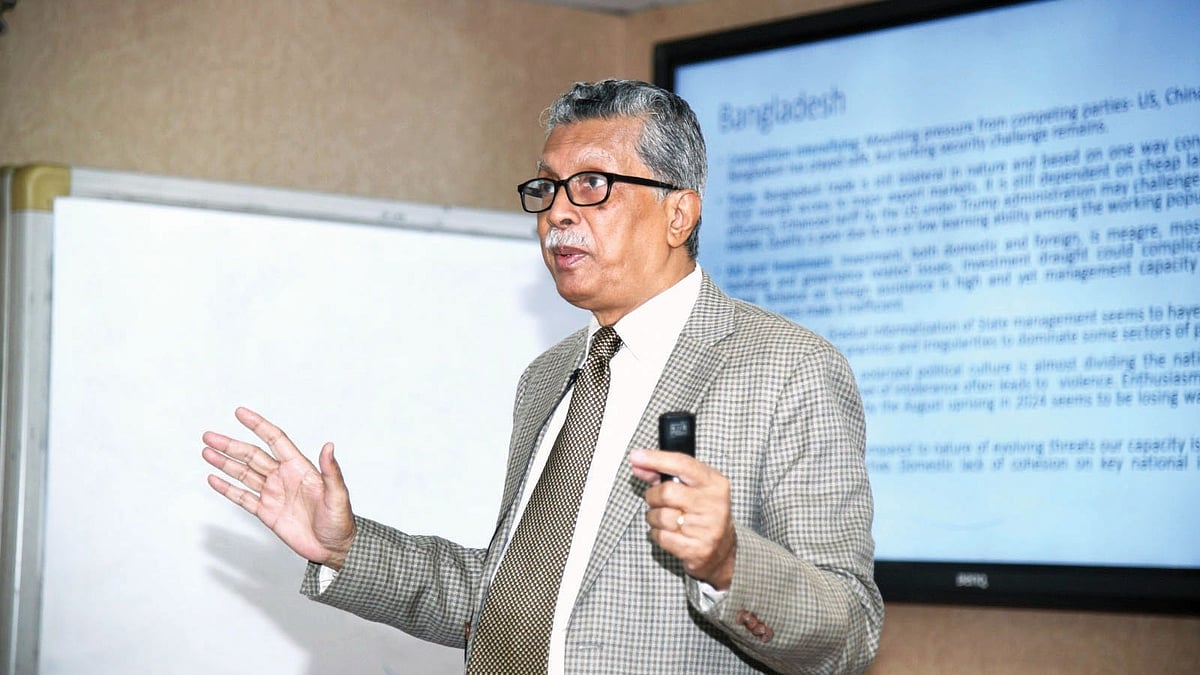
Former Bangladesh ambassador M. Humayun Kabir on the political scenario in Bangladesh, India-Bangladesh relations and South Asian geopolitics
On the evolving electoral scenario
An entire generation, aged between 18 and 30, has never voted (Note: although elections were conducted regularly, most people in Bangladesh believe they were heavily rigged. There are high hopes that the February 2026 elections will be free and fair). These ‘new’ voters will be an important factor. They are driven by new ideas, they want an end to corruption and they aspire for a more humane society based on justice.
These ideas, reminiscent of the Mukti Yuddha (Liberation War) of 1971, are gaining renewed urgency. Take for instance Osman Hadi’s funeral. I do not remember seeing such a large gathering. Mukti Yuddha veterans also attended the funeral. Hadi’s call for a society based on justice has found resonance in the country.
Another idea gaining traction among young voters is that of Bangladesh refusing to live in anyone’s shadow. We do not, however, have a template that can explain how the churning of these ideas will reflect on the elections. The Bangladesh Nationalist Party (BNP) is an old and tested organisation with a mix of positives and negatives.
It has the largest mass base across the country, but in reality, only a small percentage of workers are active. Nevertheless, the BNP appears confident of winning and potentially forming alliances with centrist or Left leaning groups.
On the Jamaat–NCP alliance
The Jamaat-e-Islami (Jamaat), which carries the stigma of its role during the Liberation War, has struggled with a limited mass base. However, during my travel across 20 districts in the past year, I have seen its influence among educated professionals, including academics and college principals. This sets it apart from other traditional activist-driven parties.
By aligning with the National Citizen Party (NCP), Jamaat aims to adopt the narrative of the July uprising which championed demands for justice, the rule of law, the end of discrimination, corruption and plunder. Such an association can rebrand the Jamaat among the younger generation which prioritises these ideals. Oli Ahmed, a former associate of BNP founder Zia-ur Rahman, distanced himself from BNP in 2001 due to its alliance with Jamaat. He has now joined forces with Jamaat.
This could lead to the assimilation of NCP and Oli Ahmed into Jamaat or prompt a transformation within Jamaat itself, signalling a more moderate stance supportive of the Mukti Yuddha legacy. Such a centripetal shift within Jamaat— till recently in the realm of impossibility— suggests the emergence of a new political landscape comprising Jamaat, NCP and other smaller parties.
It seems this is different from, and an alternative to, the traditional Awami League–BNP binary. Although they are not organisationally strong, in terms of appeal they can tap into the new aspirations. Notably, there has been no charge of corruption against any Jamaat leader or minister, even during its tenure in 2001–2006
On the likelihood of Awami League making a comeback
It does not seem likely in this electoral cycle. For one, nominations have closed. From a social perspective, the party is isolated and not in a position to be reckoned as a political force. The strong pushback against Awami League is proving beneficial for Jamaat. It is possible that Awami League voters may shift.
The buzz on the streets suggests that Awami League supporters now harbour less animosity towards Jamaat than BNP, perhaps because the latter is seen as a greater threat. It is somewhat similar to the 2021 elections in West Bengal when a large number of CPM voters shifted support to the BJP to escape the Trinamool Congress’ wrath. One cannot rule out a similar vote transfer in Bangladesh.
On anti-India sentiments
Anti-India rhetoric—like severing the ‘chicken’s neck’ or destabilising the northeast—are pushed by fringe elements. Mainstream policymakers, government or general public do not seem to subscribe to these views. Most Bangladeshis recognise the value of trade and other economic links with India, which should be based on mutual respect, mutual benefit and economic sense.
An equally shrill rhetoric is coming out of India. There is a need to parse reality from rhetoric. Neither India nor Bangladesh will be able to overcome the ongoing stress in their relationship unless both nations focus on real, practical interactions instead of inflammatory talk. One cannot ignore the fact that some Bangladeshis dislike India.
But leveraging this dislike into a conflict is not visible on the ground. In fact, the ground reality is the opposite: that India is a big country and it is best to maintain good neighbourly relations based on goodwill, mutual respect and equality.
The quality of Bangladesh’s relationship with India and Pakistan are fundamentally different. While ties with India involve geography, security, economy, trade and people-to-people connections, engagement with Pakistan centres only on trade and security. Bangladesh should continue to keep them separate and independent of each other.
On a ‘grand design’ in South Asian geopolitics
I do not see any ‘grand design’. To my mind, everyone is overthinking this. From my experience in Washington, I can tell you that maintaining regional stability is a shared priority for the Americans, the Europeans and the Chinese. The Americans have burnt their fingers in pursuit of stability. They would not like to revisit Iraq or Afghanistan.
For them, stability in Bangladesh is the main priority. Their second priority is to ensure Bangladesh’s economic growth. With Bangladesh’s exports dependent on imports from India and China, ensuring food and basic necessities for its people becomes essential for sustaining peace. Several diplomats, including the Russian Ambassador, favour reducing bilateral tensions between India and Bangladesh.
The question of a ‘grand design’ comes when you look at the region from an adversarial perspective. All major powers— India, China and the US, among others— favour Bangladesh as a democratic, peaceful and economically vibrant country. China publicly opposes extremism and prioritises stability. You can call it the positive ‘grand design’, a cooperative framework instead of an adversity-based approach.
To be fair, Prof. Muhammad Yunus’ recent comments in China—about India’s northeastern states—which created a stir in India should be seen in this context. He made similar remarks when he was in India in 2010. So, there is a realistic view as well as a rhetorical view.
SOURABH SEN is a Kolkata-based independent writer and commentator on politics, human rights and foreign affairs
Join our official telegram channel (@nationalherald) and stay updated with the latest headlines