World
Donald Trump announces ‘Golden Fleet’ battleship push
Promising unmatched power and speed, US president says the vessels will eclipse even the legendary Iowa-class battleships of World War II fame
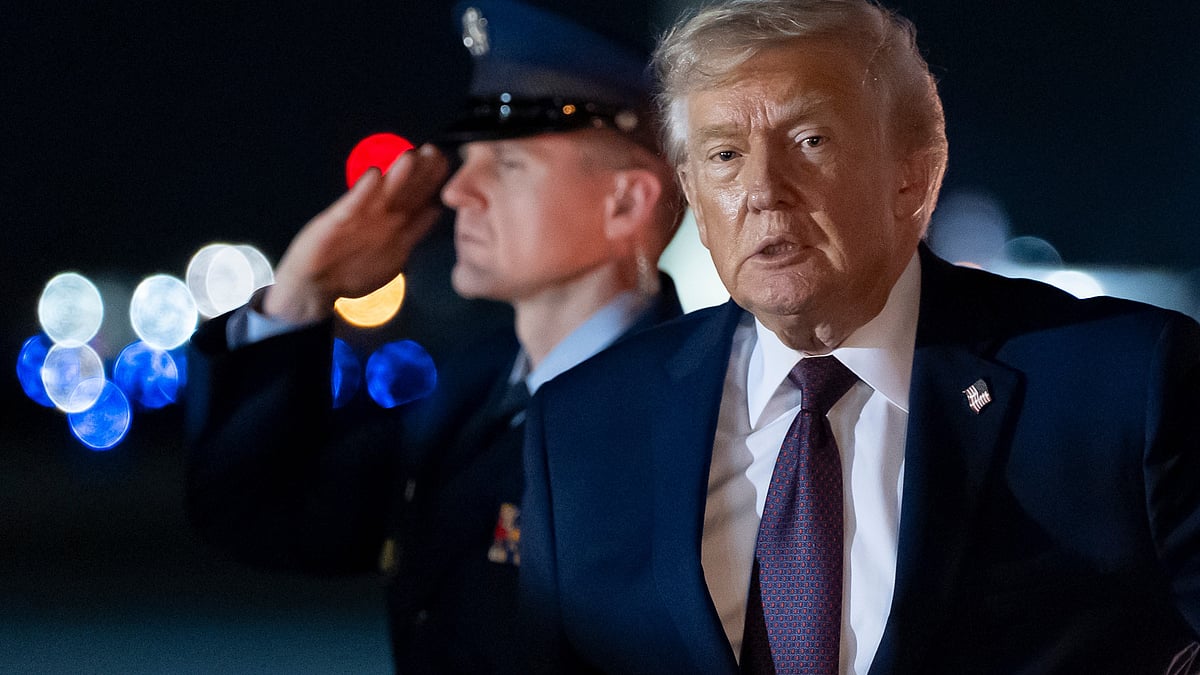
In a dramatic declaration framed as both a military revival and an industrial renaissance, US President Donald Trump on Monday announced plans to usher in a new era of American sea power with the construction of a fresh class of massive battleships — the largest ever envisioned by the United States Navy.
Speaking at a press conference at his Mar-a-Lago residence, flanked by defence secretary Pete Hegseth, secretary of state Marco Rubio and Navy Secretary John Phelan, Trump said he had approved an ambitious plan to immediately begin building two colossal warships that would form the backbone of what he called a new “Golden Fleet”.
“Today, I have the great honour of approving a plan for the Navy to begin construction of two — the biggest we’ve ever built — battleships,” Trump declared, casting the announcement as a defining moment in the restoration of American military supremacy.
Promising unmatched power and speed, Trump said the vessels would eclipse even the legendary Iowa-class battleships of World War II fame. “They’ll be the fastest, the biggest and — by far — 100 times more powerful than any battleship ever built,” he claimed.
According to Trump, the ships will be bristling with cutting-edge firepower, including advanced missile systems, hypersonic weapons, laser defenses and next-generation targeting technology. They will also be capable of launching nuclear-armed cruise missiles, making them, in his words, “among the most lethal surface warfare ships ever to sail the oceans”.
Construction is expected to begin “almost immediately”, with an initial build timeline of approximately two-and-a-half years. While the programme will start with two ships, Trump said the Navy ultimately envisions a fleet of 20 to 25 such vessels. “We’re going to start with two, quickly move to 10, and eventually reach 20 or 25,” he said.
Beyond military might, Trump framed the initiative as a bold industrial revival, aimed at resurrecting America’s once-dominant shipbuilding sector. The new battleships, expected to displace between 30,000 and 40,000 tons, will be built entirely in US shipyards, generating thousands of jobs and reinvigorating domestic manufacturing.
He also issued a pointed message to defence contractors, urging them to reinvest profits into production capacity rather than executive bonuses or stock buybacks. “I want that money going into plants and equipment,” Trump said. “I want them building fast.”
Defence secretary Hegseth hailed the announcement as a generational pivot in American defence strategy, linking naval expansion to border security, counter-narcotics operations and global deterrence. “This marks a generational commitment to American sea power,” he said, adding that it would restore what he described as the Pentagon’s “warrior ethos”.
Navy secretary Phelan said the future “Trump-class” battleships would be “the largest, deadliest and most versatile warships anywhere on the world’s oceans,” capable not only of delivering overwhelming firepower but also of commanding entire naval formations — from surface fleets to drones operating across vast distances.
Rubio cast the shipbuilding push as part of a broader effort to restore US industrial strength and safeguard freedom of navigation. “The US Navy remains the single greatest force for peace in the world,” he said, calling the initiative a vivid demonstration of American capability.
Trump rejected suggestions that the move was aimed at any specific rival, insisting the objective was deterrence through strength. “It’s not China,” he said. “It’s a counter to everybody. And hopefully, we never have to use them.”
The announcement comes against the backdrop of growing concern within the US defence establishment over shrinking shipyard capacity, ageing naval assets and the rapid expansion of China’s navy. The US has not built a new battleship since the mid-1990s, having instead relied on aircraft carriers, submarines and smaller surface combatants.
Once the titans of World War II and enduring symbols of American maritime dominance, battleships gradually faded from prominence with the rise of missile and submarine warfare. With this announcement, Trump is seeking to return them — reimagined and vastly more powerful — to the centre of American naval strategy.
With IANS inputs
Join our official telegram channel (@nationalherald) and stay updated with the latest headlines