World
Explained: Strait of Hormuz is vital — and its crisis revives Suez déjà vu
Conflict-driven disruptions revive fears of supply shocks, price spikes and strategic vulnerability
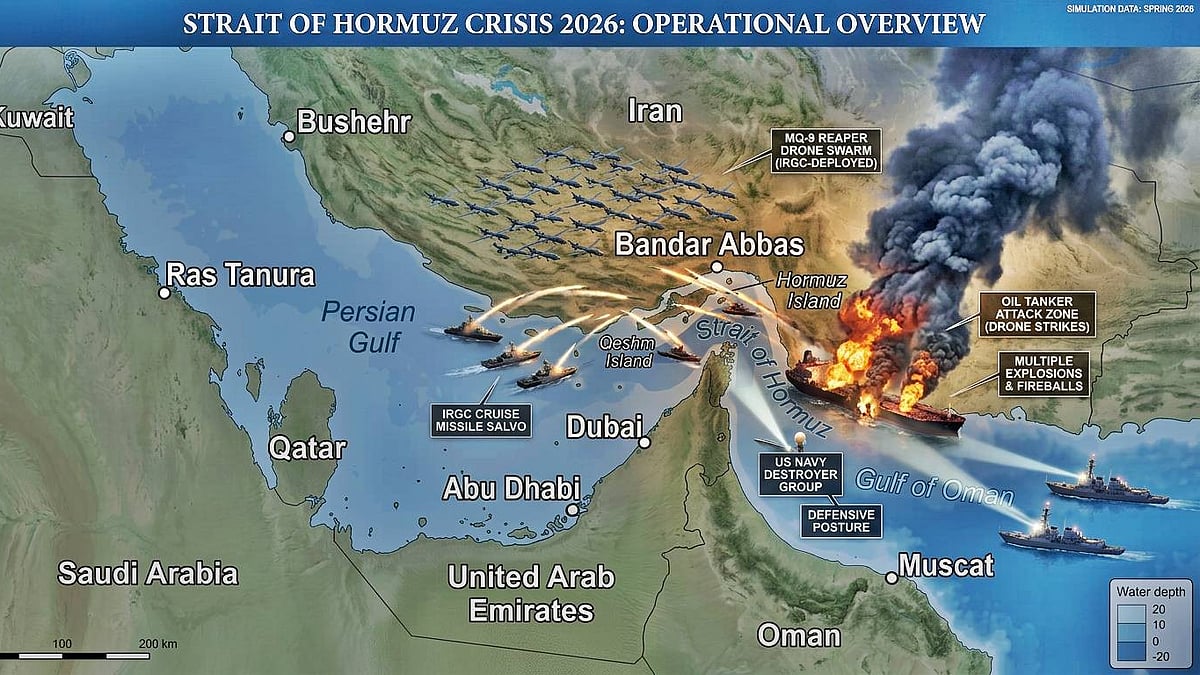
The escalating crisis in the Strait of Hormuz has revived comparisons with the 1956 Suez Crisis, raising concerns over global energy security as tensions in West Asia threaten one of the world’s most critical oil transit routes.
The narrow 39-km-wide waterway between Iran and Oman connects the Persian Gulf to the Gulf of Oman and the Arabian Sea, handling roughly 20 per cent of global oil trade and a substantial share of liquefied natural gas (LNG) shipments
The Strait of Hormuz derives its name from Hormuz Island, located near its entrance in the Persian Gulf. The island itself is believed to be named after 'Hormoz' or 'Ahura Mazda', the supreme deity in ancient Persian (Zoroastrian) religion. Over time, the name came to represent the strategic waterway adjoining the island, reflecting its historical and cultural roots.
Suez déjà vu: lessons from history
Parallels can be drawn between the current Hormuz tensions and the Suez Crisis of 1956, when Egypt’s nationalisation of the Suez Canal triggered a military intervention by Britain, France and Israel.
While the invading forces achieved initial military success, the operation was halted under international pressure, particularly from the United States, leading to economic disruption and a strategic setback for the intervening powers.
Like Suez, Hormuz represents a narrow maritime chokepoint critical to global energy flows. Any disruption — whether through conflict or blockade — can have far-reaching consequences for global trade and oil prices.
The comparison underscores the risks of escalation, where military action can trigger prolonged economic fallout, including supply shocks and price volatility.
A historic chokepoint
The strategic importance of Hormuz stretches back centuries. Ancient powers such as the Achaemenid Persians controlled it as a gateway linking trade between India, Iran and beyond.
The route was surveyed in 325 BCE by Nearchus, an admiral of Alexander the Great, underscoring its early maritime relevance.
During the medieval era, the Sassanids and later the Abbasid Caliphate integrated the strait into Silk Road trade networks connecting the Gulf with China and Southeast Asia.
In 1507, the Portuguese captured Hormuz Island and established naval dominance over regional trade through a protection system known as the cartaza, controlling key India–Mediterranean routes for over a century.
They were expelled in 1622 by Persian forces under Shah Abbas I, aided by the British East India Company, marking a shift in regional power dynamics.
The strait has been at the centre of several geopolitical crises, including the 1973 Arab Oil Embargo and the Iran-Iraq War’s “Tanker War” (1980–88), during which more than 500 vessels were attacked.
More recent incidents in 2012, 2019 and 2023–24 involving ship seizures and threats of closure have reinforced its vulnerability.
Strategic significance
Around 21 million barrels of oil per day transit through the strait, accounting for about 20 per cent of global consumption and nearly 25 per cent of LNG trade.
Its geography gives Iran strategic leverage, as shipping lanes pass close to its territorial waters, enabling it to threaten disruption during periods of escalation.
Any prolonged disruption could trigger sharp increases in oil prices, with estimates suggesting a full closure could push prices above $100 per barrel.
India’s dependence on Hormuz
India, the world’s third-largest oil consumer, imports nearly 88 per cent of its crude oil, with a significant share historically routed through the Strait of Hormuz.
Supplies from Iraq, Saudi Arabia, the UAE and Kuwait have accounted for 45–50 per cent of imports in the past.
Diversification efforts — including sourcing from Russia, the United States and Africa — have reduced dependence, with a larger share of imports now bypassing the strait.
However, India remains vulnerable to disruptions affecting LPG and LNG supplies, as well as freight costs, prompting the government to build strategic reserves.
Officials have said inventories are sufficient to manage short-term disruptions.
Join our official telegram channel (@nationalherald) and stay updated with the latest headlines