World
Explained: Why Yemen’s Houthis have grown stronger through years of war
Airstrikes by Saudi Arabia, the US, Britain and Israel have failed to weaken the Iran-backed group
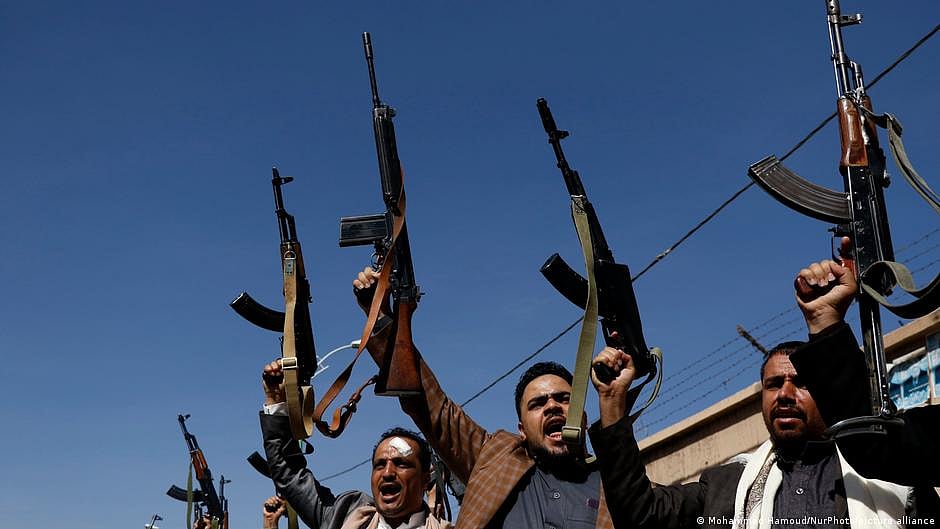
Years of airstrikes by Saudi Arabia, the United States, Britain and Israel have failed to weaken Yemen’s Houthi rebels, who have instead expanded their military capabilities and are now advancing towards the strategically important Bab el-Mandeb strait.
The Iran-backed group has also targeted Saudi oil infrastructure and shipping, raising concerns over a vital global trade route and contributing to wider pressure on energy markets.
The Houthis' resilience is partly attributed to the geography of Yemen, where mountainous and expansive territory allows fighters and military infrastructure to be dispersed. Their access to Iranian expertise, training and sophisticated weapons has also strengthened their capabilities, according to UN and other experts cited by The Associated Press.
Michael Knights, head of research at strategic advisory firm Horizon Engage, described the Houthis as among Iran's most committed and aggressive regional allies, saying their military capabilities had developed rapidly.
Growing arsenal
The Houthis possess ballistic and cruise missiles and drones capable of reaching Gulf states and Israel. They have also used anti-ship missiles and naval drones against vessels in the Red Sea.
Iran denies supplying weapons to the Houthis, which would violate a UN arms embargo. However, Iranian weapons and components have been seized from shipments bound for Yemen, while a 2024 UN experts' report documented extensive military links between the Houthis, Iran and its regional allies.
The group is estimated to have expanded its fighting force significantly. A 2024 UN report estimated that the Houthis had recruited as many as 350,000 fighters, compared with about 30,000 in 2015, when Saudi Arabia intervened in Yemen's civil war.
The Houthis can use relatively inexpensive drones and missiles to threaten oil infrastructure in Saudi Arabia and commercial vessels in the Red Sea. While Iran is believed to provide advanced components such as guidance systems, the Houthis are also capable of manufacturing much of their weaponry domestically.
Saudi Arabia has sophisticated US-supplied aircraft and missile-defence systems, but its ability to intercept repeated attacks could be constrained by supplies of high-end interceptors.
Airstrikes fail to shift the balance
Saudi Arabia began its military intervention in Yemen in 2015 after the Houthis seized large parts of northern and central Yemen, including the capital, Sanaa.
Over the following seven years, Saudi-led airstrikes repeatedly targeted Houthi positions. Despite the campaign and efforts by Yemeni government forces and southern separatists to regain territory, the front lines changed little before a ceasefire in 2022.
After the Gaza war began in 2023, the Houthis started attacking Red Sea shipping, saying they were acting against Israel. The US and Britain launched their own strikes against Houthi targets from January 2024.
In 2025, US President Donald Trump ordered an intensified campaign. A US military official told AP at the time that around 2,000 munitions were used against more than 1,000 targets.
The campaign came at a significant cost. US munitions alone cost more than USD 750 million, while the Houthis destroyed seven MQ-9 Reaper drones, each costing more than USD 30 million. An F/A-18 fighter jet worth more than USD 60 million also slid off an aircraft carrier.
Following weeks of US strikes, the Houthis agreed to stop attacking American ships but continued targeting Israel. Israeli strikes later killed the Houthi prime minister and other senior officials and repeatedly targeted a key port.
The Houthis largely stayed out of the initial months of the Iran war but resumed attacks on Saudi Arabia in July and declared a blockade on Saudi shipping.
Ground offensive remains difficult
A lasting military defeat of the Houthis would likely require ground forces capable of taking and holding territory after airstrikes. But forces opposed to the Houthis remain deeply divided.
They include fighters loyal to Yemen's Saudi-backed government and southern separatists supported by the United Arab Emirates. The UAE withdrew much of its involvement in Yemen in 2019 and has at times had competing interests with Saudi Arabia.
Thomas Juneau, a professor of international affairs at the University of Ottawa specialising in Iran and Yemen, said Iranian support was only part of the explanation for the Houthis' strength.
He attributed the other part to the weakness and fragmentation of their opponents, saying Yemen's internationally recognised government was divided and had been exploited by the Houthis.
That weakness has become more visible in recent weeks, as anti-Houthi forces have retreated from several positions while the rebels have advanced towards Bab el-Mandeb, the narrow waterway connecting the Red Sea with the Gulf of Aden.
Saudi Arabia appears reluctant to launch another full-scale ground war, which could result in prolonged fighting and heavy casualties. The US, meanwhile, remains focused on Iran and has shown little indication of wanting to commit ground forces.
A Saudi mutual defence agreement with Turkey and Pakistan signed last month has also not been activated.
Diplomatic options remain limited. The Houthis are demanding that Saudi Arabia lift its blockade, a step that could be seen as an admission of defeat and potentially enable greater Iranian support for the group.
Juneau said that without a resolution of US-Iran tensions, significant progress between Saudi Arabia and Iran was unlikely, while the Houthis currently appeared unwilling to make concessions.
Join our official telegram channel (@nationalherald) and stay updated with the latest headlines