World
In Bishkek, India joins China, Russia in SCO stand on Iran, Palestine
India joining China, Russia and other SCO members on Iran, barely 10 days before BRICS summit, carries diplomatic weight
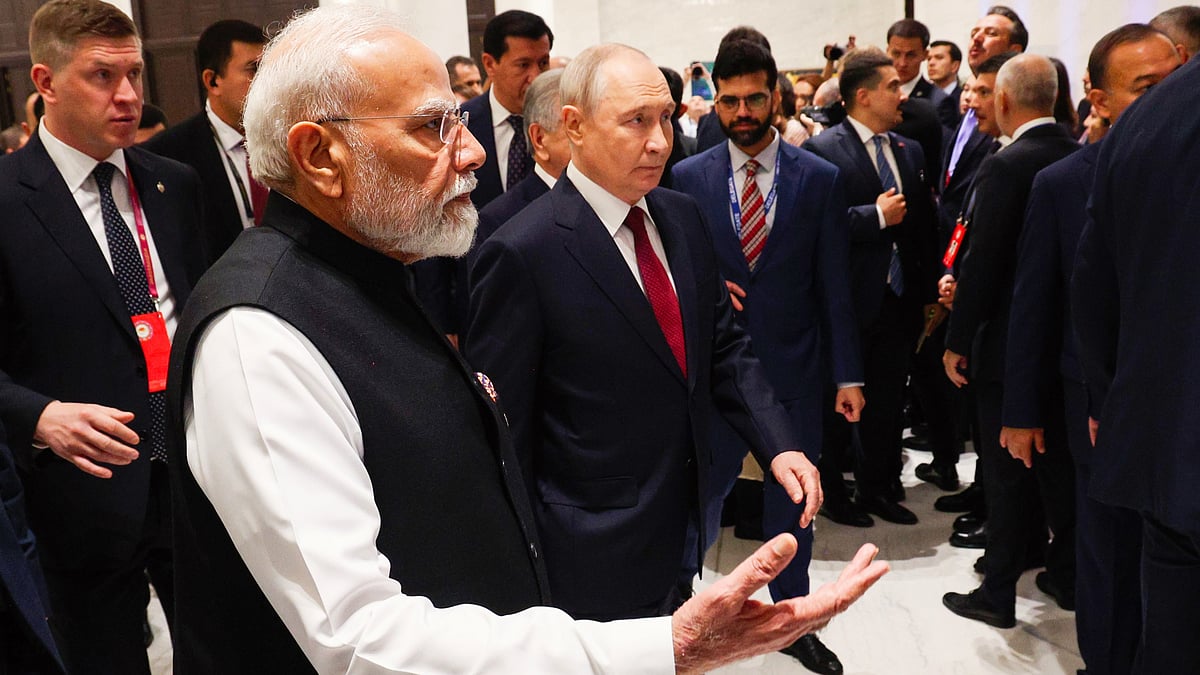
In a joint statement, leaders of the Shanghai Cooperation Organisation (SCO) have condemned US and Israeli military strikes on Iran and Western sanctions on some of their members. The 'Bishkek Declaration' was signed, among others, by Chinese President Xi Jinping, Russian President Vladimir Putin, Indian Prime Minister Narendra Modi and Pakistani Prime Minister Shehbaz Sharif.
The declaration came after a two-day summit in Kyrgyzstan’s capital, Bishkek. The SCO’s 10 members are China, Russia, India, Pakistan, Iran, Belarus, Uzbekistan, Kazakhstan, Tajikistan and Kyrgyzstan.
India had so far refrained from condemning the United States and Israel for their military action against Iran. New Delhi has also been extremely reluctant to condemn Israel for its sustained attacks on Palestine. At past SCO and BRICS summits, too, no agreement was reached on the language to be used in joint declarations on the war in Iran and the attacks on Palestine. It is in this context that the 'Bishkek Declaration' assumes significance.
The declaration is also seen as another sign of the decline of the US as a major power and an acknowledgement of Iran’s ability to withstand what the declaration describes as military strikes against it. While US President Donald Trump is likely to fret and fume and dismiss the declaration as signifying nothing, diplomatically the declaration is among the strongest in recent times to condemn military action by the US and Israel.
The SCO condemned 'military strikes on the territory of the Islamic Republic of Iran, which have resulted in numerous civilian casualties and significant damage to the country’s economy'. The declaration states that the US-Israel attacks on Iran 'violate the principles and norms of international law and the UN Charter and create serious risks to international peace, security and stability'. It goes on to add: 'Member States express their sincere condolences to the people and Government of the Islamic Republic of Iran on the tragic death of Supreme Leader Seyyed Ali Khamenei, and to the families of the victims.'
Significantly, the grouping’s leaders also backed Iran’s rights as a member of the Nuclear Non-Proliferation Treaty (NPT). Apart from the US, Russia, China, the United Kingdom and France, other NPT signatories cannot build nuclear weapons. But they have the right to a peaceful nuclear programme. They can build civilian nuclear reactors and use nuclear technology for research and medicine, the declaration pointed out. The SCO said its members support the right to develop and use nuclear energy for peaceful purposes without discrimination.
The declaration also mentions that Israel’s attacks on Palestine have destabilised West Asia. 'Member States note that the only possible way to ensure peace and stability in the Middle East is a comprehensive and just settlement of the Palestinian question,' the declaration said.
The declaration also implied that secondary US sanctions threatened against countries trading with Iran had cut no ice with the SCO.
Without specifying US sanctions on Iran and on countries doing business with Iran, or Western sanctions on Russia over its war in Ukraine, SCO members said in their declaration that they oppose any 'unilateral coercive measures' that go against the rules of the UN and World Trade Organization and could have a 'negative impact on the global economy'.
The declaration also included a commitment to combat terrorism. Prime Minister Modi, in his speech at the SCO, had described terrorism as a 'grave challenge to all of humanity' and asked countries to steer clear of 'double standards' on the issue.
The Indian PM’s comments were clearly directed at Pakistan. PM Sharif, however, insisted that Islamabad was a victim of terrorism and reiterated that 'terrorism must be condemned in all its forms and manifestations'. Observers interpreted this as a reference to India’s alleged role in fomenting unrest in Balochistan. Pakistan has made such allegations against India, while New Delhi has rejected them.
The Bishkek Declaration balanced the concerns of both and said: 'Member States strongly condemn terrorism in all its forms and manifestations, emphasise that ‘double standards’ in the fight against terrorism are unacceptable, and call on the international community to combat terrorism, including the cross-border movement of terrorists.'
Next stop, New Delhi, for the BRICS summit on 12 September. Wait for the BRICS declaration.
Join our official telegram channel (@nationalherald) and stay updated with the latest headlines