World
IRGC claims strike on US Marines in Kuwait, hit on landing craft in Dubai
Signals broader campaign against US military assets, deploys long-range missiles capable of targeting naval platforms across Gulf
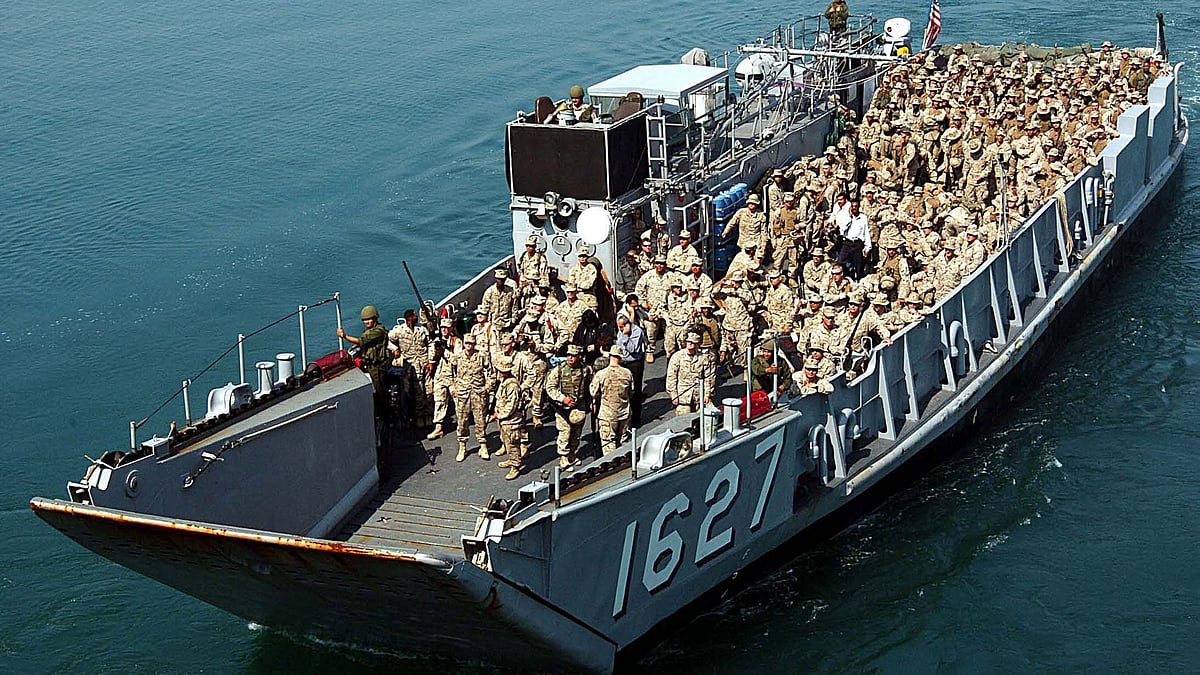
Iran’s Islamic Revolutionary Guard Corps (IRGC) has claimed responsibility for a drone and missile strike targeting US Marine forces stationed on Kuwait’s Bubiyan Island, saying the attack caused casualties among American troops as the confrontation between Washington, Tehran and Israel expands across the Gulf.
In a video statement, Iranian military spokesperson Ebrahim Zolfaghari described the assault as part of what Tehran characterised as a broader campaign aimed at forcing US forces out of the region.
“Complete elimination of American soldiers from land of Muslims," Zolfaghari said, framing the strike as retaliation for recent US and Israeli attacks on Iranian nuclear and strategic infrastructure.
Bubiyan Island, located off Kuwait’s north-eastern coast near the Iraqi border, hosts logistics and surveillance facilities used by US forces to support operations in the northern Gulf. The island’s proximity to key shipping lanes makes it strategically important for monitoring maritime traffic and coordinating deployments.
Iranian state-linked channels have also claimed that six US Landing Craft Utility (LCU) vessels were struck at Dubai’s Port of Al Shyoukh using Qadr-380 cruise missiles. LCUs are amphibious transport vessels designed to move troops, armoured vehicles and heavy equipment from sea to shore during expeditionary operations.
While there has been no independent confirmation of damage to the vessels, the claim reflects Iran’s growing emphasis on targeting logistics and transport platforms that underpin US amphibious capability in the region.
The Qadr-380 is a long-range anti-ship cruise missile unveiled by Iran in 2025, reportedly capable of striking maritime targets at distances exceeding 1,000 km and designed to evade electronic countermeasures through anti-jamming technology.
IRGC has previously showcased the missile during naval exercises in the Strait of Hormuz and Gulf of Oman, highlighting its ability to threaten US naval assets operating in the region’s narrow waterways.
Military analysts say the system is intended to complicate US naval operations by targeting high-value assets such as destroyers, logistics ships and amphibious platforms that support troop deployments.
The latest claims come amid intensifying hostilities triggered by the United States and Israel’s military campaign against Iran, launched on February 28 with coordinated strikes targeting nuclear-linked facilities, missile infrastructure and senior commanders.
Iran has since responded with waves of drone and missile attacks on US-linked assets and allied infrastructure across the Gulf, widening the geographical scope of the conflict and increasing the likelihood of sustained confrontation.
US President Donald Trump has acknowledged the possibility of further American casualties even as he continues to describe the confrontation as a limited military operation rather than a full-scale war.
Meanwhile, Kuwaiti authorities confirmed that key civilian infrastructure has also come under attack, highlighting spillover risks for Gulf states hosting US troops or facilitating logistics operations.
Kuwait’s Shuwaikh Port, the country’s primary commercial gateway, was struck by drones at dawn, resulting in material damage but no reported casualties, according to the Kuwait Ports Authority.
A second site, the under-construction Mubarak al-Kabeer Port in northern Kuwait, was also hit, the ministry of public works said. The port forms part of regional connectivity corridors linked to global trade routes, underscoring the wider economic stakes of the conflict.
Kuwait has faced repeated strikes in recent weeks as Iran accuses Gulf governments of enabling US and Israeli military operations.
Earlier this month, a drone attack on a US logistics facility operating within a civilian port killed six American soldiers, signalling a shift towards more direct targeting of US personnel stationed across the region.
The escalation has raised concern among Gulf states about the vulnerability of energy infrastructure and shipping lanes, particularly as tensions persist around the Strait of Hormuz, through which roughly one-fifth of global oil supplies pass.
Several Gulf countries have raised the issue at the United Nations, warning that continued missile and drone attacks on ports, refineries and logistics hubs could destabilise energy markets and threaten civilian populations.
Kuwait’s ambassador to the UN, Naser Abdullah H.M. Alhayen, described the attacks as an “existential threat” to regional and global security, saying they violate sovereignty and international law.
Analysts say Iran’s expanding target set — from troop positions and amphibious vessels to commercial ports — indicates a calibrated attempt to raise the strategic cost of the US military presence in the Gulf without triggering immediate full-scale conventional war.
However, with American casualties rising and key maritime infrastructure increasingly exposed, the risk of miscalculation continues to grow, fuelling concern that what Washington still describes as a contained military operation could evolve into a broader conflict involving multiple state and non-state actors across West Asia.
With agency inputs
Join our official telegram channel (@nationalherald) and stay updated with the latest headlines