World
Vance exits ‘Islamabad Talks’, after making ‘best and final offer’
Hours after reports of resumed talks, the US says no deal is reached, leaves its “final offer”, and puts the onus on Iran to respond
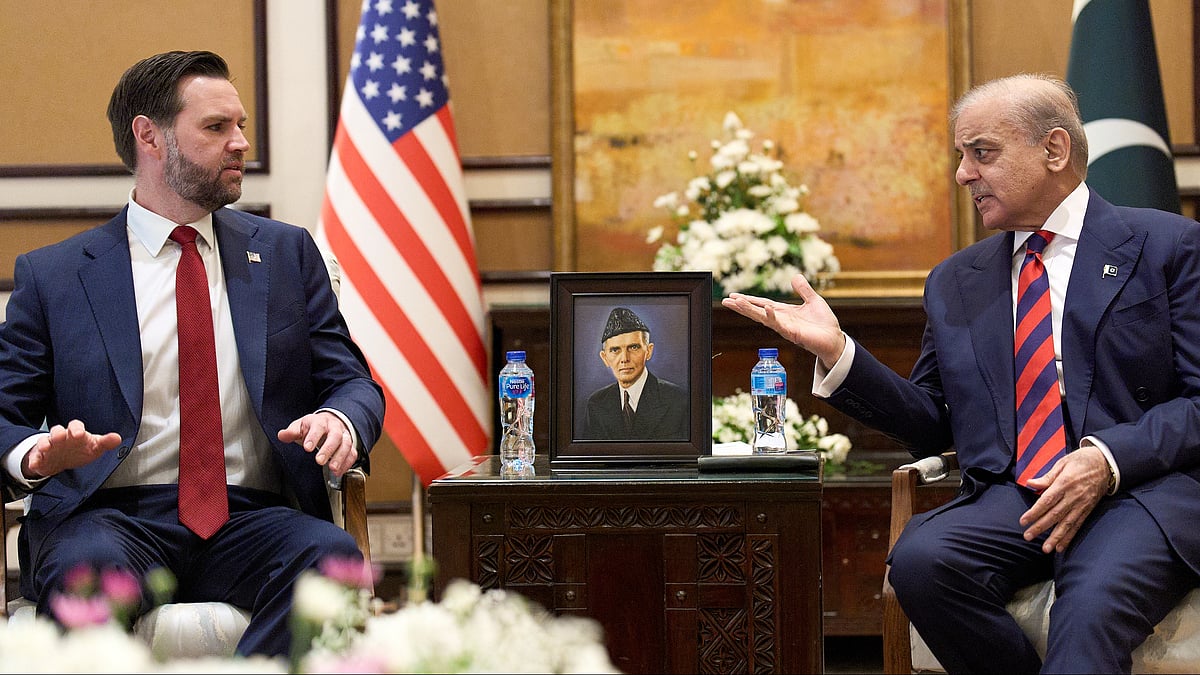
The US vice-president J.D. Vance, who is leading the US delegation in the talks broke his silence at 7 am on Sunday, 12 April and addressing the media said, “We’ve had a number of substantive discussions with the Iranians. That’s the good news. The bad news is that we have not reached an agreement — and I think that’s bad news for Iran much more than it's bad news for the United States of America.” He went on to say, “The simple fact is that we need to see an affirmative commitment that they will not seek a nuclear weapon, and they will not seek the tools that would enable them to quickly achieve a nuclear weapon."
Vance indicated that he was leaving Pakistan and heading back to the US, without clarifying if the rest of the US delegation would stay back for a final attempt at diplomacy. He declared that Washington had shared with Iran its “final and best offer” on “a method of understanding, ” adding, “We’ll see if the Iranians accept. He refused to get into details or say specifically what the Iranian delegation rejected. However, he said that U.S. presented clear red lines and terms, adding, “Iran chose not to accept” them.
The US, Vance suggested, wanted a firm, long-term commitment from Iran not to pursue a nuclear weapon or the capability to rapidly build one, claiming that Iran’s enriched uranium stock had been destroyed, saying, ‘the issue is now political will, not capability’. The US vice president claimed that the U.S. was “flexible” and negotiating in good faith, that U.S. officials were in constant contact with Trump and the national security team throughout the negotiations.
Ironically, barely an hour earlier at 6 am the official handle of the Government of Iran issued the following statement, “Iran-U.S. talks mediated by Pakistan concluded after 14 hours. Technical teams from both sides are now exchanging expert texts. Negotiations will continue despite some remaining differences. At Pakistan’s proposal and with the agreement of the negotiating teams of Iran and the U.S., talks mediated by Pakistan will continue for another round after a pause on Sunday.” What could have happened between 6 am and 7 am in Islamabad? The speculation emerging from
Pakistan’s capital is that President Trump had pulled the plug.
A defiant US President Donald Trump had told reporters in Washington D.C., “Whether we make a deal or not, it makes no difference to me; the reason is because we’ve won. We’re in very deep negotiations with Iran. We win regardless. We’ve defeated them militarily…We have defeated their navy, their air force, their aircraft, their radar — and their leaders are all dead,” he reiterated.
The Strait of Hormuz and Iran’s claim of sovereignty over it and Israeli attacks on Lebanon were seemingly the two most concerning stumbling blocks as Islamabad Talks, mediated by Pakistan, continued for a marathon 14 hours. There were apparently several tense moments, the first when Iran informed Pakistan that unless a US Navy Destroyer moving towards the Strait of Hormuz failed to turn back, it would be targeted within the next 30 minutes. The ship was apparently pulled back. The Iranian delegation repeatedly made it clear throughout the night that they were ready to return to Tehran and continue with the war.
American and Iranian officials were holding face-to-face talks in Pakistan, the most significant since the 1979 Islamic revolution as the two countries tried to end the war launched by the US and Israel on 28 February 2026, a conflict that plunged the Middle East into violence and rocked the world economy. The two-week ceasefire agreement declared on 8 April expires on 22 April unless
the two sides decide to resume the war earlier. Trump said as much when he repeated that US warships were loaded and ready, if talks failed. Independent reports also spoke of the steady movement of ships, planes and US marines in the region.
CNN quoted an Iranian source as saying, “The status of the Strait of Hormuz will remain unchanged until Iran and the United States reach a ‘common framework’ for continuing negotiations”. an Iranian security source told CNN, adding that “excessive demands” by the American side have blocked progress. “Iran is in no hurry,” he said, adding that Iran has told the U.S. that until a framework agreement is reached “even the number of ships that had been agreed upon will not be able to pass.”
Earlier, a spokesperson of the Iranian delegation in Islamabad, Seyed Mohammad Marandi declared on Iranian TV, “Iran is fully prepared to return to Tehran without an agreement. Negotiations are to show the international community and regional people that Iran gave a chance for de-escalation. If the US and Trump ignore Iran's rights and the rights of Palestine, Lebanon, and the Axis of Resistance, ‘we will prepare ourselves for war’.
Esmaeil Baqaei, another spokesperson reflected the US vice president’s sombre mood. At 6 am, an hour before J.D. Vance took the podium, Baqaei posted on X, “The success of this diplomatic process depends on the seriousness and good faith of the opposing side, refraining from excessive demands and unlawful requests, and the acceptance of Iran's legitimate rights and interests. We express our appreciation to the government and the warm-hearted and noble people of the Islamic Republic of Pakistan for hosting the negotiations and their benevolent efforts in advancing this process."
Join our official telegram channel (@nationalherald) and stay updated with the latest headlines