World
WHO chief appeals against travel bans as Ebola cases surge in DRC, Uganda
DRC health minister Roger Kamba says authorities hope to contain the outbreak within four to six months
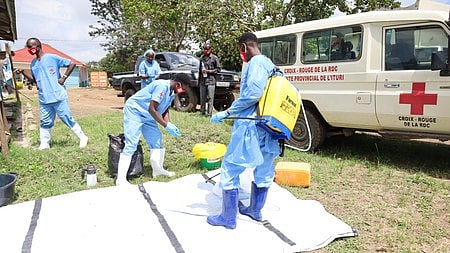
World Health Organisation (WHO) director-general Tedros Adhanom Ghebreyesus has urged countries that imposed travel bans and border closures in response to the Ebola outbreak in the Democratic Republic of the Congo (DRC) and Uganda to reconsider the restrictions, warning that such measures could hamper efforts to contain the disease.
Speaking in Bunia, the capital of Ituri Province and the epicentre of the outbreak, Tedros said travel restrictions risk undermining the transparency and trust needed for an effective public health response.
"I call on countries that have imposed travel bans or border closures to reconsider. These measures make the response harder, and they discourage transparency and trust that saves lives," Tedros said.
The WHO chief said his visit was aimed at engaging directly with affected communities as health authorities grapple with an outbreak that has already generated more than 1,000 suspected cases.
Despite the absence of approved vaccines or specific treatments for the current outbreak, Tedros stressed that early diagnosis and quality medical care can significantly improve survival rates.
"Patients can recover if they receive timely, quality medical care," he said.
The outbreak has also spread beyond the DRC's borders. Uganda has confirmed nine Ebola cases, including two new infections detected in the capital, Kampala, according to the country's health ministry.
DRC health minister Roger Kamba said authorities hope to bring the outbreak under control within four to six months if response efforts continue as planned.
"In the best-case scenario, we can contain and end the outbreak within four to six months," Kamba said.
He said the immediate focus remains preventing the virus from spreading beyond the three affected provinces — Ituri, North Kivu and South Kivu.
Kamba also highlighted improvements in the country's testing capacity, saying laboratories have eliminated sample backlogs and are now equipped to handle a sharp increase in daily testing.
According to the minister, around 900 samples have been analysed so far, with roughly 260 testing positive for Ebola.
"We now have the capacity to process all incoming samples, even if testing rises to 200 or 300 samples a day," he said.
Health authorities continue to intensify surveillance, testing and community outreach efforts as they race to contain one of the region's most serious Ebola outbreaks in recent years.
With IANS inputs
Join our official telegram channel (@nationalherald) and stay updated with the latest headlines