World
Who was Osman Hadi? Why has his murder triggered anti-India sentiments?
Bangladesh on edge as Dhaka awaits Osman Hadi’s body; colleagues allege killers fled to India
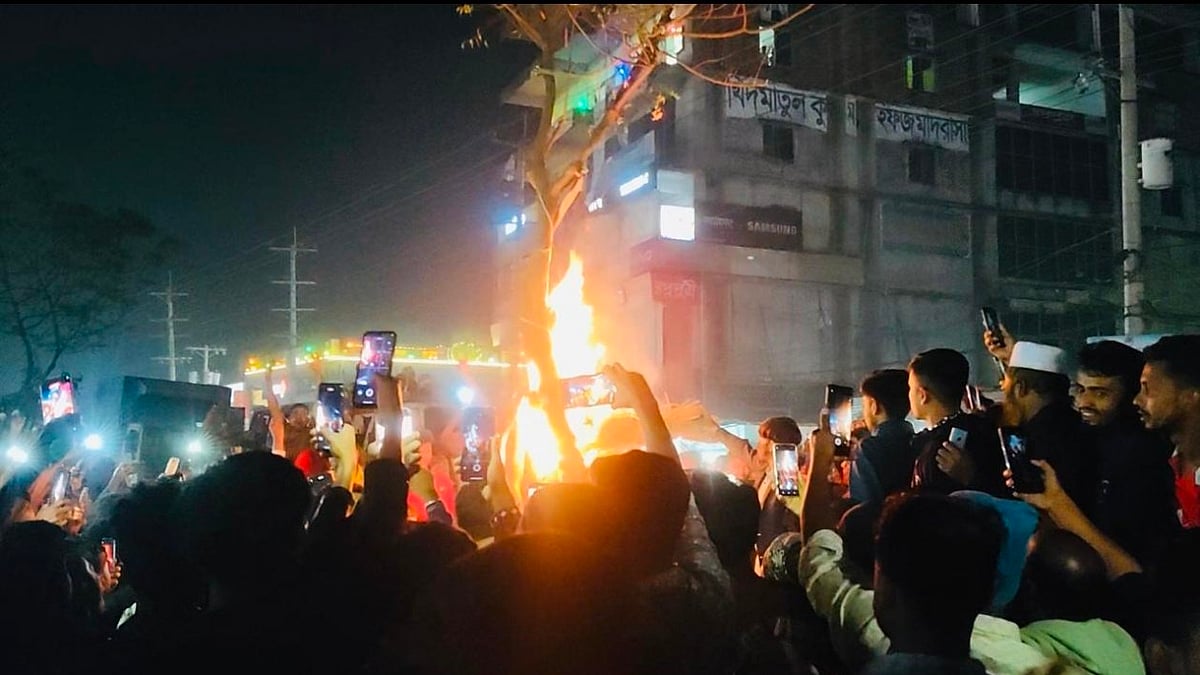
The killing of Sharif Osman Hadi, a prominent leader of the 2024 student uprising in Bangladesh and spokesperson for the radical political platform Inqilab Mancha (Manch), has come as a setback to the already fragile India-Bangladesh relations. Following his death at a Singapore hospital on 18 December 2025—after being shot by two motorcycle-borne assailants in central Dhaka on 12 December—a wave of anti-India sentiment is sweeping across Bangladesh.
This is because after the attack on Hadi, Bangladesh’s Islamist groups went on overdrive, claiming that the assailants had escaped to India. Violent demonstrations came out at several places. Mobs shouting anti-India slogans marched toward the Indian High Commission, demanding its shut down. Indian visa centres in Dhaka, Rajshahi and Chittagong faced stone-pelting. The Indira Gandhi Cultural Centre was ransacked.
The violence was not confined to Indian establishments alone. Bangladesh's leading newspaper, Prothom Alo, had to suspend its print and online operations after mob set fire to its office in Dhaka’s Karwan Bazar on the night of 18 December. Angry protesters also ransacked the office of Daily Star located at Dhaka’s Farmgate area.
The diplomatic fallout over Hadi’s killing was significant. Bowing to protesters’ demand that the Indian High Commission in Dhaka be closed until the "assassins" are returned, Bangladesh’s Foreign Ministry summoned the Indian High Commissioner to demand cooperation in apprehending the suspects. In response, Delhi summoned Bangladesh High Commissioner to India, Riaz Hamidullah, and issued a strongly-worded demarche, conveying its concerns at the deteriorating security environment in the country.
Citing security threats, India temporarily suspended operations at several Visa Application Centres, a move that impacted thousands of Bangladeshis who visit India for medical treatment and trade. However, the rhetoric has now moved beyond diplomacy.
After Osman Hadi was shot in the head on December 12, the interim government and student groups quickly directed their suspicions towards India. Investigations by Bangladeshi authorities alleged that the suspects, including individuals reportedly linked to the ousted and banned Awami League, fled across the border into India immediately after the attack.
Hadi was a vocal critic of what he considered as Indian hegemony. His political platform, Inqilab Mancha, rose to prominence during the July-August 2024 uprising that ousted Sheikh Hasina. A few hours before he was shot, Hadi had posted a distorted map of India on Facebook.
In his post, Punjab, Ladakh and Jammu and Kashmir were shown detached from India and depicted on the map as part of Pakistan. Meanwhile, most of West Bengal and Bihar, the whole of Jharkhand, the Northeastern states of India and the coastal area of Myanmar's Rakhine State were shown as part of a "Greater Bangladesh." His strident, but popular, rhetoric made him a polarizing figure in regional politics.
The timing of the attack—just months before the scheduled February 2026 elections—is also significant. With the interim government of Muhammad Yunus struggling to maintain law and order, Hadi’s death has created a martyr for nationalist and Islamist groups who use "anti-India" sentiment as a tool for political mobilization.
The incident, meanwhile, has provided talking points and boosted the sagging morale of the student-centric National Citizen’s Party (NCP) which was battling waning popularity, as revealed in the recent opinion polls, conducted, among others, by Prothom Alo. “Hadi's fight was to build institutions. The fight was to break the hegemony and build Bangladesh,” said NCP Convenor Nahid Islam.
He was quick to distance his party from the incidents of arson, saying it was a planned sabotage by those who were trying to take the movement and protests in a different direction by indulging in violence. “We will not allow Hadi's martyrdom to be used by any extremist group. India must return mass murderer Hasina and the murderers of Hadi,” Islam declared on his verified social media post.
Hadi’s killing has injected a high dose of hostility in an already-stretched bilateral relation. For India, the challenge is no longer just dealing with a different administration but navigating a landscape where mainstream sentiment is increasingly hostile. At the core lies in a deep-seated perception of asymmetry. Many in Bangladesh view India’s hosting of Sheikh Hasina as an act of shielding a fugitive, while New Delhi views the current unrest as a result of the interim government's inability to curb extremist elements.
Saner voices, however, point to a middle path. “Targeting India as the hegemonic force pushes into the background other hegemonic forces at play in Bangladesh like the US and the EU,” says scholar and political thinker Farhad Mazhar. “Our fight is against policies of Delhi’s current dispensation and not against India, where we know people who have interests of both India and Bangladesh in their hearts,” Mazhar explained.
Sourabh Sen is a Kolkata-based independent writer and commentator on politics, human rights and foreign affairs
Join our official telegram channel (@nationalherald) and stay updated with the latest headlines