Remembering Nehru
Nehru's Word: Asian countries will have to work together for progress, prosperity
"If political independence has any meaning, it must be used for the elimination of poverty. I talk of poverty in India, but there are few Asian countries that are not cursed by poverty"
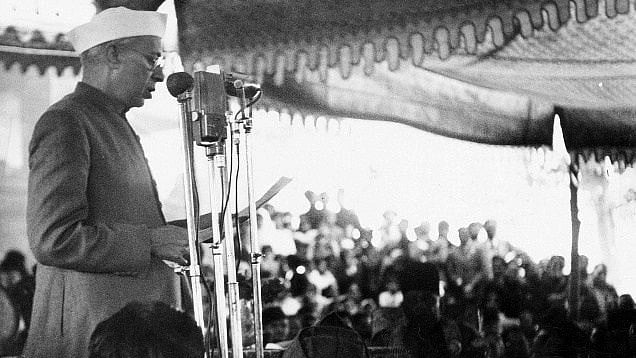
The Narendra Modi government tom-tommed its rotational G20 presidency and the summit in New Delhi as an unprecedented achievement. Those who are aware of independent India’s history know that in 1983 the country hosted a Non-Aligned Movement summit in which leaders from more than a hundred countries participated. But even before that, in April-May 1947—three months before Independence—Indian leaders, largely at the initiative of Jawaharlal Nehru, who then headed the interim government, called an Asian Relations Conference in Delhi from 23 April to 2 May 1947 which was attended by around 30 countries. The following is an extract from one of Nehru’s speeches delivered at the conference.
---
Ten days ago you came here from distant countries. Over the days, we have discussed many problems together and now we have arrived at the end of this conference.
The end I said, but actually it is the beginning—the beginning for which we have laid the foundation formally this morning. All these nine days during which we discussed many problems we were preparing for this final act of laying the foundation of some kind of organisation that will carry on the work of this conference. And today the plenary session of the conference decided to start an Asian Relations Organisation….
The Provisional Council did me the honour of electing me its president. Being irresponsible by nature, not thinking too much of what may lie in store in the future, I accepted that office. But it is a heavy burden that you have cast upon me because there are no known paths to tread except memories of long ago, memories of today and hopes of the future.
Published: undefined
That is enough certainly, yet we have to build this organisation from the bottom up. It is not something which we merely have to carry on. In the building of this, obviously, we will not succeed unless all of us cooperate and function together.
It is an astonishing thing that any sensible person, when he can easily realise that the whole world can be a happy, prosperous and cooperative commonwealth, should believe in and think of wars, of hating, killing and wanting to suppress another.
We might understand this in ignorant people, but the curious thing is that the most learned, the most civilised—according to modern standards—indulge in fantasies of war and preparation for it. It is an extraordinary thing.
We stand for the United Nations because therein lies some hope of world cooperation and world peace. Yet the nations have not functioned in an obviously united way. They have not set an example of peace and goodwill in their attempt to function together. I hope those are only the troubles of early beginnings which they will survive to lead us to a better and cooperative world.
But this mighty civilisation of the West that has done so much to raise human standards, somehow occasionally has something which makes it sink to the level of the brute. Perhaps it may be that something of the essential spirit, the old wisdom of Asia, which might help remove the lack in Western civilisation; I do not know….
Published: undefined
We cannot and we must not think in terms of a narrow and a purely nationalistic part, although inevitably the nations of Asia must advance along the lines of their nationalism. Today we are facing big problems and these cannot be solved by the mere nationalistic approach. Therefore, we have to meet and confer together so that we may evolve common plans of action.
I have no doubt that your coming here has been a vast education to the Indian people. They will feel in a friendly way towards your countries, and I hope that in the same sense, when you will go away from here, you will carry friendly memories of the people of India. Unfortunately, the part of India you have seen most is New Delhi.
Mahatma Gandhi was telling you that this is not India. (Speaking at the closing plenary session Mahatma Gandhi said, “You, friends, have seen not the real India; you are not meeting in conference in the midst of real India… See perhaps a few villages of India. Then you will find the real India.”)
If you want to see India you have to go to her hundreds of villages and see her poverty. It is not a pleasant sight. Yet it is no good avoiding realities because they are unpleasant. That is India and the problem of India is the problem of her poverty. We are going to have political independence, of course, but if that independence has any meaning it must be used for the elimination and liquidation of poverty.
I talk of poverty in India, but there are few Asian countries that are not cursed by poverty and the low standards [of living]. It is a common problem for all of Asia, and therefore, one of the special things we have to undertake is to tackle this problem of raising the standards of the people.
Published: undefined
I trust that the new organisation that we have started will help us in learning from each other’s failures as well as each other’s successes… I hope that the people of Delhi especially, and the people of India generally, will see to it that we have an academy which will really be in the nature of a big university.
Now, finally, you who have come from outside and you who live here, read in the newspapers of the troubles we are having in India. We sometimes read in the newspapers of the troubles you are having in your countries. There is hardly a country that is devoid of trouble and conflict. Perhaps that is the legacy of this War. Perhaps it is an inevitable consequence of having to pass through this period of transition.
What is happening in India is bad enough, and those of us who have to shoulder the responsibility for these, find it a heavy enough burden. Yet, do not imagine for a single instant, you who have come from abroad or you who live in this country, that this trouble and conflict is anything that frightens us…
When ancient empires are uprooted, the ground shakes. You cannot have the birth of complete freedom without the labour pains that accompany every birth.
So, while we regret what is happening and we try to find a peaceful way of progressing, we also realise that sometimes it is inevitable that this kind of thing happens. We have to face it and try to conquer it as, undoubtedly, we will.
Published: undefined
Selected and edited by Mridula Mukherjee, former professor of history at JNU and former director of Nehru Memorial Museum & Library.
More of Nehru's thoughts and writings can be found in our archives here.
Published: undefined
Follow us on: Facebook, Twitter, Google News, Instagram, WhatsApp
Join our official telegram channel (@nationalherald) and stay updated with the latest headlines
Published: undefined