Nation
35 days, no water: Kolkata Muslim colony says BJP MLA 'punishing them'
Children bathe in polluted river as residents allege civic deprivation and eviction threats in Muslim-majority Jyotinagar
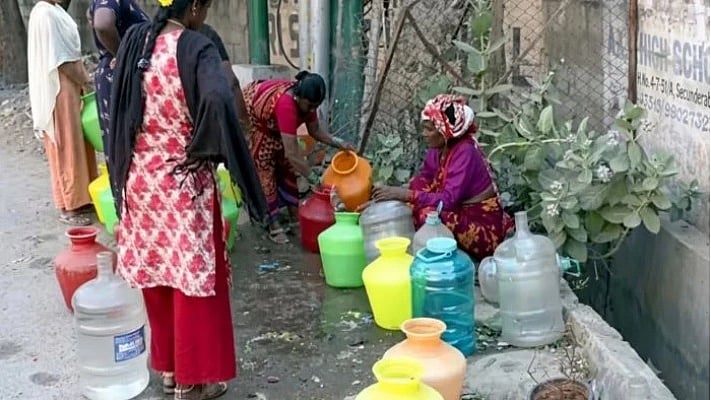
For 35 days, residents of Jyotinagar colony in north Kolkata's Cossipore have been living without a regular drinking-water supply. Five public taps that once served hundreds of families have run dry, leaving residents with little choice but to collect water from the polluted Ganges or buy from municipal tankers.
The crisis has turned an already impoverished neighbourhood into a daily struggle for survival. Residents say they have repeatedly approached the Kolkata Municipal Corporation (KMC), police and local administration, with little result.
The allegations are particularly serious because most of Jyotinagar’s residents are Muslim. Locally known as 'Molla para' or Muslim colony, the settlement has existed for around six decades.
Residents say the water supply was cut after KMC workers carried out pipeline repairs between 27 and 29 July. Water was available on 29 July, they say, but stopped suddenly at around 11.30 that night. The prolonged deprivation has fuelled allegations that the problem is not simply a technical failure but an act of political discrimination.
Those allegations come against a backdrop of the wider political rhetoric in West Bengal. BJP leaders, including chief minister Suvendu Adhikari, have repeatedly claimed that Muslims do not vote for the BJP and used the community’s electoral preferences as a political point of confrontation. In Jyotinagar, residents fear this rhetoric has translated into something more tangible: the withholding of basic civic services.
Residents have specifically pointed to local BJP MLA Ritesh Tiwari. They allege that after the election, he told a public meeting that because Muslims had not voted for him, he would not work for them for the next five years. Residents also recall allegations that Tiwari had described people living in the colony as illegal Bangladeshi immigrants.
Tiwari has denied that the water stoppage was deliberate. “There was maintenance work that was done in the pipeline. That might have caused some problem. We came to know about the incident. We are looking into the matter,” he said.
State Congress president Suvankar Sarkar after visiting the area feels BJP has something else in mind. "There is a Jain college just at the border of this locality and I think the BJP is trying to drive these people from this area and give the land to them. Or they might also plan to give the area to a big promoter as the land is very lucrative. We are with the people and will stand by them," he said.
The difference between that explanation and the residents’ experience is stark. Jahanara Bibi said children are being forced to go down to the river to wash and bathe. “Many children have fallen into the Ganga, and some narrowly escaped drowning. Even those who cannot swim are forced to bathe in the river,” she said.
The riverbank is particularly dangerous for older people and people with disabilities. The muddy steps become slippery, residents say, and several people have been injured while trying to collect or use water.
Roshmila Khatun, a young resident, described the consequences. “We are using this Ganga water for everything. Just see the filth and garbage in it. Our children bathe here. Even babies of six and seven months are brought to the ghat and bathed there. Their skin turns red, rashes all over their bodies,” she said.
The crisis has also disrupted education. Isa Khatun, a 15-year-old schoolgirl, said she has been unable to attend school because of the water shortage. Her studies have suffered at a crucial time, with examinations approaching. The school inside the settlement, residents say, does not have a water connection either.
The shortage has affected religious life as well. At the local mosque, residents say people cannot easily perform wudu, the ritual ablution required before prayers.
The colony is home to roughly 500 families, many of whom survive on precarious daily wages. Construction workers and labourers in bottle-melting factories make up a significant part of the workforce. For people already living close to subsistence, paying for water is an additional burden.
Alamgir Biswas, secretary of the local CPI(M) branch, said residents have been buying KMC tanker water for about Rs 700. “A single tanker every three or four days is not enough for 5,000 people,” he said. Residents estimate the population at between 3,500 and 5,000.
The crisis has also exposed the fear and vulnerability of Hindu residents living alongside their Muslim neighbours. Saraswati Biswas, who said she has lived in Jyotinagar for nearly 60 years, remembers a very different relationship between the communities. “Poor people from both Hindu and Muslim communities have lived here together, facing various challenges. But a crisis like this is entirely new to us.”
Some Hindu residents in a nearby settlement have shared water with their Muslim neighbours. But residents say even that solidarity is accompanied by fear. Some Hindu families reportedly worry that openly helping Muslim residents could put their own water supply at risk.
Residents also allege that BJP workers have threatened them with eviction. The colony, they insist, is government-registered and has existed for generations. “If we are encroachers, several residents ask, why did nobody say so for seventy years? Our slum is a registered one. How did it suddenly become KoPT (Kolkata Port Trust) land, and how can they want to evict us?” local resident Salauddin Shiekh asked.
The West Bengal Slum Development Association has taken up the issue and submitted representations to the authorities. The Human Rights Commission has also been informed. Lawyer Shamim Ahmed said the association has approached the court over the eviction threat and that a stay order has been granted.
Residents also say local Trinamool Congress (TMC) councillor Suman Singh has failed to respond adequately, with some alleging that he left the area after the 4 May election results, granting a sweeping win to the BJP.
TMC MLA Kunal Ghosh said, “We have asked our local party leaders to help the affected residents by arranging water tankers. We will also provide them with legal assistance in court.”
Join our official telegram channel (@nationalherald) and stay updated with the latest headlines