Nation
Bageshwar Baba runs into furious Bengalis over ‘vegetarian food’ firman on Durga Puja
FIR lodged in Kolkata seeking police action against ‘Bageshwar Baba’ alias Dhirendra Shastri for hurting Hindu sentiments and polarising Bengali society
How dare he come to Bengal and tell Bengalis how to celebrate Durga Puja? Have Bengalis ever told people in other states what to eat and how to observe their festivals? How has he been allowed to get away after calling Bengalis who consume meat and fish during Durga Puja ‘fraud’ Hindus (pakhandi)? Why has there been no FIR lodged and why has there been no arrest? These were some of the questions raised by the celebrated anchor of TV Ananda, the Bengali channel of the ABP Group, during a prime-time show on Monday, 7 September.
The controversy centres on Dhirendra Shastri, popularly known as Bageshwar Baba, a 30-year-old Hindu religious preacher and head priest of the Bageshwar Dham temple in Madhya Pradesh. Shastri is known for his public durbars, where he claims to miraculously identify devotees’ problems and offer solutions to them.
Can an obscure Baba from Madhya Pradesh be allowed to call Bengalis names and divide society? The question was endorsed by the panelists on the show.
The outrage is real.
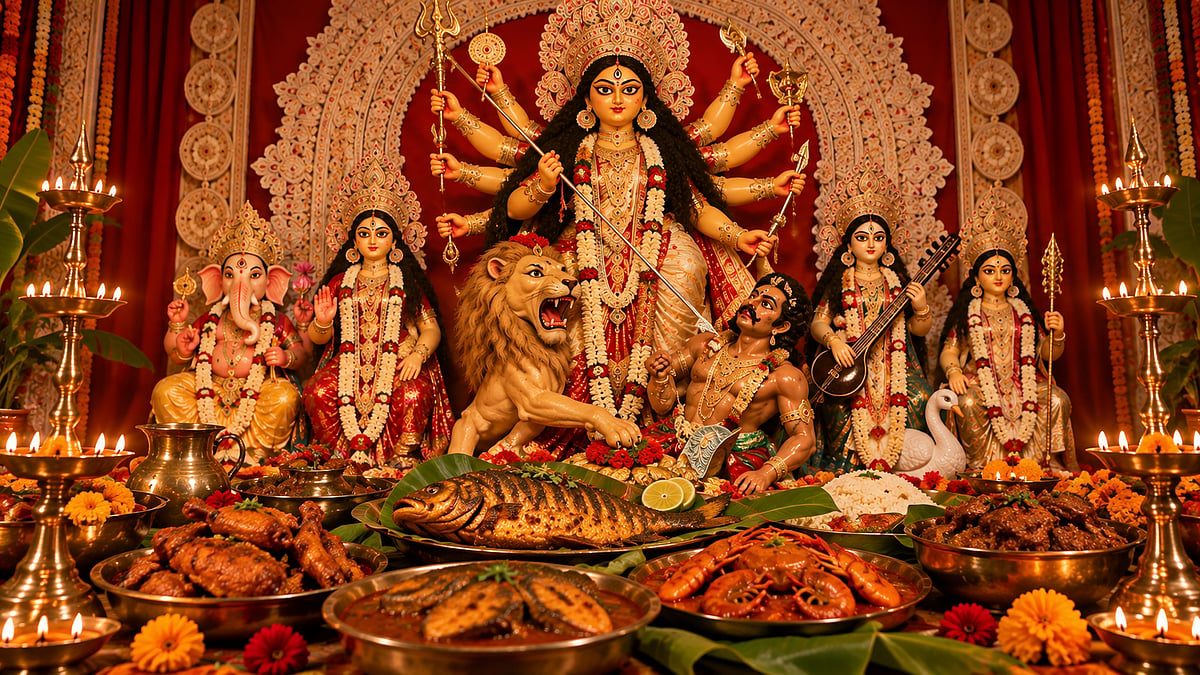
Bengalis are pointing out that they consider the annual Durga Puja festival as Ma Durga’s homecoming—the time when the daughter returns to her maternal home to be fed and fussed over. It has traditionally been a time to greet the daughter with the choicest fish and meat. Swami Vivekananda not only asked his followers to consume meat, he also enjoyed cooking meat.
Meat is central to Shakta Hinduism, the tradition of Hindu worship centred on the divine feminine. It is offered to Ma Durga and Ma Kali as part of ancient rituals in some Shakta traditions. Meat offerings and their consumption as prasad are also part of certain Durga Puja practices. Any interference in these long-standing rituals, many Bengalis argue, will not be tolerated.
An FIR has meanwhile been lodged in Kolkata seeking police action against Bageshwar Baba alias Dhirendra Shastri, accusing him of hurting Hindu sentiments and attempting to polarise Bengali society over his appeal for people to avoid non-vegetarian food during Durga Puja.
Embarrassed by the growing controversy, BJP leaders have been busy fire-fighting. State BJP president Shamik Bhattacharya has dismissed the Baba’s appeal.
“No sadhu or political party has the right to dictate dietary restrictions on anyone. At the same time, no Baba must think himself to be above Swami Vivekananda here,” Bhattacharya has said, adding that Bengalis will continue eating what they have always eaten during the Puja.
Other BJP leaders have accused anti-BJP forces of overreacting and making a mountain out of a molehill. Bageshwar Baba, they have argued, had the right to say what he did, just as Bengalis have the right to ignore his appeal. Why accord him so much importance, they have asked.
The counter to that argument is the red carpet rolled out by the state government for what some people claim was Bageshwar Baba’s first visit to West Bengal. Former chief minister Mamata Banerjee feted him and hosted an official lunch at the state guesthouse ‘Soujanya’. https://x.com/chhuti_is/status/2096498141050908926?s=20
Shastri has been critical of the previous chief minister and had vowed to visit the state if the BJP was voted to power. Now that “Didi” has gone and “Dada” is in the saddle, the Baba declared, the state was bound to prosper. He also said, ‘Ek baar CM House mein bhi durbar lagna chahiye’ — that at least once the Baba should hold a durbar at the Chief Minister’s official residence.
He appeared unaware, however, that West Bengal does not have a designated official CM residence. For more than half a century, chief ministers have lived in their own residential houses in the state.
An exasperated senior BJP leader, Tathagata Roy, scoffed at the raging discourse.
“The pig-headed stupidity of desperate Hindu-baiters is interesting. Dhirendra Shastri of Bageshwar Dham may have objected to eating non-vegetarian food during Navaratri. I don’t agree with him and I do eat non-vegetarian food during Navaratri. And I still remain 100 per cent Hindu. There is no concept of ‘munafiq’ (half-believers) in Hindutva. This diversity is the essence of Hindutva. I may have respect for Dhirendra Shastri, but what he said is no firman (decreee); and I allow neither Shastri, Manu-Samhita or Quran-Hadith to control my life,” Roy said.
The controversy shows no sign of abating. The ‘Baba’, meanwhile, must be quite happy. Relatively unknown in West Bengal until recently, he has quickly become a household name in the past few days, with people asking who he is and what his organisation represents.
His purpose too has been served to a large extent, as Bengal has rarely seen such a sharp debate over food, religion and identity immediately ahead of Durga Puja. Bengalis are being pitted against non-Bengalis, and there is growing apprehension that this year’s Puja could be marked by tension and clashes.
Who is Bageshwar Baba?
Bageshwar Baba, alias Dhirendra Shastri, is 30 years old and is the head priest of the Bageshwar Dham temple in Madhya Pradesh, which was founded by his grandfather. He claims to be able to read the minds of visitors and identify what is troubling them even before they speak.
He holds live ‘durbars’, where people are invited to write down their ‘pleas’ on slips of paper. Shastri then writes what he presents as the solution or prescription on another slip, sometimes before the supplicants have finished writing their pleas.
His claims have attracted scepticism from rationalists. During an event in Nagpur, he was challenged by a rationalist to repeat the exercise with the supplicants selected by the rationalist. Shastri subsequently left the city before completing the programme, according to the account cited in the original report.
He also claims to deal with cases of spirit possession, with men and women believed to be under the influence of evil spirits brought to him for treatment.
Shastri has also faced criticism over statements about alternative remedies, including an instance in which he reportedly prescribed cow urine for cancer. He has been associated with plans for a cancer hospital being built in Madhya Pradesh. Prime Minister Narendra Modi has publicly referred to him as his “younger brother”.
Shastri is closely associated with the Rashtriya Swayamsevak Sangh (RSS) and the Bharatiya Janata Party (BJP), making his intervention in Bengal’s intensely political and culturally sensitive Durga Puja season particularly contentious.
The immediate controversy, however, is less about Shastri’s political affiliations than his attempt to prescribe what Bengalis should eat during their biggest festival. For many in Bengal, the argument is not simply about food but about who has the authority to define how Hinduism should be practised — and whether an outsider can dictate the terms of a deeply rooted regional tradition.
Join our official telegram channel (@nationalherald) and stay updated with the latest headlines