Nation
Delhi records worst Dec AQI since 2018; farm fires contribute just 3.5% to PM2.5
Capital logs average AQI of 349 in December; data shows stubble burning share at lowest in five years
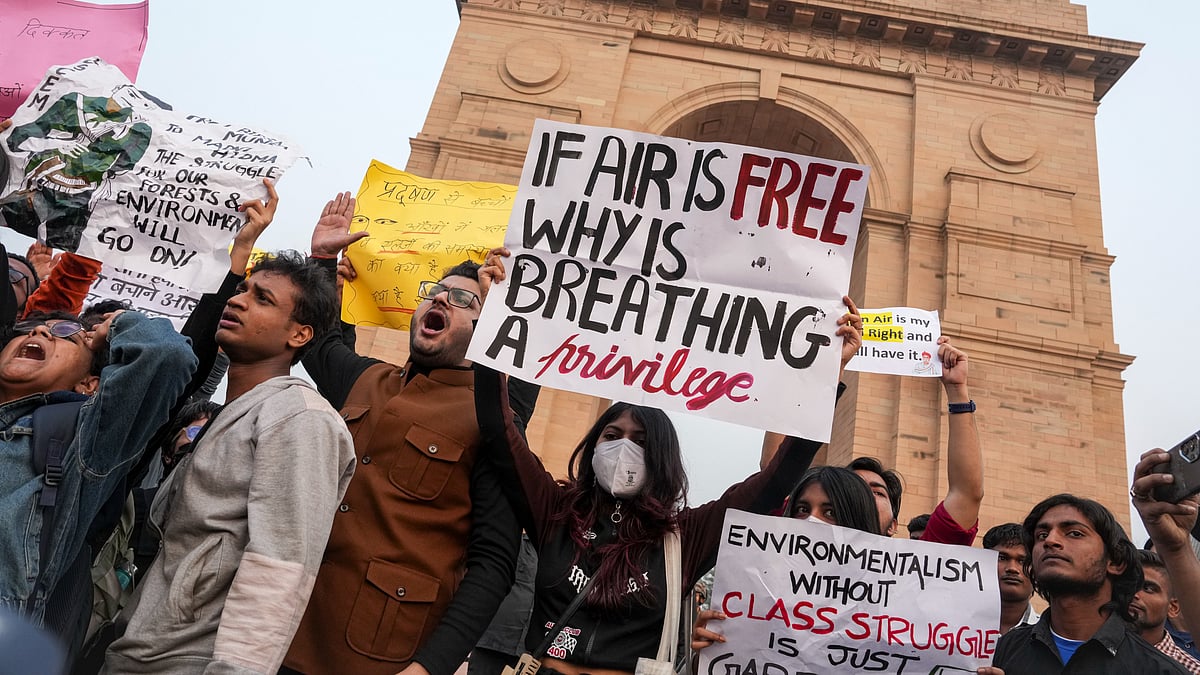
Delhi recorded its worst air quality for the month of December since 2018, with an average AQI (Air Quality Index) of 349, even as farm fires accounted for only 3.5 per cent of the city’s PM2.5 pollution, according to official data.
In December 2018, the national capital had logged a higher monthly average AQI of 360, an official said. Data from the CPCB (Central Pollution Control Board) shows that the December average AQI stood at 294 in 2024, 348 in 2023, 319 in 2022, 336 in 2021, 332 in 2020, 337 in 2019, and 301 in 2015.
This December, Delhi recorded ‘severe’ air quality on five days, marginally lower than the six such days seen in December last year. On Monday, air quality again slipped into the ‘severe’ category, with the AQI touching 401 at 4 pm, compared with 390 on Sunday, which fell under the ‘very poor’ category.
As per CPCB standards, an AQI between 0 and 50 is categorised as ‘good’, 51 to 100 ‘satisfactory’, 101 to 200 ‘moderate’, 201 to 300 ‘poor’, 301 to 400 ‘very poor’, and 401 to 500 ‘severe’.
Meanwhile, data provided by the CPCB in response to a RTI (Right to Information) application filed by Noida-based environmentalist Amit Gupta shows that stubble burning contributed only 3.5 per cent to Delhi’s PM2.5 pollution till December 5 this year, even as the Delhi-NCR region remained among the most polluted parts of the country.
The pollution watchdog said it continues to rely on the TERI–ARAI Source Apportionment Study of 2018 to assess the contribution of various sources to PM2.5 and PM10 pollution in Delhi-NCR, noting that no comprehensive source apportionment study has been conducted since then.
However, daily mean data generated by the Decision Support System of IITM Pune, under the Ministry of Earth Sciences, indicates a steady decline in the contribution of stubble burning to PM2.5 levels during the October–December period over the years.
According to the DSS data, the share of stubble burning stood at 13 per cent in 2020 and 2021, declined to nine per cent in 2022, rose marginally to 11 per cent in 2023, and was 10.6 per cent in 2024 before dropping sharply to 3.5 per cent in 2025.
With PTI inputs
Join our official telegram channel (@nationalherald) and stay updated with the latest headlines