Nation
No country for Christians either
Hindutva goons go after India’s Christians, especially in BJP-ruled states, with impunity; PM Modi’s Christmas photo-op is a surreal contrast
This is what December looked like for Christians in India.
In Bareilly, Uttar Pradesh, Hindu zealots gathered outside a church to chant the Hanuman Chalisa on Christmas eve. In Ghaziabad, Pastor Raju Sadasivam and his wife were cornered on camera by Satyanishth Arya, known for his rabid videos, and aggressively questioned about Jesus.
In Raipur, Chhattisgarh, a group of Hindutva vandals ripped through a mall that was open during a statewide bandh announced by Hindu groups to protest alleged religious conversions. Decorations were destroyed, employees were asked to show their identity cards and non-Hindus were threatened.
In Haridwar, Uttarakhand, a Christmas celebration at a government-run hotel on the banks of the Ganga was scrapped after Hindu groups claimed it offended religious sentiments in the ‘holy city’.
In Delhi’s Lajpat Nagar, Bajrang Dal militants accused Christian women wearing Santa hats of proselytisation in a public place and forced them to leave. The video went viral. Teenagers caught wearing Santa caps were also heckled and humiliated.
In Bhubaneswar, Odisha, street vendors selling Santa hats and Christmas accessories were threatened by men proclaiming a ‘Hindu Rashtra’ was no place for such activities.
In Jabalpur, Madhya Pradesh, a viral video captured a visually impaired woman being publicly abused and physically harassed by city BJP vice-president Anju Bhargava during a Christmas programme.
In Jhabua, the police blocked four Catholic parishes from holding Christmas carol programmes by refusing to accept applications, forcing the Madhya Pradesh High Court’s Indore Bench to step in to uphold the diocese’s rights.
In Kerala, young carollers were attacked and several schools knuckled under the Sangh’s instructions and cancelled X-mas celebrations.
In Assam, members of the Bajrang Dal vandalised St Mary’s School in Nalbari’s Panigaon village, setting Christmas decorations on fire and shouting ‘Jai Shri Ram’.
The list is as long as it is distressing.
India’s Christian minority — estimated at around 32 million, or 2.2 per cent of a total population of 1.46 billion — is besieged like never before. Hindu vigilantes treat Christmas festivities as provocations to attack, with the full blessing of the Sangh parivar. But these hate crimes unfold year-round, surging over the last decade to unprecedented levels.
On 8 December, the National Christian Convention presented documented evidence of violence against the community: 579 incidents were recorded between January and October this year, but only 39 FIRs filed.
The United Christians Forum, a New Delhi-based ecumenical organisation, reported a sharp increase in attacks against Christians across India, rising from 127 cases in 2014 to 834 in 2024. That’s an average of more than two attacks per day. Reports indicated a climate of impunity where perpetrators often face little to no formal police action.
“Christians in India are punished not for wrongdoing but for simply gathering, praying or helping their neighbours,” said Tehmina Arora of the Christian legal advocacy group, Alliance Defending Freedom International. “Even the Supreme Court of India recently noted how the anti-conversion laws are misused to wrongly prosecute Christians.”
In October, a Supreme Court bench of Justices J.B. Pardiwala and Manoj Misra delivered a scathing rebuke to authorities, observing, “The criminal law cannot be allowed to be made a tool of harassment of innocent persons, allowing prosecuting agencies to initiate prosecution at their whims and fancy, on the basis of completely incredulous material.”
The judgment quashed all FIRs, along with all consequential proceedings, vindicating Evangelical Church of India pastor Vijay Masih and staff members of Broadwell Christian Hospital in Fatehpur, officials of Sam Higginbottom University in Prayagraj and others named since 2022 under Uttar Pradesh’s anti-conversion law.
This followed the acquittal in neighbouring Uttarakhand of the first Christian charged under its ‘anti-conversion’ law — pastor Nandan Singh — who was cleared after a four-year battle.
Twelve Indian states now enforce anti-conversion laws, often used to intimidate and criminalise peaceful religious activity. This year, 123 criminal complaints have been filed against Christians, with several believers imprisoned in jails across the country.
On 17 June, addressing a public meeting in Sangli, BJP MLA Gopichand Padalkar allegedly offered a bounty of Rs 3 to Rs 11 lakh for acts of violence against Christian priests and missionaries engaging in ‘forceful conversions’.
Church leaders assert that if conversion was indeed taking place as widely as alleged, India’s Christian population would have risen dramatically, instead of holding steady between 2 and 3 per cent in every census since 1951.
The independent, bipartisan US Commission on International Religious Freedom has repeatedly ‘recommended’ — this year too — that the US state department designate India as a ‘Country of Particular Concern’ for ongoing and egregious violations of religious freedom.
‘The Indian government, at the national and state level, tolerates and at times fuels widespread harassment and violence against religious minorities…’ it notes in its November 2025 report on Systematic Religious Persecution in India.
‘The BJP-led government has introduced and enforced discriminatory legislation that disenfranchises religious minorities, including the Citizenship Amendment Act (CAA), the National Register of Citizens (NRC), the Unlawful Activities Prevention Act (UAPA), and various state-level anti-conversion and cow slaughter laws — for alleged systemic violations of religious freedom, particularly targeting minorities like Muslims and Christians, with issues including anti-conversion laws and Hindu nationalist rhetoric.’
The report states what the incidents reveal: ‘The RSS’s primary mission is to build a “Hindu Rastra”, or Hindu state. It promotes the notion that India is a Hindu nation, excluding Muslims, Christians, Jews, Buddhists, Parsis, and other religious minorities.’
While the Commission’s recommendations are not binding, they highlight growing international scrutiny over India’s religious intolerance.
Leaders like the All India Catholic Union’s Elias Vaz and the All India Christian Council’s Madhu Chandra have spoken out about a pervasive ‘climate of hate’ being kindled by rumours of forced conversions.
In July, two Catholic nuns from Kerala, Sisters Preeti Mary and Vandana Francis, were arrested in Chhattisgarh on charges of human trafficking and forced conversion. Church sources stated the nuns were taking the three tribal women with them to Agra for salaried kitchen-help jobs.
The police are complicit more often than not, as in March when VHP activists assaulted two Catholic priests inside a Jabalpur police station, in the presence of police personnel.
In 2024, the UN General Assembly circulated a submission by Christian legal advocacy group European Centre for Law and Justice urging the UN ‘to hold India accountable’, citing India’s rank as the 11th most dangerous country in the world for Christians to live in, with the last five years seeing ‘a dramatic increase in violence against Christians’.
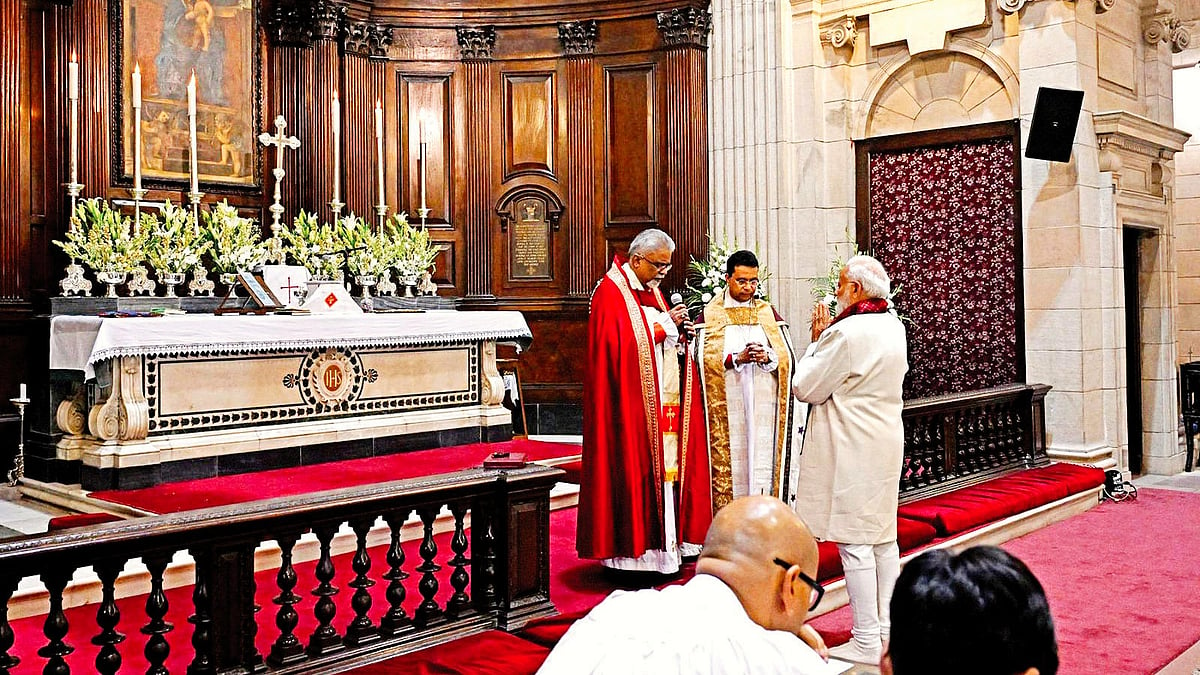
Given all this, what sense does one make of Prime Minister Modi’s Christmas photo-op at a Delhi cathedral?
Sarosh Bana is executive editor of Business India. More of his writing can be read here
Join our official telegram channel (@nationalherald) and stay updated with the latest headlines