Nation
Of empty nests and ageing parents
Kerala’s proposal of a dedicated department for senior citizens prompts a closer look at the psychological cost of changing demographics
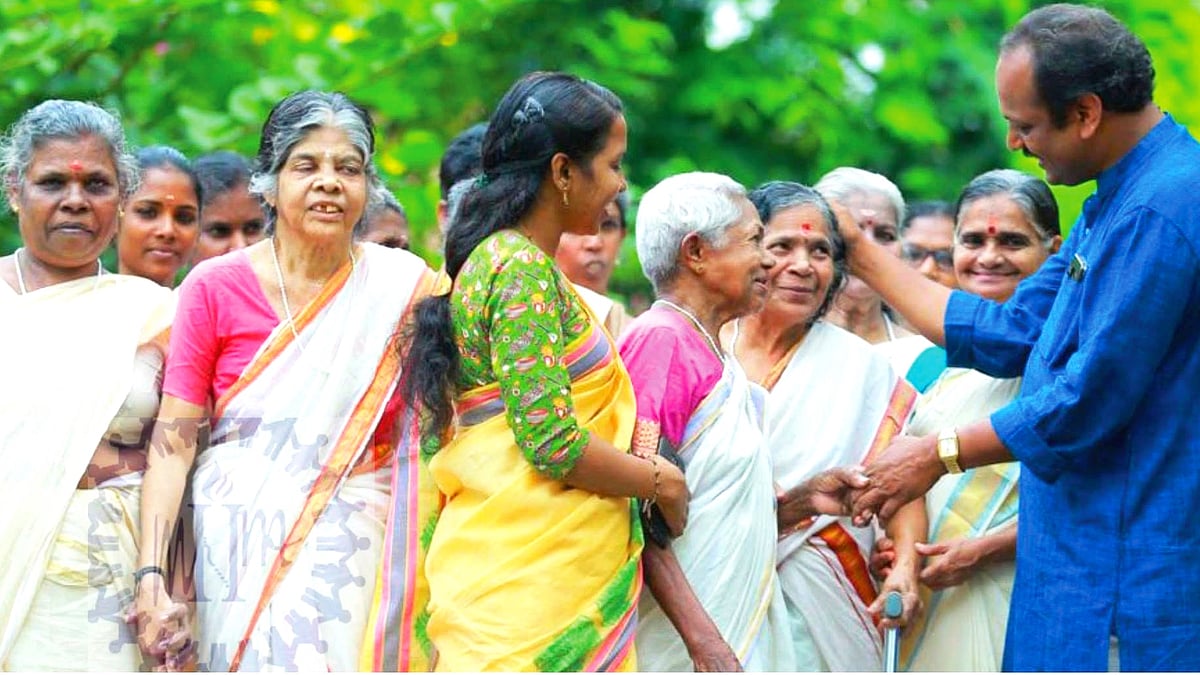
Rajesh Thiruvalla was abandoned long before he began caring for people abandoned by others. The founder of Mahatma Janasevana Kendram in Adoor in Kerala’s Pathanamthitta district, Rajesh’s childhood was marked by rejection, poverty and emotional neglect. His parents remarried, leaving him to survive on the generosity of distant relatives as he moved from one house to another. Hunger was a recurring reality. Formal education became a luxury. He dropped out of school and spent years doing menial jobs in different parts of India.
Life changed unexpectedly when he returned to Kerala and found work in an old-age home near his village. There, his empathy towards elderly residents who had been rejected by their own families drew attention. Visitors noticed his patience. Residents trusted him. Among those who recognised his commitment was a senior IAS officer who approached Rajesh with an unusual request: would he care for a 107-year-old relative who had no one to look after her? Rajesh agreed. What began as a simple act of compassion gradually evolved into a much larger humanitarian mission.
Today, Mahatma Janasevana Kendram is one of Kerala’s largest shelters for abandoned senior citizens. Of its 370+ residents, many were thrown out by their own families. “Old age homes are mushrooming in Kerala, where senior citizens are increasingly turning into liabilities,” says Rajesh.
His remark is uncomfortable because it challenges the cherished image of Kerala as a society where family bonds remain strong. What it points to is one of the most profound demographic transformations in India. The generation that contributed to the state’s celebrated development model is now ageing rapidly, often in circumstances marked by loneliness, vulnerability and uncertainty.
The urgency of the situation has prompted the V.D. Satheesan government to announce a landmark intervention: a separate department exclusively for senior citizens. It proposes an integration of healthcare, rehabilitation, social protection and community support within a single administrative framework.
According to data from the Kerala State Planning Board, in 1961, those aged sixty and above comprised only 5.1 per cent of the state’s population, slightly below the national average of 5.6 per cent. Over the next decades, Kerala rapidly overtook the national average: 10.5 per cent against 7.5 per cent (2001); 12.6 per cent against 8.6 per cent (2011); 13.1 per cent against 8.3 per cent (2015).
Today, Kerala is home to nearly 48 lakh senior citizens. Fifteen per cent of them are super-senior citizens (80-plus). Women outnumber men, with Census figures indicating that 23 per cent of women between 60-69 are widows. Above 70, the figure rises to 43.06 per cent. Remember that Kerala also enjoys the highest life expectancy in India — estimated at 72.5 years for men and 77.8 years for women — a reflection of improved healthcare and living conditions that now present new social challenges.
Professor S. Irudaya Rajan, former professor at the Centre for Development Studies and chairman of the International Institute of Migration and Development, has spent decades studying the implications of these changes. Through the Kerala Ageing Surveys and other longitudinal research initiatives, he has documented a phenomenon more commonly associated with developed countries.
The departure of younger generations has transformed family structures and caregiving arrangements. The weakening of traditional support systems, the rise of nuclear families and increasing geographical distance between parents and children have produced new vulnerabilities among older people. Rajan’s studies reveal that ageing is accompanied by high levels of morbidity, disability and psychological distress.
Few places illustrate these realities more vividly than Kumbanad in Pathanamthitta district. Unlike regions whose prosperity was primarily built on migration to the Gulf, Kumbanad went westward.
Women from here have established themselves as nurses in the UK, Germany and other European countries, caring for ageing populations abroad even as their own parents grow old at home. Young men have migrated to the United States, Canada and Europe as doctors, engineers, IT professionals and entrepreneurs. Entire families have settled overseas, making return less likely.
The result is a village where spacious homes are occupied by lonely geriatric couples. Pensions, savings and financial support from children abroad provide material comfort; it’s the emotional support that is missing.
“Our young people have succeeded globally,” says IT businessman Joseph C. Mathew from Kumbanad. “But the unintended consequence is that parents are spending the final years of their lives alone.”
The National Sample Survey found that 65 per cent of Kerala’s elderly population suffers from morbidity. Hypertension, diabetes, arthritis, cardiovascular diseases and visual impairment are widespread. Rajan’s research indicates an increased demand for assisted living arrangements, rehabilitation services and home-based support systems. Mental health concerns further complicate the picture. Rajan argues that policies must recognise mental well being as integral to quality of life rather than treating it as a secondary concern.
According to health department figures, at least 270 elderly patients who have fully recovered medically continue to remain in government hospitals because their relatives have abandoned them. Preliminary assessments identified dozens of such patients in the Government Medical College Hospital in Thiruvananthapuram alone. Health minister K. Muraleedharan has described the situation as a serious challenge for hospitals with too many patients and too few beds.
Hospitals have begun experimenting with rehabilitation models. Kottayam Medical College Hospital constituted a team to trace relatives and try to facilitate reintegration. Where this proves impossible, voluntary organi- sations assume responsibility. While many caregivers provide exemplary service, instances of financial exploitation, abuse and crimes involving elderly individuals living alone is another serious worry.
Once associated primarily with destitution, old-age homes are increasingly catering to diverse social groups, both rich and poor. Among them is Janaseva Gandhibhavan in Pathanapuram, founded by Dr. Punalur Somarajan in 2002. “Our mission has always been to restore dignity to people who have nowhere else to go,” says Dr Somarajan.
Kerala’s response to ageing has seen many programmes: Vayomithram, which provides healthcare services; Vayo Amrutham, which extends health insurance benefits; Sayamprabha homes; Vayoraksha initiatives; Mandahasam, which provides dentures; and Sallapam, a telephone friendship programme intended to reduce loneliness. Policymakers realised, however, that ageing cannot be addressed through isolated schemes.
Minister C.P. John, who is expected to lead the proposed department for senior citizens, says that Kerala’s response must move beyond viewing older people solely as recipients of welfare. Civil service officer Adeela Abdulla, involved in the preliminary groundwork, believes policy responses must emerge from lived experiences. The needs of widows differ from bedridden patients requiring institutional care. Affluent ageing couples separated from migrant children face different challenges from economically vulnerable senior citizens. Effective interventions must reflect these distinctions.
There are lessons here for the rest of India. Studies suggest that Kerala’s population could rise from 3.34 crore in 2023 to 3.69 crore in 2036, with life expectancy increasing apace. By 2050, one in every three Keralite could be a senior citizen.
Rajesh Thiruvalla’s journey raises questions that cannot be ignored. Who cares for the elderly when families fail? What responsibilities do communities bear? How should governments respond when traditional support systems become inadequate?
For Rajesh, the answer remains deeply personal. The elders who arrive at Mahatma Janasevana Kendram are not ‘inmates’ or ‘beneficiaries’. They are individuals who once raised children, cultivated land, taught classrooms, healed patients…
As Kerala prepares to establish a dedicated department for senior citizens, it stands at a crossroads. Its decisions will determine whether ageing stays a story of abandonment and institutionalisation or an opportunity to redefine care within a swiftly changing society.
K.A. Shaji is a South India–based journalist who has chronicled rural distress, caste and tribal realities, environmental struggles and development fault lines. More of his writing here
Join our official telegram channel (@nationalherald) and stay updated with the latest headlines