Nation
Kolkata: Barefoot parade of protest accused despite court directives
Civil liberties advocates question public parade of NEET protest accused despite repeated court warnings
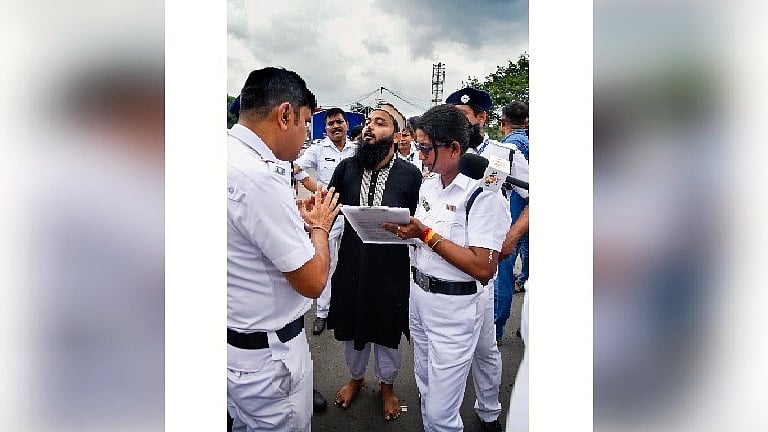
Despite repeated judicial warnings against publicly humiliating accused persons, Kolkata Police on Monday, 27 July escorted five men arrested in connection with the violence during last week's NEET protest through Esplanade (Dharmatala) barefoot and wearing shorts, prompting fresh questions over compliance with constitutional protections and court directives.
The public reconstruction of the alleged crime scene came despite repeated observations by the Supreme Court and the Calcutta High Court that accused persons cannot be subjected to public shaming merely because they have been arrested.
Advocate Swadesh Taral pointed to a June 2026 Calcutta High Court direction in which the court reportedly said, "You may arrest them, you may prosecute them, but you cannot humiliate them." According to Taral, the court described publicly parading accused persons in partial states of undress as "impermissible" and a violation of human rights. The Supreme Court has likewise held that the right to life under Article 21 of the Constitution includes the right to dignity, which extends to accused persons until proven guilty through due process.
Against that legal backdrop, police brought five arrested men — Mohammad Afroz, Khaled Reza, Sheikh Salman, Mohammad Moinuddin and Alamgir — to Dorina Crossing to reconstruct Friday's alleged violence. One by one, they were taken out of a prison van, made to walk barefoot under heavy police escort and questioned at different locations before being returned to custody. The exercise lasted for more than an hour.
The reconstruction quickly turned into what critics described as a public media trial. Reporters surrounded the accused as they walked through the streets, repeatedly questioning them. Afroz, who police allege was among the key participants in the violence, was asked: "Why did you attack the media?", "Are you mafia?", "Why did you join the students' protest?" and "Is anyone related to you associated with the NEET exam?"
Wearing a black shirt and shorts, Afroz remained largely silent, responding only occasionally to police officers.
Police allege Afroz appears in social media videos identifying himself as part of 'Team Mafia' and brandishing weapons. They also claim photographs show him campaigning for Trinamool Congress MLA Khalek Ali Molla, although the MLA has denied knowing him. These allegations have not been tested in court.
Another accused, Khaled Reza, identified as a local Congress leader, denied wrongdoing. "We were holding a protest at the Esplanade crossing. Our leaders Shubhankar Sarkar and Amitabha Chakraborty were present. Rahul Gandhi had given us instructions. There are traffic cameras there; check the footage to see what happened," he told reporters.
A third accused, Raju, who was questioned inside the police van because of an injured leg, claimed he had not even been present at Esplanade. "I am a Congress worker. I was at College Street that day. I have three plates in my leg and cannot even walk properly. I run a fruit business. There are no photographs of me at Esplanade," he said.
The arrests stem from Friday's demonstrations against the alleged NEET question paper leak. Left-affiliated student organisations, including the Students' Federation of India (SFI), had organised a protest demanding the resignation of the Union education minister, later joined by the Cockroach Janta Party (CJP). Police allege sections of the crowd vandalised public property, assaulted journalists and attempted to attack police personnel. Seven criminal cases have been registered by Hare Street and Entally police stations.
With the arrests of Waqar Azam from Park Circus and Javed Akhtar from Garden Reach, the total number of people arrested has risen to 16. Police say they have identified more than 70 people with no apparent connection to the student movement through CCTV footage, media videos and other digital evidence, and that further arrests are expected. Authorities have also invoked the state's new anti-goonda law.
Chief minister Suvendu Adhikari has alleged that the violence was deliberately orchestrated and warned, "We will take such measures under the anti-goonda law that these goons — and three generations of their families — will remember it forever." He had earlier named five alleged "notorious miscreants" in the Assembly, including Afroz.
Monday's reconstruction has now generated a controversy beyond the criminal investigation itself. Civil liberties advocates argue that publicly displaying accused persons barefoot and in shorts, while allowing them to be questioned by television cameras before trial, risks eroding the presumption of innocence and the constitutional guarantee of dignity.
Courts have consistently held that criminal investigations must proceed through evidence tested in a court of law — not through public spectacle. Whether Monday's exercise crossed that constitutional line may itself become a matter of legal scrutiny.
Join our official telegram channel (@nationalherald) and stay updated with the latest headlines