Nation
Kolkata SRFTI: Students claim attack by 'outsiders', at least 4 hurt
Students objected to 'RSS Parivar' organisation holding an event on campus; claim assault upon objecting
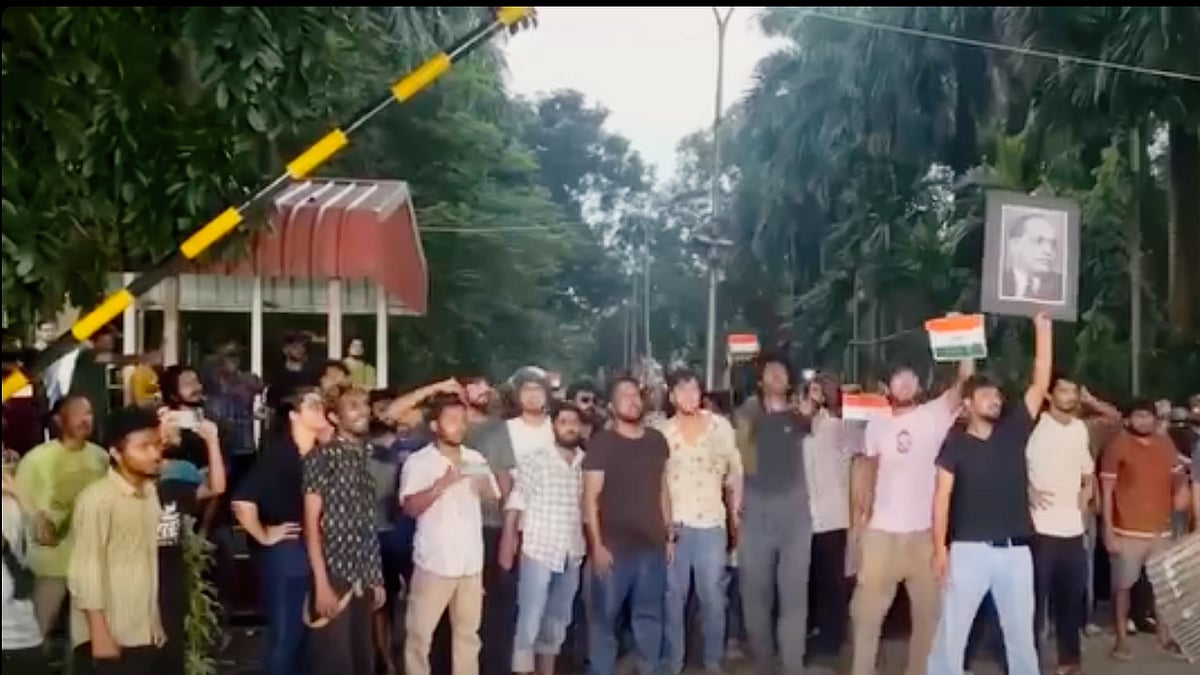
Students say the objection was to an outside organisation from the 'RSS Parivar' holding an event inside their institute’s auditorium, where they normally attend practical classes.
Students and teachers allege they were attacked, while ABGP says it had legally booked the auditorium and claims its members were attacked first.
Allegations of violence, abuse and weapons on both sides have intensified calls for an investigation into what happened inside and outside the campus.
The violence reported at the Satyajit Ray Film and Television Institute (SRFTI) in Kolkata on Sunday, 27 September raises a basic but important question: when an outside organisation uses an educational institution for a political or ideological gathering, what happens when students object?
The controversy began when Akhil Bharatiya Grahak Panchayat (ABGP) held an event inside the institute’s auditorium. ABGP describes itself as a national consumer organisation; an official document hosted by the Telecom Regulatory Authority of India (TRAI) has also described it as part of the ‘RSS Parivar’.
The students’ objection, according to those present, was not simply to a meeting taking place somewhere in Kolkata. It was to outsiders being brought into their institute.
Student Meghraj Rao said, “We hold our practical classes in the auditorium. A meeting was being conducted there with outsiders brought in for the purpose.” He added that students initially protested by putting up posters and that “members of that organisation attacked us”.
A female student alleged, “They entered our campus and called us anti-nationals, Naxalites and terrorists. They are beating up students, assaulting women, and even attacking with knives. They are calling us Bangladeshis.”
Another student said, “They have no shame. They are beating us and dragging us out by force.”
A third student put the central grievance more simply: “This is our institution. We study here. They come from outside to attack us and then label us terrorists?”
There are also reports that teachers were caught up in the violence while attempting to intervene. One professor said, “The students were being beaten up. Seeing this, I stepped in. Some of them charged at us as well; we were not spared either.”
The account given by filmmaker and SRFTI teacher Indranil Roychowdhury is equally stark. Referring to footage he had seen, he said, “The incident is deeply concerning. From the visuals I have seen, the students were beaten brutally.” He added, “There were certainly ways to inform the authorities if something was amiss.”
The other side has given a sharply different account. Pankaj Roy, state president of ABGP, said, “We booked the hall by paying the required fee. Four people have already been hospitalised.”
The organisation has also alleged that students attacked its members and damaged a portrait of Swami Vivekananda. It claimed that “all the students there were intoxicated” — an allegation that would itself require evidence rather than assertion.
The scenes outside SRFTI make the situation still more troubling. Students alleged that people outside the gates threw stones and carried sticks and rods, while police intervened amid continuing tension. The ABGP side, meanwhile, claimed that some of its members were effectively being prevented from leaving safely.
The incident has drawn political condemnation as well.
The West Bengal Pradesh Congress Committee strongly condemned what it described as a rampage by RSS-backed miscreants at SRFTI. State president Subhankar Sarkar said, “Satyajit Ray’s Hirak Rajar Deshe warned against suppressing education, knowledge and independent thought. Today’s incident, we believe, reflects a similar attempt to intimidate progressive voices and undermine free thinking in educational institutions.”
He added, “The appointment of Gajendra Chauhan at the Film and Television Institute of India (FTII) had already raised concerns about political interference in cultural institutions. Bengal’s tradition of progressive thought and cultural practice cannot be silenced. We demand a thorough investigation and exemplary punishment for those responsible.”
Left leader Saikat Giri said, “This is a residential educational institution. How was its premises rented out for an event on a Sunday? The organisers reportedly labelled students as ‘terrorists’, ‘Bangladeshis’ and ‘anti-nationals’. Can such allegations and conduct be justified by a religious organisation? The entire incident raises serious questions and requires an independent investigation to establish what actually happened and hold those responsible accountable.”
Mamata-AITC leader Pratikur Rehman said, “This is the culture of the RSS. They have no power to win over the hearts and minds of students, and therefore, they resort to arms and intimidation to gain control of educational institutions. They started with JNU, then reached Jadavpur University, and today SRFTI has become the target. They will try to take control of colleges and universities across Bengal. But people have started to unite against them, and they will not be able to continue this for long.”
Join our official telegram channel (@nationalherald) and stay updated with the latest headlines