Nation
Fake forms, targeted deletions
Rashme Sehgal on the wholesale deletion of minority votes in Uttarakhand
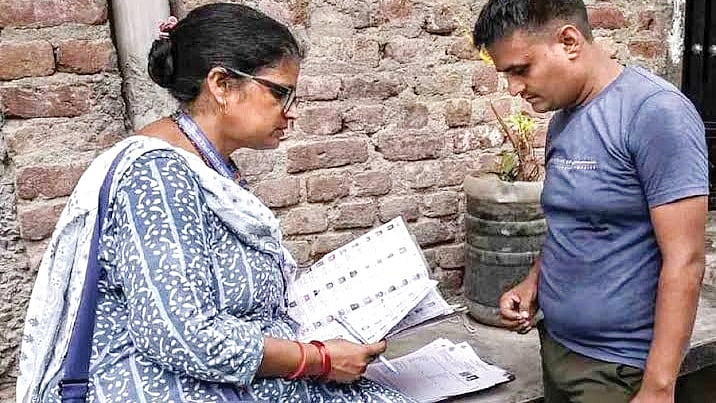
Uttarakhand was one of 16 states part of the concluding phase of the Election Commission’s reconstruction of voter rolls in India. The draft rolls published on 14 July have 71.33 lakh names, down from the pre-SIR baseline of 79.6 lakh, a net deletion of 8.27 lakh names.
The Kolkata-based Sabar Institute, a public policy research non-profit, has analysed data of 807,410 deleted voters across 70 Assembly segments (not the entire set because official data for 415 of 12,543 ‘parts’ or booths was not available at the time of analysis — Ed). Their conclusion is this: districts with higher Muslim populations have registered greater deletions.
Sabar’s findings reveal that Dehradun (12 per cent Muslim pop.) has the highest number of deletions at 186,008 voters. Udham Singh Nagar is next (22 per cent Muslim pop.) with 177,673 deleted voters. Haridwar has 132,003 deleted names, Nainital 71,810, Chamoli 23,436, Uttarkashi 18,405, Rudraprayag 10,809, Tehri Garhwal 43,636, Pauri Garhwal 51,359, Pithoragarh 27,436, Bageshwar 13,010. The population of Muslims in these districts ranges from 8 to 12 per cent.
Opposition leaders say the ECI is accepting unverified bulk submissions of Form 7 (used to either object to someone’s inclusion in the roll or request deletion of a name already listed). On 20 August, the Congress submitted a memorandum to the ECI in Delhi, alleging that thousands of Form 7 applications generated centrally, without any ground-level checks, were submitted by a pool of 262 individuals without verifiable identities.
Congress leader Qazi Muhammed Nizamuddin, who represents the Manglaur Assembly segment, was part of this delegation. While a separate delegation met the state’s chief electoral officer B.V.R.C. Purushottam in Dehradun to express these concerns, Nizamuddin said all district magistrates — including the DM of Haridwar — have been informed. According to Purushottam, 24.3 lakh notices have been issued so far under the SIR, of which around 20.27 lakh have already been delivered to voters.
In a phone interview with this reporter, Nizamuddin raised a crucial point: if any person files more than five objections, the electoral registration officer is mandated to conduct an inquiry to review the legitimacy of each claim.
“There’s been wholesale misuse of Form 7, with fake signatures. Voters have submitted affidavits objecting to the use of their names in these forms. One of them is abroad, and someone has casually used his ID,” Nizamuddin said. Several Opposition parties have also pointed out that the protocol of summoning both the objector and the person whose name is to be deleted is not being observed.
“A certain Mange Ram in Haridwar constituency had filed Form 7s to delete 30 names. We traced all 30 voters and each one of them exists. But there is no person called Mange Ram. A fake ID was used to make these objections. In this particular case, the ‘objectees’ appeared before the BLO but the objector did not,” said Nizamuddin. “How could he, when he does not exist?”
There are, the MLA added, other such highly questionable cases, which have been raised with the CEO who has “promised to take action.” And some officers, he admitted, have shown spine despite pressure from above.
Nizamuddin asks: “How can one individual, like Rajesh Tiwari from the Kichha Assembly segment in Udham Singh Nagar, submit as many as 6,410 objections? If only five complaints can be registered from a single mobile number, how many mobile connections would be required to file 6,410 complaints? What else can we infer if not that the individual has been provided institutional access to the Election Commission website with party or agency help?”
Several voters are of the opinion that outspoken critics of the government have been deliberately deleted. The Sabar report also found environment activist Reenu Paul is one of them. “My name has been deleted while my husband Vijendra Paul is there. I believe this has been done to harass me,” Paul said.
Another vocal critic Kamala Pant, who heads the Uttarakhand Mahila Manch, says she has been spared but her husband Nandan Pandey’s name has vanished. (Pandey had served as Uttarakhand’s director of education.)
Congress vice-president Suryakant Dhasmana maintains, “They are targeting minorities, especially Muslims and Christians. All the voters identified are Congress voters. The intention is clearly mala fide. The state election commission has ordered an enquiry but we are yet to receive a satisfactory response to our queries.”
In the last one year, the SIR exercise in India has seen nearly six crore voters deleted. Minorities in Uttarakhand fear they are next in line.
Muslims in the state believe the SIR is being used to systematically target them. Factors such as impossibly tight verification timelines, discrepancies in names and addresses caused by scribal errors, marriages and migrations; and classifications like ‘logical discrepancies’ could lead to disproportionate exclusions. The bogey that those living in border areas adjacent to Uttar Pradesh are also registered in cities such as Bareilly, Moradabad and Rampur is false — a rumour circulated to disenfranchise them.
The Sabar report also found that in 45 of Uttarakhand’s 70 Assembly segments, the number of voters deleted exceeded the winning margin recorded in the 2022 Assembly election. The BJP is known to be closely monitoring 23 Assembly seats that they lost in the 2022 elections with special focus on Khatima (represented by chief minister Pushkar Singh Dhami in 2012 and 2017; lost in 2022).
Apart from the Kichha seat where around 9,300 objections have been filed, Rudrapur recorded 2,818 objections, Gadarpur 1,370, Khatima 394 and Nanakmatta 391. Most of these objections have been filed by individuals with close links to the BJP.
Purushottam has tried to reassure voters, telling them not to panic if they receive such notices, and that errors in names, addresses and other particulars can be corrected by submitting the prescribed documents. He himself received a notice after a discrepancy was found in the electoral records. ‘Routine discrepancy cases’ will be verified and disposed of at the BLO level, he said, adding that district election officers have been instructed to ensure that voters aren’t unnecessarily inconvenienced.
Nainital sub-divisional magistrate Nawazish Khalik claims BLOs were visiting households to verify voter details and collect the required information. In Nainital, a notice was served at the residence of BJP MLA Sarita Arya, seeking voter verification details for both the legislator and her younger son. A similar notice reached Kumaon commissioner Deepak Rawat.
The claims and objections period will remain open until 13 August and the deadline for disposing notices is 11 September. The comprehensive breakdown of individual voter deletions will be published by the Election Commission on 15 September. What will be the fate of those permanently struck off?
Dhasmana reminds us that in West Bengal, the Supreme Court-appointed SIR appellate tribunals have restored 91 per cent of only 2.7 per cent of the appeals brought before them. “This means the vast majority is still left hanging. All these people were not given the right to vote. The Bengal elections should be declared null and void, and fair and free elections should be held once again.”
Join our official telegram channel (@nationalherald) and stay updated with the latest headlines