Opinion
Back to first principles
Revisiting Manmohan Singh’s vision as global uncertainty raises questions about India’s current diplomatic approach
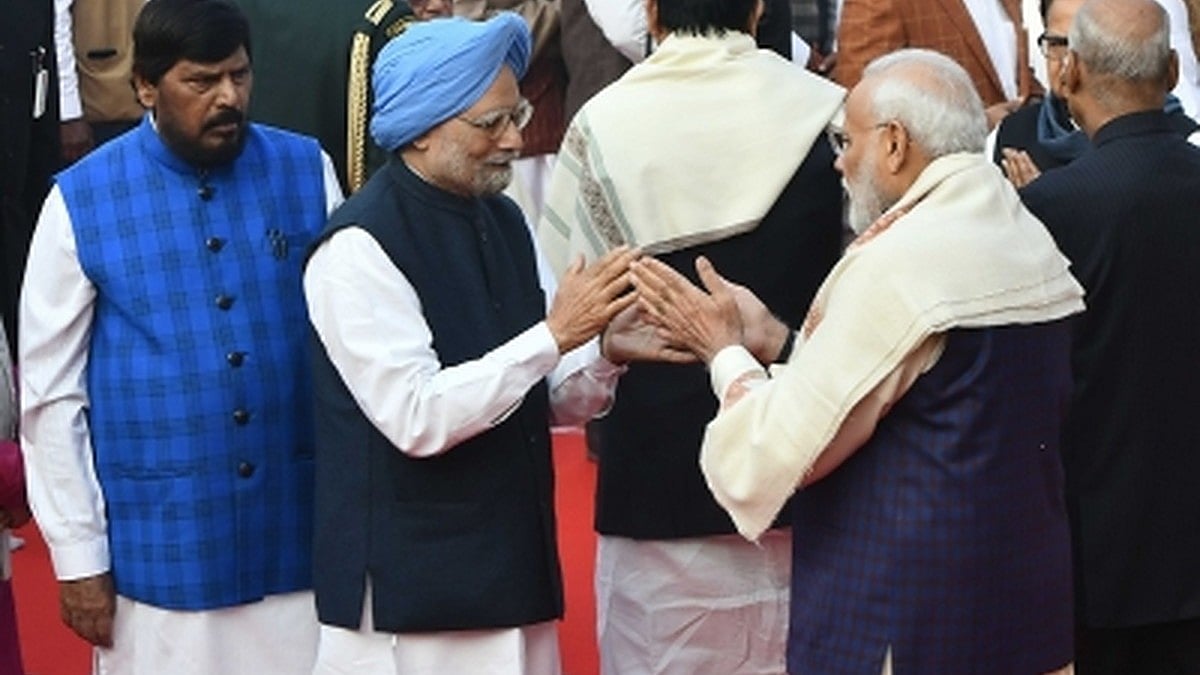
On 4 November 2013, then Prime Minister Manmohan Singh spoke to over 120 heads of Indian missions and outlined the five principles that defined his foreign policy. These were: First, recognition that India’s relations with the world—the major powers and Asian neighbours—were shaped by its developmental priorities.
Singh said that ‘the single most important objective of Indian foreign policy has to be to create a global environment conducive to the well-being of our great country’. Second, that greater integration with the world economy would benefit India and enable Indians to realise their creative potential.
Third, to seek stable, long term and mutually beneficial relations with all major powers. And to work with the international community to create a global economic and security environment beneficial to all nations.
Fourth, to recognise that the Indian subcontinent’s shared destiny required greater regional cooperation and connectivity.
Fifth, a foreign policy defined not merely by interests, but also by the values dear to Indians: ‘India’s experiment of pursuing economic development within the framework of a plural, secular and liberal democracy has inspired people around the world and should continue to do so.’
This was a clear exposition of what was sought to be achieved. India would use foreign policy to advance its economic development; it would be friendly with global great powers and its neighbours; and it would be helped in doing this by continuing to be a pluralist and secular democracy. I will not go into the present government’s foreign policy principles, mainly because it doesn’t have any.
This is not a smear or a casual observation and I have devoted a chapter in a book to explain why. It is in fact the case that the foreign minister not only accepts that our policy has no principles; he says that lack of principles is the basis of our policy.
In a book of his compiled essays and speeches, he has laid out what he means. What India wanted was a ‘multi-polar Asia’ meaning one in which India could claim parity with China. He offers no way of doing this, but assumes that we can merely because we desire it to be so. He writes that many balls would need to be kept in the air (Jaishankar has a fondness for stock phrases) and India would handle them with dexterity.
This was opportunism but that was all right because opportunism was India’s culture. The Mahabharata’s lessons, Jaishankar writes, are that deceit and immorality are merely to ‘not play by the rules’. Drona’s demanding of Eklavya’s thumb, Indra’s appropriation of Karna’s armour, Arjuna using Shikhandi as a human shield, these were but ‘practices and traditions’.
Inconsistency in policy was not only fine but required because ‘obsessing about consistency’ made little sense in changing circumstances. Here was a man who could put into words something that was insubstantial and make it sound reasonable.
But what was such a doctrine to be called? In a speech he made where he first laid out this doctrine of opportunism and inconsistency, Jaishankar said it is hard to give it a name. He takes up and discards the phrases — ‘multi-alignment’ (‘sounds too opportunistic’) and ‘India first’ (‘sounds self centred’).
He settles at ‘advancing prosperity and influence’, which he says is accurate but admits is not catchy. He believes some name for it will eventually come if it is pursued long enough, because part of the challenge is that we are still in the early phase of a major transition.
This was published some time ago, in the second term of this government. The world as we can see all around us, has changed. It has become uncertain and it has turned dangerous, especially for nations that are dependent, as we are, for energy and for external employment, especially in the Gulf.
US president Donald Trump has offered no real reason for starting this third American Gulf War and has articulated no real aims that he wants achieved besides tactical ones.
The minister handling America’s defence department appears totally unhinged and incompetent in his press briefings. How the war will conclude is not known to anyone because Iran has a say in how and when it will end. Israel’s involvement in the attack makes this war particularly alarming because it unlike America cannot just cut and run, since it is part of the region and armed with nuclear weapons.
What is to be done by India in this time and what is the policy to be adopted? Perhaps we will get by through what Jaishankar is saying we should do. And looking at what we are doing seems clear that we have proceeded along the lines of opportunism. Hours before the war, with an armada in place, we flew to Tel Aviv to receive a medal, endorsing what was to come.
We have shied away from condemnation of state assassinations, of the mass murder of schoolgirls and the murder of sailors without a declaration of war. Where we see opportunity, such as getting a couple of tankers out, we will take it.
We have no role in the larger making of peace or reestablishment of a rules-based order because our creed is opportunism and that means not shaping the world but taking short term advantage where we can.
Perhaps this will work, but equally it might not. And for this reason, we should be going back to first principles. Reconsidering what Manmohan Singh said about India’s external policy, what it was intended to achieve and for what reason is a good start.
Views are personal. More of Aakar Patel’s writing may be read here
Join our official telegram channel (@nationalherald) and stay updated with the latest headlines