Opinion
'Daro mat': Is the government scared that people are no longer scared?
Has the government miscalculated in handling the students’ protest movement?
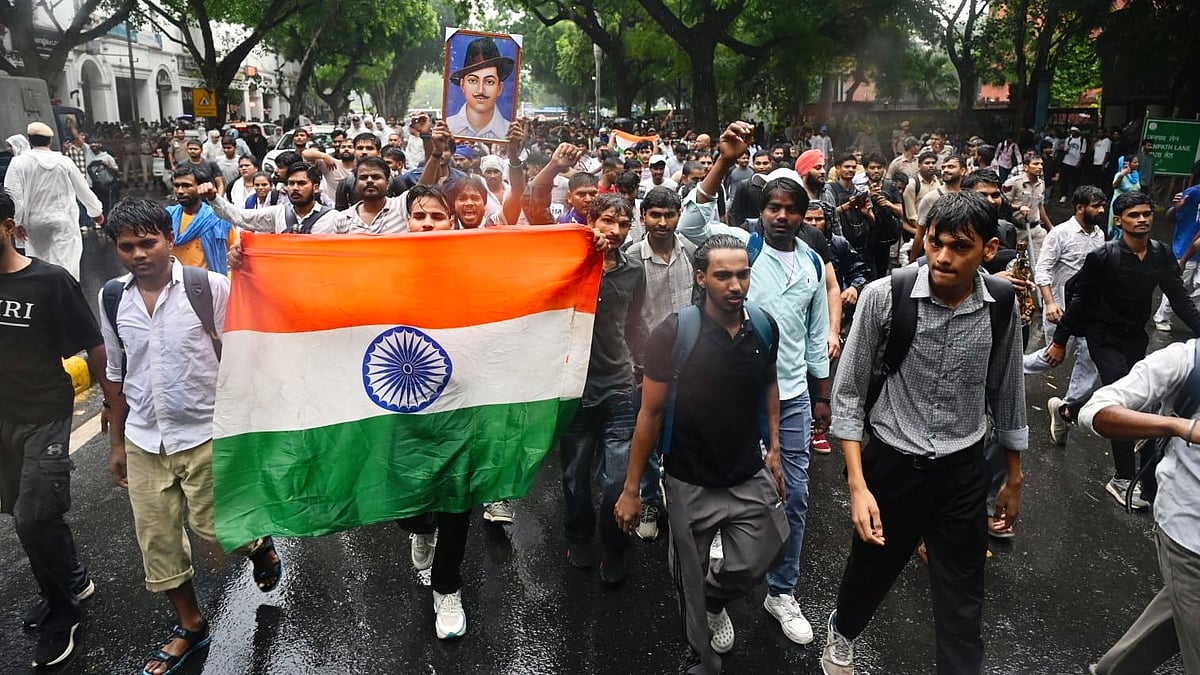
Nothing captures the mood in central Delhi on Monday, 20 July, better than this first-person account circulating on social media:
“A sea of people, a vibrant, beautiful wave of protesters demanding change and accountability! There were sporadic incidents of lathi charge and some people were forced into buses, but largely protesters managed to move ahead peacefully, with slogans of 'Bharat Mata ki Jai' and 'Vande Mataram'. Carrying the national flag, the Constitution, and photos of Ambedkar, Mahatma Gandhi and Bhagat Singh, they marched on. The police also mingled with the crowd and moved forward with them. The protesters were simply walking towards Parliament; nobody was using any force or violence against the police. This was the scene up until Sansad Marg police station, where more buses were stationed to prevent people from moving ahead.
“All this while, all the police did was try to push the people back. People still managed to move forward. Seeing this, the government could have decided to let the march proceed and allowed the MPs to meet the protesters outside Parliament. Eventually, spokespersons from the CJP did meet JP Nadda, and some MPs also set out from Parliament to meet the protesters. All this could have happened peacefully, without the need for force, violence, lathi charge or tear gas shelling. But the protesters managed to brave that as well. People were not scared anymore.”
A 16-year-old Class XI student, who was caned by the police, was heard asking disarmingly, "What was my fault? That I love my country?" He had arrived to take part in what he believed would be a peaceful march. He wept unabashedly, partly in relief that he would eventually return home.
In another viral video, a young man was seen being beaten by several policemen. The unarmed youth stood there saying, "Maaro sir, aur maaro", and the policemen obliged. Trinamool Congress MP Mahua Moitra shared another clip in which a few policemen could be heard abusing protesters and exhorting their colleagues by screaming, "Beat the motherf***ers."
The government seems to have mishandled the situation badly. It could have initiated a dialogue with Sonam Wangchuk and the Cockroach Janta Party (CJP) over the weekend to reach a settlement. It did not. The government could have allowed a delegation of around 100 protesters to march to Parliament and meet a group of ministers and MPs. It did not think that necessary.
It could also have invited the two CJP spokespersons to meet J.P. Nadda on Monday morning before Parliament convened and made a statement in the House that the demands were being looked into. The Union health minister did eventually meet the two spokespersons, but only after the morning sitting of Parliament had been washed out.
Delhi Police was clearly acting under instructions when it forcibly shifted Wangchuk to hospital on Saturday morning. The medical team from Dr Ram Manohar Lohia Hospital, which had been monitoring the fasting activist, was nowhere to be seen when he was removed.
Wangchuk was taken to Safdarjung Hospital, not to Lohia or AIIMS. The government's counsel also strongly opposed Geetanjali J. Angmo, Wangchuk's wife, when she approached the court seeking his release and permission to shift him to a hospital of her choice. The health minister could have met Wangchuk in hospital and then invited the youth for talks. He did not.
Similarly, on Monday, Delhi Police acted on instructions while preventing protesters from marching to Parliament. However, it appears to have miscalculated that removing the three prominent faces of the movement — Abhijeet Dipke, Ashutosh Ranka and Saurav Das — from Jantar Mantar would make it easier to disperse the crowd. Instead, the crowd swelled, broke through barricades and remained determined to march towards Parliament. The police then resorted to baton charges and tear gas to disperse the protesters, injuring several people.
Videos of alleged police brutality at Jantar Mantar and around Rajiv Chowk were widely shared on social media. Denials issued by Delhi Police have carried little conviction, and by Monday evening, reports were emerging from other parts of the country of spontaneous protests breaking out in solidarity.
Just when the month-long protest at Jantar Mantar seemed to be petering out, the Union government appears to have succeeded in breathing fresh life into the movement. The next few days will reveal how costly its handling of the protest proves to be.
Join our official telegram channel (@nationalherald) and stay updated with the latest headlines