


'Questioning those in power is resistance'
CJP's Parliament march reflected spontaneous public anger over alleged examination irregularities and the demand for accountability
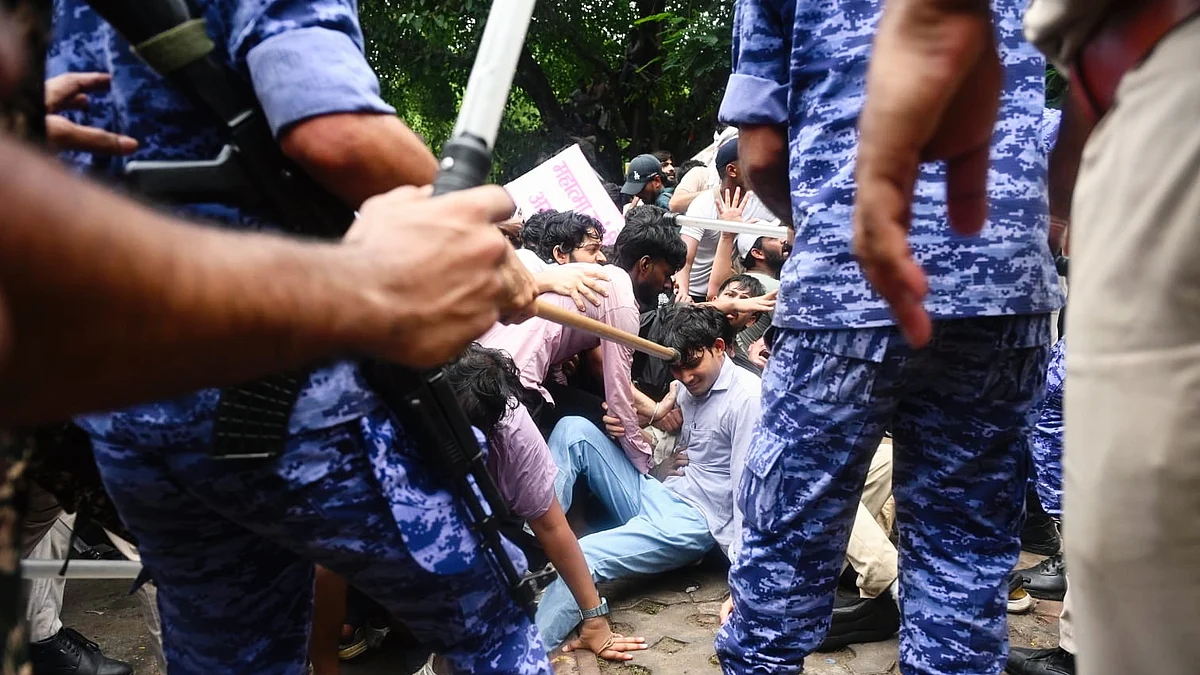


Despite Delhi Police making it clear on 19 July that the Parliament march called by the Cockroach Janta Party (CJP) and scientist-activist Sonam Wangchuk for 20 July had not been permitted, thousands of students and young people gathered at Jantar Mantar and surrounding areas, determined to press ahead with the protest.
Crowds had begun assembling at Jantar Mantar from Saturday itself. By Monday morning, Parliament Street, Jantar Mantar Road, Tolstoy Road, Jai Singh Road and Janpath were packed with protesters demanding that Prime Minister Narendra Modi accept responsibility for the alleged examination irregularities and seek the resignation of Union education minister Dharmendra Pradhan.
While the Parliament march had been announced by Wangchuk, many of those who turned up were not part of the month-long sit-in at Jantar Mantar. They said they had travelled specifically to participate in the march.
Fahreen, a young entrepreneur from Gurugram attending a protest at Jantar Mantar for the first time, questioned the government's silence. "More than 20 children have died by suicide, but the government seems unconcerned. Where is the accountability? Why doesn't the government come to Jantar Mantar and speak to us? This is the question everyone here wants answered," she said.
Many protesters said the gathering was not driven by any individual leader but by a collective demand for accountability. Throughout the morning, people occupied roads leading to Jantar Mantar, raising slogans, delivering speeches and sharing videos on social media. They said they had come of their own accord rather than at the direction of any political organisation.
Slogans such as 'Resign, Narendra Modi' and 'Resign, Dharmendra Pradhan' echoed through the crowd. Many participants said it was their responsibility as citizens to hold the government accountable. Anil Chaudhary, who travelled from Jhajjar in Haryana, described the demand for accountability as a "national duty", adding, "The country has awakened."
The intensity of the protest was evident as large numbers of demonstrators managed to reach areas close to Parliament despite heavy security arrangements. Videos shared by the CJP and political activist Yogendra Yadav showed protesters pressing ahead even though police had erected three layers of barricades on Sansad Marg (Parliament Street).
Protesters attempted to breach the barricades in the morning, prompting a baton charge in which several people were injured. Participants claimed that the sheer size of the crowd initially forced police to retreat before security personnel later resumed action.
Shashwat, a student from Laxmi Nagar in Delhi, said he had joined the Parliament march because the government needed to respond to demands for Pradhan's resignation. "The government should address the demand for Dharmendra Pradhan's resignation. Removing Sonam Wangchuk from the protest site without his consent was completely wrong. The protest was peaceful, yet action was taken without notice. This protest is entirely justified. The government must answer these questions. If it refuses to do so, then this cannot be called a democracy," he said.
Another young protester said if demonstrators remained united, the pressure could eventually extend beyond Pradhan. "If people stay firm, not just Dharmendra Pradhan but even Narendra Modi may have to resign," the protester said.
Protest organisers said public anger intensified after Delhi Police forcefully removed Wangchuk from Jantar Mantar on Saturday, 18 July. Before that, CJP leader Abhijeet Dipke and his colleagues had campaigned in Delhi and Pune to mobilise support for Wangchuk's hunger strike.
Jaswinder Singh, another participant, said he was not personally affected by the NEET paper leak but felt compelled to join the movement. "None of my children were affected by the NEET paper leak, but I have come here for the future of the country. We cannot wait until something happens to us personally before raising our voice," he said.
Praveen Vadhera, a theatre artist associated with Jan Natya Manch, described education as an issue that had united people across political ideologies.
"Education is one issue on which people from the Left, Congress and many other backgrounds stand together. Protests are taking place across the country, with people demanding accountability. The crowd that gathered today is not a hired crowd. It is a crowd asking questions, and in today's times, questioning those in power is itself an act of resistance. It will not be easy to suppress that resistance," he said.
Join our official telegram channel (@nationalherald) and stay updated with the latest headlines