Opinion
Trumpism after the midterms
Might a hamstrung US president become even more dangerous and erratic on overseas affairs?
It was an uncomfortable coincidence for the Narendra Modi regime that a United States civil court issued summonses on Indian national security adviser Ajit Doval and a former external espionage agency Research and Analysis Wing (R&AW) chief Samant Goel this week.
India’s ministry of external affairs predictably condemned the concerned case as a ‘frivolous lawsuit’ based on ‘fabricated and malicious’ charges. The matter pertains to an attempt to assassinate an anti-India Khalistan separatist in New York Gurpatwant Singh Pannun in 2024. In February 2026, Nikhil Gupta, 54, an Indian national, pleaded guilty of hiring for murder and is currently awaiting sentencing.
Prosecutors had alleged Gupta was directed by an official known as Vikas Yadav who worked in the Indian government’s cabinet secretariat (which houses the R&AW) to execute the plot. While this man’s indictment was apprehended, serving subpoenas to Doval and Goel is not only a major exacerbation in the legal proceedings, its timing is also being interpreted in some diplomatic circles in Washington as yet another pressure tactic by the US as its trade talks with India drag on.
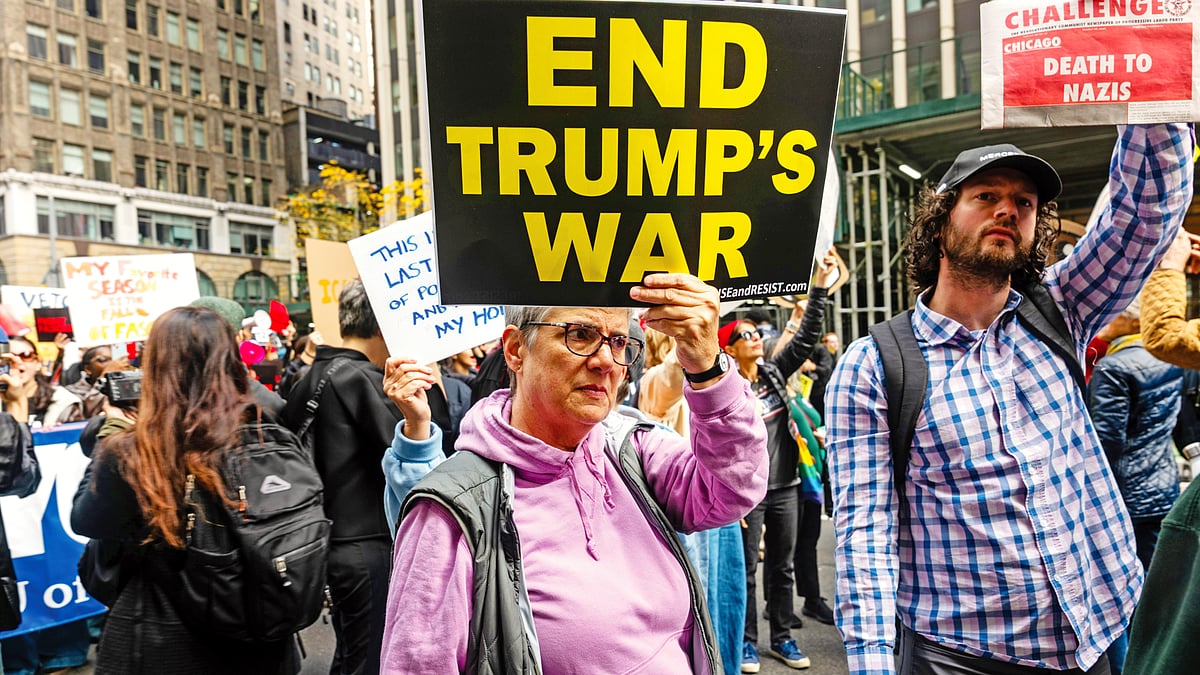
Preceding this development, there was, not unexpectedly, worldwide interest in the US midterm elections. It is, after all, still the world’s leading superpower, though rapidly conceding ground to China. Interest was enhanced by the fact that President Donald Trump had caused more turmoil in the world in the past two years than any of his predecessors.
The outcome mattered to many. Speculation abounded. Would the elections clip his wings? Could Congressional restraints make him more dangerous and erratic on overseas affairs?
Let’s begin with what the result might mean for India. For more than a year and a half, New Delhi has been harassed by crippling customs duties, demands for increased imports from the US and a threat of 100 per cent tariffs on Indian exports to the US if India continued to buy Russian crude.
Such aggressive behaviour by Trump has been analysed as being a consequence of weakness on the part of the Modi government; the kind of frailty no previous Indian administration had ever demonstrated. In simple terms, far from standing up to the bully, Modi was seen to have succumbed rather abysmally.
Without going into why that happened, let us examine whether the equation can change, now that Trump has received a thorough drubbing in the midterms. “Just imagine,” he said at rally after rally for a month, “just imagine I am on the ballot.” American voters did; and dealt him a deserving rebuke.
Columbia University economist Jeffrey Sachs told The Wire’s Karan Thapar: “What I’d say to my friends in India and friends anywhere is negotiate hard. This man doesn’t have the authority, nor does he have the political support to what he’s doing… hold your ground. Get a good deal. Don’t cave in… the American people don’t want tariffs. They don’t want the sanctions.”
Those are precisely the urgings consistently underlined in these columns since February 2025, when Trump delivered a somewhat unfriendly démarche to Modi: that India should exponentially multiply its purchase of US goods and services. The latter apparently acquiesced. The US Supreme Court struck down his April 2025 executive order which imposed tariffs on countries across the globe, including India. It will likely do the same to his renewed efforts to revive levies by other means. The lower courts have done so.
In these circumstances, if Modi continues to be browbeaten by a lame-duck Trump, it will amplify concerns that there is more to such weakness than meets the eye. What did Trump mean when he said in October 2025 that he can “destroy Modi’s career”? Why did a photo of a private meeting between Hardeep Puri, a minister in Modi’s cabinet, and the late convicted New York paedophile Jeffrey Epstein suddenly surface last month? Did Epstein visit Delhi in January 2017? Who met him? Such questions swirled around the District of Colombia.
Bloomberg headlined, ‘India Sees Some Trade Relief, New Risks After Democrat Sweep.’ Experts in Washington seem to believe the outcome of the midterms may motivate Trump to push harder for an early trade deal with India. They also feel India now has some elbow room to negotiate the nitty-gritty in the draft, which has made visibly slow progress for months now.
With a significant opposition Democratic majority — when the newly elected lawmakers enter the House of Representatives and Senate in January — Congress would be empowered under US laws to revise or cancel presidential executive orders; but that can, in turn, be opposed by a White House power of veto. In short, it is a recipe for a gridlock unless better sense prevails.
In such a situation, it will be tougher for Trump to whimsically escalate rates of tariff, which could be a relief for India’s garments and textiles, gems and jewellery sectors. At the same time, it might be wise for New Delhi to widen diplomatic outreach beyond the administration to Congress and the states which benefit from Indian exports.
Where Democrats and Trump’s Republicans may be united is in pushing for US agricultural and dairy products into the Indian market — a virtual death knell for Indian farmers. The smart money is on Trump’s electoral setback not necessarily making him any less protectionist.
Then there’s the matter of the new US law approved by Trump which holds the threat of slapping 100 per cent tariffs on India for its import of Russian crude. A Reuters file last month said implementation — in addition to an abeyance signed off by Trump — is linked to a US investigation into assessing whether excess production in various countries is damaging American businesses.
The US is India’s biggest export market. In 2025, reportedly $103.8 billion worth of Indian goods were absorbed in America, against US exports of $45.6 billion. The figures vis-à-vis services were $48.7 billion and $43.6 billion, respectively.
For the record, there is no prospect of the US easing H-1B visa restrictions on India, notwithstanding Trump admitting his harsh immigration policy was one of the reasons for the wipeout of Republicans in the midterms.
The mood swings of the US electorate this century defy evaluation. In 2001, after 9/11, they turned hostile towards Muslims. Turbaned Sikhs mistaken for being of the Islamic faith suffered too. Conservative George Bush was consequently granted a second term.
In 2008, US voters pivoted to not merely a liberal, but their first-ever Black president Barack Obama, a Christian with a Kenyan Muslim father. 2016 saw the election of Donald Trump, 2020 his rejection, 2024 his return. Two years later, his right-wing, undemocratic ways have been reproached to the extent of Egyptian-origin Abdul el-Sayed being voted in as America’s first-ever Muslim senator.
Internationally, most eyes will be on Trump’s moves on the US war against Iran and the Russia-Ukraine imbroglio. Many fear he will resume armed conflict with Tehran. Chances are that may not happen before the Asia-Pacific Economic Cooperation summit, a 21-nation gathering at Shenzhen next week. A meeting between Trump, Chinese president Xi Jinping and Russian president Vladimir Putin is being touted as a possibility on the sidelines.
Ashis Ray was editor-at-large of CNN, and is the author of The Trial that Shook Britain. More of his writing here
Join our official telegram channel (@nationalherald) and stay updated with the latest headlines