Opinion
Herald View: A litmus test for the Opposition
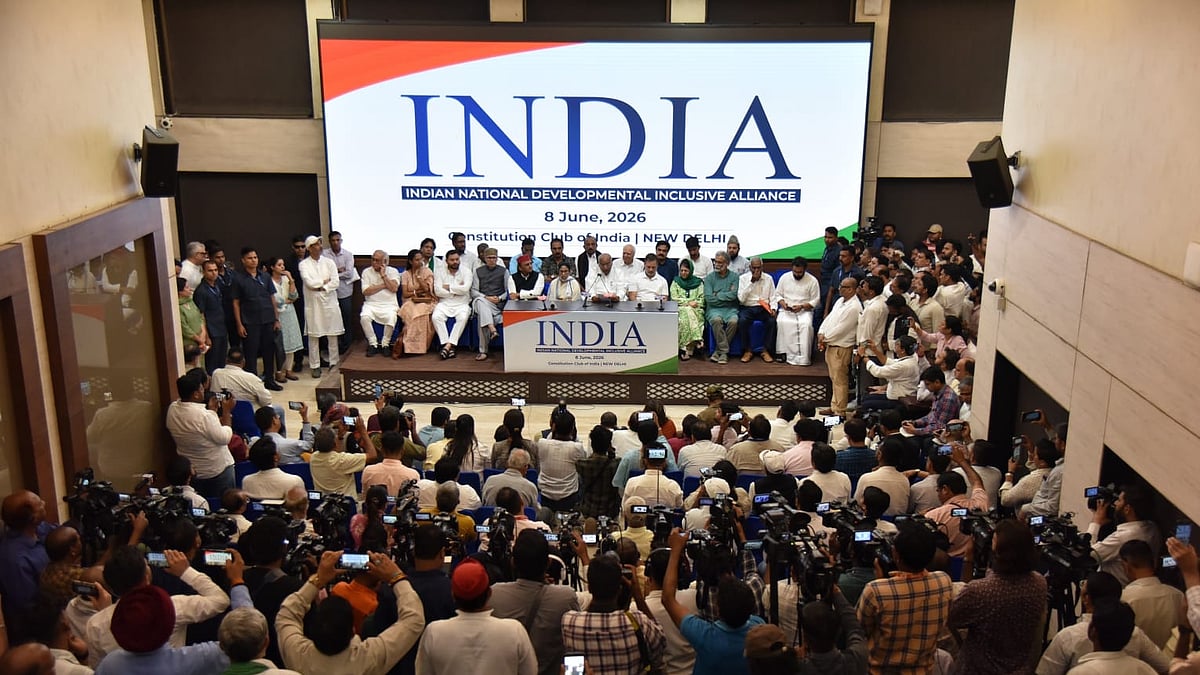
The INDIA bloc meeting on 8 June was a beginning. There’s still a mountain to climb
It was effective 2018, four years into Prime Minister Narendra Modi’s first term in office, that Sweden’s V-Dem Institute marked India’s descent into a state it describes as an ‘electoral autocracy’. That dubious classification has stuck ever since, though the democratic backsliding is, in fact, far worse than the label might suggest. In the 2026 edition of V-Dem’s Democracy Report, India is ranked #105 (out of 179 countries) on its ‘Liberal Democracy Index’.
For citizens who have watched this erosion with concern, then alarm and now a sense of resignation, the 2024 Lok Sabha elections had briefly offered a ray of hope. That was two years ago in June 2024, when a more well-knit Opposition than you see today was able to make common cause, push back credibly and stop the BJP from securing a simple majority in the Lok Sabha.
Again, just two months ago in April 2026, the same Opposition was able to foil the BJP+ government’s plans to push through a Delimitation Bill that threatened to dramatically undercut the representation of southern states in Parliament and undermine India’s federal compact.
In its all-too-transparent bid to concentrate power at the Centre, the BJP has also been pushing ‘One Nation, One Election’ and many other unitary variants of the same driving impulse.
The primary unitary formulation advanced by the BJP–Sangh is their foundational ideological slogan ‘Ek Desh, Ek Nishan, Ek Vidhan, Ek Pradhan’ (one country, one flag, one Constitution, one prime minister). This historical formulation traces back to the BJP’s predecessor, the Bharatiya Jana Sangh, and its founder Syama Prasad Mookerjee.
It has grown new tentacles in the Modi era, in the shape of One Nation, One Election (ONOE); One Nation, One Tax; One Nation, One Ration Card; One Nation, One Grid; One Nation, One Uniform and so on.
****
Even though the BJP returned to power in 2024, it drew some lessons from a victory that still smelled like defeat. It hadn’t managed to entirely steamroll the Opposition and had fallen way short of the crushing 400-plus majority it was sloganeering about before the elections.
In Uttar Pradesh, where it had just inaugurated the new Ram Mandir to declare a great civilisational triumph, as it were, it dropped to 33 seats (out of 80) while the Samajwadi Party bagged 37. It even lost the prestige seat of Faizabad, which includes the assembly segment of Ayodhya. That defeat stung.
After all its toolkit attempts to bribe, bully, break the Opposition, it still only managed to secure 36.6 per cent of the popular vote. Which tells you something about its real appeal with the population at large, though not enough about its disproportionate hold on the levers of power.
The big lesson the BJP drew from its 2024 performance was that it needed to do more to tighten its grip on power. It realised that after everything it had done so far, it was still not able to organically win enough support to secure the two-thirds majority needed to rewrite the Constitution. With the singlemindedness of a rampaging bull, it saw that the only way was to re-engineer the electorate itself, to do a comprehensive purge of the voter rolls, and ensure that this culling of voters was decisively net-positive for the BJP. Enter the SIR.
At its service in the project to reshape the electoral rolls, the BJP has the Election Commission of India (ECI), which presides over the SIR. Readers will know that the ECI is supposedly an autonomous, nonpartisan body, but the election commissioners are now (legally) chosen by a 2:1 ruling party majority, which turns the ECI into a government department, for all intents and purposes.
The new law came into being via The CEC and Other Election Commissioners Bill, 2023, which was passed in December 2023, ahead of the Lok Sabha elections in April–May 2024.
Under the new law, the chief election commissioner (CEC) and other election commissioners are appointed by the President upon the recommendation of a selection committee. The selection committee consists of the prime minister, a Union cabinet minister and the leader of the Opposition/ leader of the largest Opposition party in the Lok Sabha. The ECI has read the script and is duly reporting to its new master.
The state Assembly elections in Bihar (in November 2025, after SIR, Phase 1) and in West Bengal (in April 2026 after SIR, Phase 2) are both excellent test cases to demonstrate the intention and the effect of the SIR. At the end of Bengal’s SIR nightmare, the state’s count of eligible voters was ~90 lakh less than the pre-SIR baseline of 7.66 crore. In Bihar, 69 lakh voters were dropped.
Citizens who view these developments with alarm had hoped that the Supreme Court of India might step in to question all this and hold the ECI to account. But on 27 May, the Supreme Court gave a clean chit to the SIR exercise. The bench of CJI Surya Kant and Justice Joymalya Bagchi ruled that the SIR process was constitutional and well within the ECI’s statutory powers. It held that the SIR process is necessary to protect the integrity, accuracy and credibility of electoral rolls.
Phase 3 of said SIR is currently under way in the remaining 16 states and three Union Territories. The first two phases, covering 10 states and 3 UTs, saw 7.2 crore deletions (and 2 crore additions, as per the ECI). This is down 10.2 per cent from pre-SIR baselines; in other words, the exercise has disenfranchised one in every 10 Indian voters.
****
Although mainstream media practically blacked out all the evidence of targeted deletions and more suspect tampering with the voter rolls, there were enough reports (on this portal and media outfits like The Wire, Newslaundry, Scroll, The News Minute, Reporters’ Collective and others) and other exposés besides — like the ones by Rahul Gandhi on Mahadevpura and Aland in Karnataka — that demanded a thorough investigation.
There was enough evidence to create reasonable doubt that the SIR was compromised — and yet, instead of demanding some answers from the ECI, demanding that it come clean on the SIR, and refute the evidence that had been presented, the Supreme Court has chosen to stamp its approval on the process.
This should tell the Opposition that the elections are no longer a fair battleground to take on the BJP. It needs to find other means to fight the capture of Indian democracy, the capture of India’s democratic institutions, the capture of media and other means of communicating with the people.
Opposition leaders should remember that to fight this assault on free and fair elections, on our democracy, on our Constitution, on India’s pluralist character, they need to make common cause. They need to define a Common Threat Perception, much before they can formulate a Common Minimum Programme of governance.
To even have another shot at governance, they must first learn to swim together, to recognise true allies and Trojan horses, and to keep true allies onside. The INDIA bloc meeting on 8 June was a beginning. There’s still a mountain to climb.
Join our official telegram channel (@nationalherald) and stay updated with the latest headlines