Opinion
How to undermine elections, Assam style
No one was surprised by the timeline, and choreography, preceding the announcement of dates for the Assam assembly elections. We have grown used to it, writes Yogendra Yadav
Sir, I can tell you this with 200 per cent certainty. The election announcement won’t come before 14 March. And let me add this—whatever happens in the other states, elections in Assam will be wrapped up before 14 April.”
This was from about two weeks ago. We were crisscrossing Assam. I’d assumed that elections in four states would be announced end-February/early-March. When that didn’t happen, I called a political worker
in Assam.
He opened my eyes.
“Look, sir, the prime minister is scheduled to visit Assam on the 13th or 14th. He’ll make some big announcements. The Election Commission will wait for that, and only then impose the Model Code of Conduct. But after that, elections will be rushed through in Assam. This time, during Bihu, you’ll see Zubeen Garg’s photos everywhere, his songs playing—reminding people that the government never investigated his death. So, the BJP wants the elections over before Bihu begins on 14 April.”
And that is exactly how it played out.
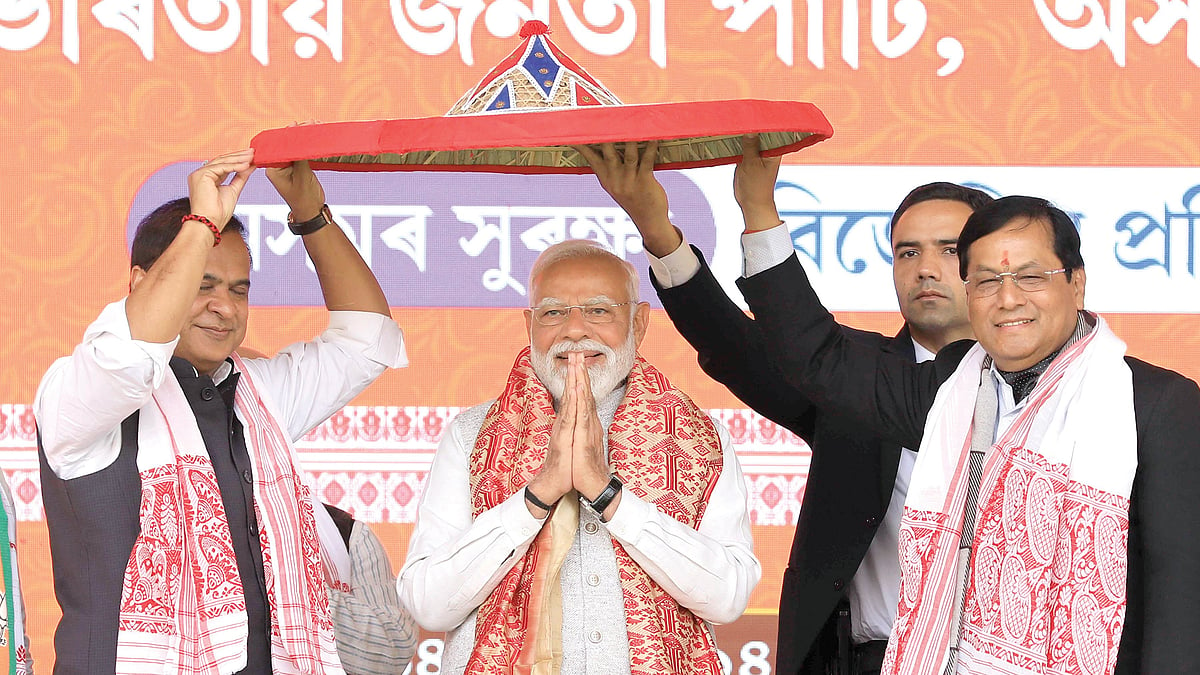
Prime Minister Modi visited Assam on 13-14 March. In two days, he announced dozens of development schemes for the state: released the next instalment of the PM-Kisan scheme, distributed land titles to tea garden workers, flagged off three new trains, laid the foundation for an expressway from Silchar to Shillong, and dedicated a new hydropower project—promised investments of Rs 47,800 crore just ahead of the announcement of poll dates. And in every speech, he lashed out at the previous Congress government.
The very next day—15 March—the Election Commission of India (ECI) announced elections in four states and the Model Code of Conduct kicked in. No one was surprised by the choreography—we have grown used to it.
We’ve grown used to another thing: just before elections, cash will be transferred directly into voters’ bank accounts as inducement. In keeping with this new tradition, Assam chief minister Himanta Biswa Sarma was suddenly overcome with concern for women’s welfare just ahead of the polls.
Under the state’s Orunodoi scheme, four million women in self-help groups receive Rs 1,250 a month. But this time, in an outpouring of concern, they’ll receive a lumpsum of Rs 9,000—six months’ advance, plus a Bihu bonus. Clearly, this year’s Bihu is special.
Last month, unemployed youth were also given a one-time payment of Rs 2,500 as ‘life inspiration’. Nobody asked what inspired this inspiration dole, not even the media that otherwise scoffs at ‘freebies’. Not even the Supreme Court, which often frets about the culture of handouts.
We’ve grown used to it.
We’ve also grown used to elections bringing with them a storm of lies, a downpour of hate, spatters of blood.
On this count, Himanta Biswa Sarma has outdone even Yogi Adityanath.
Sarma openly urged his party workers to ensure that the votes of ‘Miya’ Muslims are struck off in the revision of voter lists. He even claimed that his party had filed objections against five lakh such voters. Not stopping there, the chief minister called for an economic boycott of Bengali-speaking Muslim citizens in his own state—asking people to pay a ‘miya’ rickshaw puller Rs 4 instead of Rs 5, to harass them in every possible way.
On a television programme, the chief minister candidly admitted that he knows Bengali Muslims cannot be legally deported from Assam. “So I create pressure so that they leave on their own.”
If that still wasn’t clear enough, the Assam BJP released a video showing Sarma holding a pistol, aimed at a stereotyped ‘miya’ Muslim figure and a Congress leader seated beside him.
Not everyone, it seems, is inured to this kind of naked bigotry. They protested. The video was quietly taken down, but no action was taken for spreading hate.
Some naïve intellectuals in Assam made the mistake of approaching the Supreme Court against the chief minister’s statements. Ever ready to intervene in matters big and small, the court promptly sent them back—empty-handed—to Gauhati High Court.
They, too, will get used to it.
There is only one thing we are not yet used to.
In the United States, it is called gerrymandering—drawing electoral boundaries so as to ensure the victory of a particular party. We have learnt much from America but we hadn’t yet reached this stage of ‘development’. Assam has now crossed that threshold.
In 2023, parliamentary and assembly constituencies were redrawn in Assam. The order may have been issued by the Election Commission, but its meaning was spelt out by the chief minister himself. Right at the outset, he had declared that the delimitation exercise would reduce the electoral influence of ‘miya’ Muslims. Exactly what happened: the Election Commission carved out bizarrely shaped constituencies—some snake-like, others resembling crabs. The result: Muslim-majority assembly constituencies are down from 29 (out of 126) to 22.
This hasn’t been normalised yet in the rest of the country. Not every Indian knows this or is accustomed to this. But habits have a way of forming—we’ll get used to this too.
Views are personal. More of Yogendra Yadav’s writing can be read here
Join our official telegram channel (@nationalherald) and stay updated with the latest headlines