Opinion
The jackboot has replaced the ballot box
As civil liberties shrink and questions mount over electoral fairness, the symbols of Indian democracy no longer match its reality
On 5 March 2021, the Press Information Bureau of the Indian government put out a statement headlined: ‘Rebuttal to Freedom House report on India’s declining status as a free country’.
It was in response to a finding by the US think tank, founded in 1941, that India was not really democratic and was only ‘partly free’. This was one of many similar findings by several respected global institutions. We are focusing on this one because it elicited a response from the government.
The government’s statement opened with a defence of the electoral process and said: 'Many states in India under its federal structure are ruled by parties other than the one at the national level, through an election process which is free and fair and which is conducted by an independent election body. This reflects the working of a vibrant democracy, which gives space to those who hold varying views.'
This was dishonest. The Freedom House report had two parts. The first, given 40 per cent weightage, was on political rights. Here, India got a score of 34/40 (falling to 33/40 in 2023), including full marks for free and fair elections, election commission impartiality, freedom to start political parties and opportunities for the Opposition to increase its power.
In this part, India did not get full marks on whether voting was unhampered by violence and unaffected by communal tension. This is hardly arguable. In fact, the government even got 3/4 on transparency, which was probably overgenerous. The government’s response was therefore merely repeating what Freedom House had already said. Where India’s rating was hurt was in the other 60 per cent, for civil liberties, which are also a part of freedom.
Here, it performed poorly (33/60). On issues of freedom of expression, freedom of religion, academic freedom, freedom of assembly, freedom for NGOs to work (the report specifically named the government’s attack on Amnesty International India), the rule of law, independence of the judiciary and due process by police, India’s rating was poor.
But the scores merely reflected reality. The government appeared baffled by the results. It sought details from ministries about the parameters used by the Economist Intelligence Unit in downgrading India to a ‘flawed democracy’, though the report itself clearly says that the 'primary cause was an erosion of civil liberties' and the introduction of religion into citizenship laws.
The scores have dropped further in 2026, which is based on the events of 2025. Political rights are now at 31/40 and civil liberties at 31/60, the lowest scores India has ever received. One suspects that the events of the last few months will further damage the score, and our image. Why do I say that?
India was a democratic state because its institutions were intact and widely seen as neutral, reasonably efficient and usually fair. They were as good and as bad as the democratic institutions of most real democracies. That is what the Freedom House score represents.
To the question, ‘Was the current head of government or other chief national authority elected through free and fair elections?’, Freedom House thought that'executive elections and selection procedures are generally regarded as free and fair' and gave us a score of 4/4.
On the question, ‘Were the current national legislative representatives elected through free and fair elections?’, we also got 4/4, with the observation that 'elections were considered generally free and fair, though some violations of campaign rules were reported'.
A score of 3/4 came on the question, ‘Are the electoral laws and framework fair, and are they implemented impartially by the relevant election management bodies?’
And here is the critical paragraph, which says that the Opposition parties’ concerns 'intensified in 2025 as the government expanded its Special Intensive Revision (SIR) of the voter list, as carried out in Bihar, to 12 other states and territories. Among other things, the opposition has alleged that the ECI has unfairly deleted large numbers of voters from the rolls and prevented eligible voters from registering by introducing excessive verification requirements. Political analysts and opposition leaders have expressed concern that the SIR suppresses the opposition vote and disenfranchises Muslim and other minority voters. Government officials have rejected allegations of voter roll manipulation. The SIR remained underway at year’s end'.
This was last year.
On the question, ‘Do the people have the right to organise in different political parties or other competitive political groupings of their choice, and is the system free of undue obstacles to the rise and fall of these competing parties or groupings?’, India scored 3/4.
On ‘Is there a realistic opportunity for the opposition to increase its support or gain power through elections?’, again, we scored 3/4.
None of these scores make any sense now. They do not reflect our reality. The voter rolls have been mangled, the ECI is an arm of the government and hardly independent. Legislators are bought en masse, and it doesn’t matter who loses elections because the house always wins, as they say about casinos.
The beating that civil liberties have taken over the last few years showed up immediately; the erosion of primary institutions has taken slightly longer to register with observers, but it is now clear.
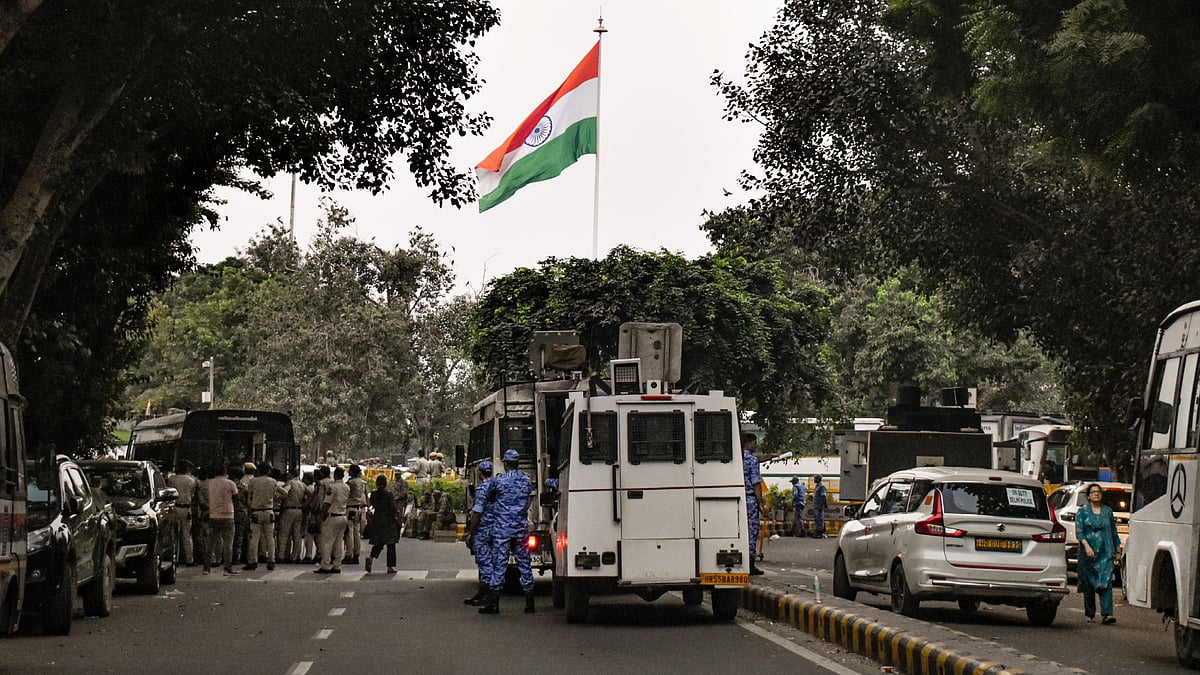
The jackboot of the state is a more honest symbol of the Indian state today than the ballot box.
Views are personal. More of Aakar Patel’s writing here
Join our official telegram channel (@nationalherald) and stay updated with the latest headlines