Opinion
India lost combat aircraft in Op. Sindoor
…and other damning highlights from the Asia-Pacific Regional Security Assessment report released end-May
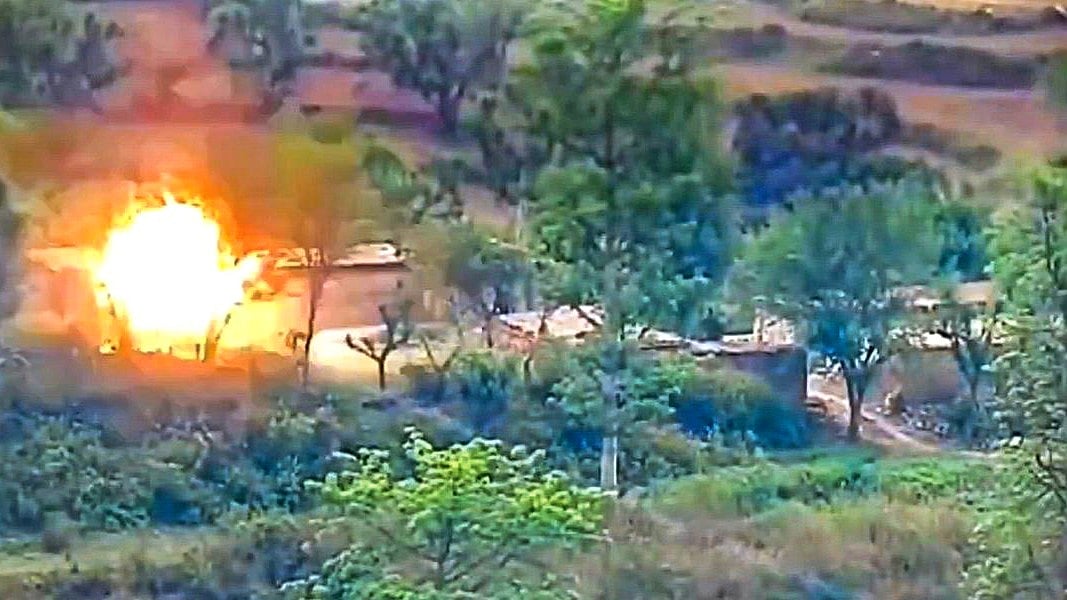
The International Institute for Strategic Studies (IISS), a leading London-based think-tank on military affairs, in its Asia-Pacific Regional Security Assessment (APRSA) reiterates that Indian combat aircraft were downed by Pakistan in Prime Minister Narendra Modi’s Operation Sindoor last year.
The APRSA analysis reads: ‘This new and third type of surgical strike (under Modi after 2016 and 2019) was an Indian Army and IAF (Indian Air Force) joint operation; the Indian Army struck targets close to the LoC or Indian border while the IAF struck more distant targets. Pakistan’s attacks were also unprecedented, with missiles and UAVs (unmanned aerial vehicles) targeting four air bases and civilian sites in India’s Punjab, Rajasthan and Gujarat states, in addition to downing Indian combat aircraft.’
The exposé regarding the Pakistani counter-attack on Indian air bases and in three Indian border states blows the lid off the concealment attempted by the Modi government.
In February, the IISS’s ‘Military Balance 2026’ report affirmed: ‘Open-source imagery has verified the loss of one Rafale EH (enhanced with advanced electronics).’ It also disclosed there were ‘Indian aircraft losses’, thereby underlining that more than one plane fell victim to Pakistani air-to-air missiles.
Neither Modi nor defence minister Rajnath Singh has, till date, owned up to the debacle. If anything, the civilian establishment in India has strenuously tried to brush it under the carpet.
Regarding India’s militarised borders with China and Pakistan, the APRSA summarises: ‘India’s conventional-threat perception in the Asia-Pacific will continue to centre on Pakistan and China. Any potential future “major conventional war” would remain local in nature… India’s border conflicts with China have been traditional in nature and are unlikely to escalate to the same level of the Indo-Pakistan conflicts, given China’s superior military capabilities in the border area and India’s reluctance to provoke it.’
The assessment concludes: ‘For India, the pacing challenge is a “hybrid” situation of “no war but also no peace” with China and Pakistan. Indian military doctrine continues to evolve…’ It added, ‘India is unlikely to play an active military role in the wider Asia-Pacific and will likely seek to avoid being drawn into a US-China conflict over Taiwan, for example.’
The appraisal of the India-China circumstances is this: ‘India and China fought in 1962 and 1967 (the latter was a success for India in Nathu La under the leadership of the Congress party Prime Minister Indira Gandhi) and engaged in conflicts or border stand-offs along the LAC (Line of Actual Control) in 1975 and 1986-87.
'They also partook in a stand-off in the Depsang Plains along the LAC (when Chinese troops withdrew within a fortnight under combined diplomatic and military pressure applied by the Congress-led government of Prime Minister Manmohan Singh) and even in 2014 during Xi’s first visit to India (when Narendra Modi was carelessly swaying on a swing with the Chinese president and signing security-breaching memoranda of understanding).
In 2017, security forces from both countries made a series of localised, low-level tactical moves in the high-altitude area of Doklam at the ‘tri-junction’ with Bhutan and India’s Sikkim state, escalating into a stand-off.’
It goes on to say: ‘June 2020 saw escalation, when four Chinese and over 20 Indian soldiers died during violent clashes in the Galwan Valley on their un-demar-cated, unresolved Himalayan border. This resulted in relations between Asia’s two largest nuclear-armed countries deteriorating to their lowest point since their 1962 war… Since then, China has joined Pakistan as India’s primary and long-term strategic and military challenge.’
China poses a heightened threat not only because of its increasingly assertive behaviour towards India and its military build-up along the shared LAC; but because of its solid commitment to Pakistan, as evidenced in the collaboration to blunt Modi’s Operation Sindoor.
‘India is also focused on securing the Indian Ocean region against threats from these two neighbours, as well as countering various non-traditional maritime-security challenges,’ the APRSA observes.
‘The Indian government has not publicly released or formally articulated a national-security policy or strategy, although some such documents have been circulating among policymakers. It reportedly has a “Union War Book”, for example, which remains highly classified.’
The report continues: ‘One important, though not comprehensive, nor the only signpost of how the military possibly intends to fight a future conventional war is the 2017 “Joint Doctrine: Indian Armed Forces”.
While each armed force has its own doctrine, this document encompasses India’s approach to wars in the land, air and sea domains and is the most recently released public document covering all three services. The document emphasises the growing focus on jointness with the Indian Armed Forces and best encapsulates its potential modern war-fighting plans.’
But ‘jointness’ — which envisaged integrated theatre commands and an integration of the army, navy and air force — has, the APRSA notes, been hindered by ‘reservations among specific armed forces’.
India’s primary military objective as spelled out in the document is: ‘[to] prevent war through strategic and conventional deterrence across the full spectrum of military conflict, to ensure the defence of India, our national interests and sovereignty.’
For India’s defence forces, ‘strategic interests in regions along our northern, western and western borders and sensitivities along the Line of Control (with Pakistan) and Line of Actual Control are to be protected with effective deterrent capabilities… our land borders and the Indian Ocean region (IOR) remain central to India’s growth and security.’
The 2017 doctrine states: ‘India has moved to a proactive and pragmatic philosophy to counter various conflict situations. The response to terror provocations could be in the form of “surgical strikes” and these could be subsumed in the sub-conventional portion of the spectrum of armed conflict…
'Conflict will be determined or prevented through a process of credible deterrence, coercive diplomacy and conclusively by punitive destruction, disruption and constraint in a nuclear environment across the Spectrum of Conflict. Therefore, undertaking “Integrated Theatre Battle” with an operationally adaptable force, to ensure decisive victory in a network centric environment across the entire spectrum of conflict in varied geographical domains, will be the guiding philosophy for evolution of force application and war fighting strategies.’
The document also stresses that future wars would be fought in ‘the space, cyber and special operation domains’. It notes that ‘the fast pace of technological advancement precludes military modernisation process implying that, a constant endeavour in this direction needs to be sustained to maintain a right balance between obsolescence and new technology’.
Before Modi’s bombastic approach, significant Indian military strikes across the LoC occurred without publicity. This is confirmed by the APRSA report: ‘During the 1999 Kargil conflict with Pakistan, the Indian military was ordered (by BJP Prime Minister Atal Bihari Vajpayee) not to cross the LoC, even though such punitive strikes had taken place before. But in 2016, the Indian government acknowledged a previously covert operation which did cross the LoC for the first time.’
The APRSA comments that cyber-security elements were evident in last year’s Indo-Pak hostilities. ‘These included disinformation campaigns, hacktivist groups launching retaliatory campaigns and reports claiming that Pakistan’s military cyber wing disrupted a communications network in India.’
It elaborates: ‘The military-on-military direct cyber operations may have been limited, at least as publicly reported. But India also used the space domain for ISR (intelligence, surveillance and reconnaissance) as well as C2 (command and control).’
As per the APRSA, ‘India used UAVs and missiles extensively in the 2025 conflict, employing them in a way not substantially covered in its 2017 doctrine. However, this does not necessarily mean that India’s future warfare will feature them in similar ways: how India will fight next is a difficult question to answer for those outside the government.’
Ashis Ray was formerly editor-at-large of CNN, and is the author of The Trial that Shook Britain. More of his writing here
Join our official telegram channel (@nationalherald) and stay updated with the latest headlines