Opinion
The true worth of affecting Hindu brotherhood
The religious symbolism of Balen Shah’s India visit does little to pull Nepal into India’s geopolitical orbit
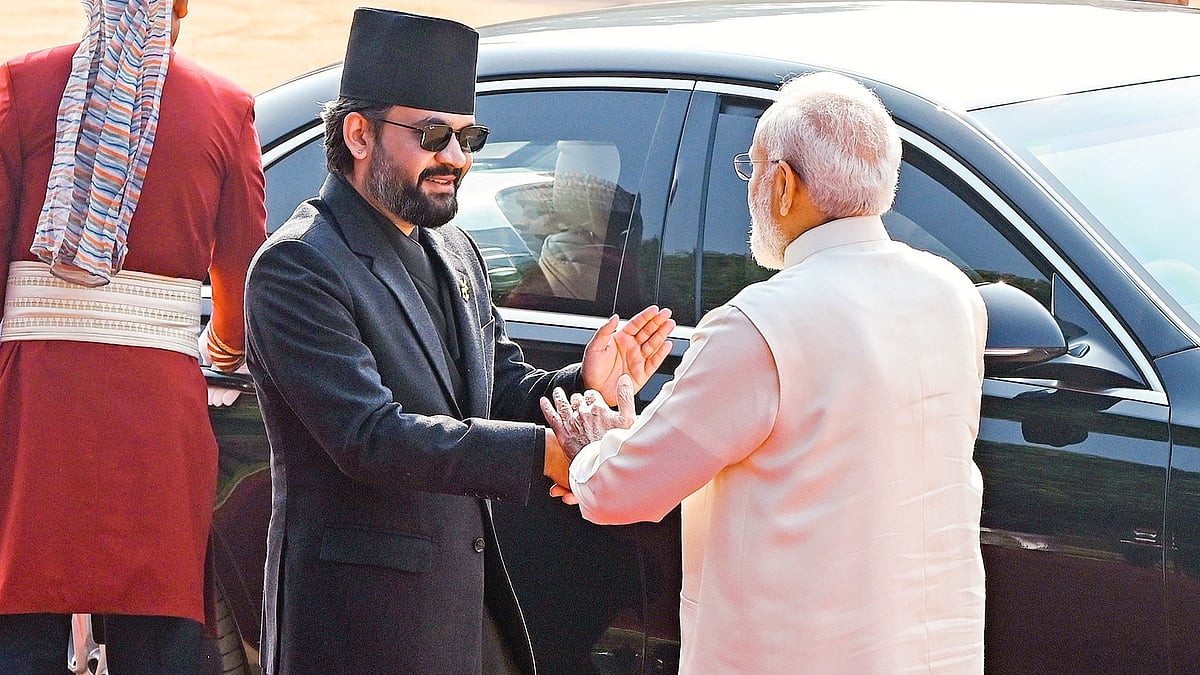
When Nepal’s Prime Minister Balendra Shah presented Narendra Modi with sacred rudraksha beads and a shaligram (fossilised stone considered sacred by devout Hindus and found in the upper reaches of Nepal’s Kali Gandaki river), and Modi reciprocated with holy water from the Ganga, both were invoking a civilisational and religious connection between their countries.
The inauguration of a train connecting Ayodhya, the birthplace of Rama, with Janakpur, the birthplace of Sita, reinforced the messaging. But beyond these choreographed gestures, Balen Shah’s visit on 22-23 November did little to change the political and geopolitical realities that have hobbled India-Nepal relations for years.
For Modi, hosting Balen was a political necessity. The rapper-turned-politician represents a generation of Nepali leadership with which New Delhi has limited familiarity and considerably less leverage. His rise following the youth-led uprising against Nepal’s established political class has disrupted India’s traditional channels of influence in Kathmandu. His overwhelming electoral mandate makes it difficult for the Modi government to deal with him as it often has with his predecessors.
Balen’s decision to make India his first bilateral visit since he became prime minister in March may give Modi some diplomatic satisfaction but interpreting that choice as Nepal’s geopolitical realignment would be a serious mistake.
The religious messaging was politically convenient for both leaders. For Modi, projecting India’s relationship with Nepal through shared Hindu heritage sits comfortably with his politics and worldview.
For Balen, religious diplomacy was an easy way to generate goodwill without making any strategic concessions. His decision to speak in Nepali at the joint press conference, departing from the practice of several predecessors — who spoke in English — also appealed to his domestic constituency. But that his choice of language should dominate the headlines at home also says something about how little the visit produced otherwise.
The failure to reach a comprehensive agreement on air connectivity was indicative. Nepal has long sought additional entry routes through Indian airspace to make its expensive international airports at Bhairahawa and Pokhara commercially viable. India agreed to convert the existing Kathmandu-Bhairahawa-Lucknow route into a two-way corridor, subject to technical consultations. However, Nepal’s more important demand for western access through Mahendranagar remained unresolved due to India’s strategic mistrust.
According to reports in the Nepali media, India sought permission to use Nepali airspace for military aircraft operating from Bagdogra. Kathmandu was reportedly prepared to accommodate civilian flights but not military aircraft. The Modi government has, through its ‘sources’, denied making such a proposal, but there was no agreement on Bagdogra airport, whose proximity to the strategically sensitive Siliguri Corridor gives the negotiations a geopolitical significance beyond civil aviation. The Bagdogra request was New Delhi’s attempt to test Nepal’s willingness to accommodate India’s security concerns vis-à-vis China.
Balen’s reluctance to accommodate these concerns indicates that his government is unwilling to sacrifice Nepal’s strategic autonomy for improved relations with India. His nationalism should not be confused with hostility towards India or allegiance to China. Nepal’s economic and geographical realities make cooperation with India unavoidable, but its relationship with China provides an important counterweight to overdependence on India. The photo-op with Modi should not be read as a strategic commitment against Beijing.
The growing reluctance among Nepali politicians to be identified as pro-India is largely a consequence of the Modi government’s policies. The memory of the 2015 blockade, perceptions of Indian interference in Nepal’s constitutional process and the enthusiasm in sections of India’s Hindutva ecosystem to restore Nepal’s Hindu statehood have generated considerable resentment.
Balen, too, has to answer some difficult questions at home. As Kathmandu’s mayor, he displayed a map of Greater Nepal in his office and repeatedly criticised Nepal’s political leadership for failing to defend the country’s territorial claims.
Yet, as prime minister, he returned from New Delhi without securing any substantial commitment to resolve the disputes over Kalapani, Lipulekh, Limpiyadhura and Susta. The instruction to foreign secretaries to address outstanding boundary matters essentially repeats the commitment made during Modi’s first visit to Nepal in 2014. In fact, the 2014 statement was more specific in identifying disputed territories.
Nepal’s concerns over the 1950 Treaty of Peace and Friendship remain largely unaddressed. Neither the suspended recruitment of Nepali Gurkhas into the Indian Army following the introduction of the Agnipath scheme nor the revival of SAARC, which Nepal chairs, received meaningful attention on this visit. Nepal’s trade deficit and the non-tariff barriers restricting its exports also remain unresolved.
The most publicised achievement was India’s announcement of a development assistance package of 240 billion Nepali rupees (approx. $1.6 billion), following the devastating August floods. Nepal had reportedly sought $2 billion, half of it in grants. India offered about $377 million in grants, the remainder consisting of concessional loans for energy projects.
Kathmandu has good reasons to be sceptical of Modi’s funding promises. Following the 2015 earthquake, India pledged $1 billion in reconstruction assistance, including $750 million in concessional loans. Much of the loan didn’t come through because of restrictive procurement conditions and cumbersome approval procedures. Unless the conditions attached to the new package are substantially different, Indian assistance could again serve the commercial interests of select Indian companies more than the reconstruction needs of Nepal.
Even the announcement of additional transit facilities deserves attention. Nepal had requested access to Dhamra and Mundra ports, but India offered Kandla and Paradip instead. For Nepali businesses, access to additional ports means little without regular freight trains to the dry port in Birgunj, competitive freight charges and simpler customs and transit procedures. The economic benefits of these arrangements remain uncertain.
Balen Shah’s visit has established a working relationship between two prime ministers who barely knew each other, but it was no diplomatic breakthrough. Nor did Modi manage to pull Nepal into India’s geopolitical orbit vis-à-vis China. Balen avoided making strategic concessions to India, but his electoral mandate makes heavier demands than simply securing the goodwill of the Indian prime minister.
India’s long-term interests would be better served by a prosperous and strategically autonomous Nepal than by a dependent but resentful neighbour. For that to happen, the Modi government must change its approach towards Nepal rather than expect every new Nepali leader to change Kathmandu’s approach towards India.
Ashok Swain is a professor of peace and conflict research at Uppsala University, Sweden. More by the author here