Opinion
What the ECI’s backdoor changes don’t fix
Gyanesh Kumar is still around and there is no sign yet that the judiciary will revisit its clean chit to the SIR
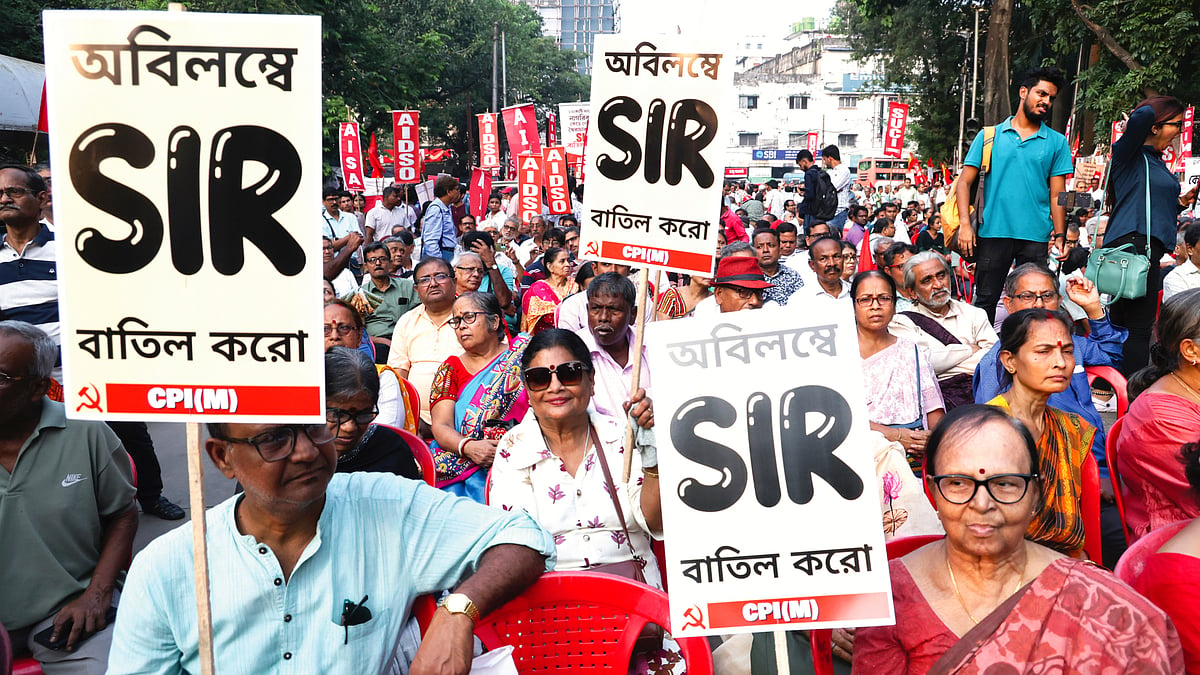
Street protests are giving the Election Commission of India (ECI) sleepless nights. Facing mounting allegations of ‘vote chori (theft)’, the Commission is scrambling to change its rules. Its latest U-turn concerns voters in Delhi, Maharashtra, Haryana, Andhra Pradesh, Jharkhand, Telangana and Nagaland who were classified as ASDD (absent, shifted, dead or duplicate) during the special intensive revision (SIR) and struck off electoral rolls.
They are now being asked to fill in fresh enumeration forms and submit in writing their reasons for failing to do so the first time. Meanwhile, after the public outcry over the SIR became impossible to ignore, the Commission is conducting a special summary revision (SSR) in 23 states and Union Territories . A special summary revision right after a special intensive revision! Even if some names are restored after this SSR, who will vouch for the integrity of the process and the new rolls? Surely not the same ECI?
Former deputy election commissioner Noor Mohammad says, “The Commission is indirectly finding new ways to scrutinise a voter’s eligibility. Nobody has the authority to demand a statement from a voter and, in the process, change the conditions for being recognised as a voter.”
Under the Representation of the People Act, 1950, the eligibility norms are simple: a person must be an Indian citizen and at least 18 years old. Yet the ECI is demanding additional explanations from voters deleted by none other than the ECI. On what legal basis?
The Commission’s retreat began only after citizens, civil society organisations and the Opposition started clamouring unitedly for the resignation of CEC Gyanesh Kumar, for the scrapping of the SIR, and a reversal of the changes to the 2023 law governing the appointment of ECs (which also grants them lifelong immunity from prosecution). As the public turned up the heat on the ECI’s opaque and arbitrary functioning, it hurriedly started chopping and changing its own (arbitrary) rules.
Yet Gyanesh Kumar stays firmly ensconced and there is no sign yet that the judiciary will revisit its clean chit to the SIR. Reassuringly, though, the agitations in the national capital and beyond have demonstrated beyond doubt that citizens are now alive to the shenanigans of the ECI under Gyanesh Kumar.
There are several serious charges against the Commission: wrongfully deleting over 13 crore names from the electoral rolls, tinkering with Form 6 without parliamentary approval, using the ECINet platform to centrally control the electoral rolls and conspiring to manipulate elections held in the aftermath of the SIR.
The Form 6 controversy is particularly revealing. Prescribed under the Registration of Electors Rules, 1960, Form 6 is a statutory document that only the central government can formally amend. Yet during the SIR, the Commission added an additional declaration to its online version, asking voters for details linking them or their parents and grandparents to earlier SIR electoral rolls.
As revealed in the Indian Express report (23 September), two election commissioners, Vivek Joshi and S.S. Sandhu objected. Following sustained criticism, the ECI finally removed this declaration from the online Form 6 on 21 October.
Worse, existing voters whose names had disappeared from draft rolls were being forced to submit Form 6 to seek re-enrolment. Form 6 requires applicants to declare that they are seeking registration for the first time and are not registered in another constituency. Voters rightly feared that signing it would amount to a false declaration, inviting prosecution under Section 31 of the Representation of the People Act.
On 3 November, the ECI declared that previously registered voters excluded from the SIR draft rolls could submit Form 6 without facing action. Which law or code entitles the ECI to now issue this guarantee after first illegally modifying the form itself?
The issue reached the Supreme Court during hearings on a petition filed by transparency activists Anjali Bhardwaj and Amrita Johri. The court observed that enumeration forms or Form 8 should be used to restore existing voters’ names, rather than forcing them to make false declarations.
In a statement on 7 November, the Voter Adhikar Manch asked why the latest corrective measure applied to only seven states. What about states where the SIR is already complete? West Bengal has even held elections using rolls prepared through this exercise. The organisation demanded that original EPIC numbers be restored and ‘left out’ voters reinstated in every state where the SIR was conducted.
It warned that wrongful deletions cannot be buried under the revision of the revision. In Delhi, where the SIR allegedly deleted one in three voters, a missive issued midway through the process cannot undo the damage. The only credible remedy is to withdraw the flawed SIR in toto and conduct a fresh exercise through transparent, public audits at the booth level.
The U-turns extend to its IT operations as well. New modules and portals being developed under director general (IT) Seema Khanna will now have to pass through a committee of officers before being submitted to the ECI for approval. Joshi and Sandhu had objected that these systems were being developed without their knowledge. Khanna has also been instructed to route files through the senior deputy election commissioner rather than send them directly to the ECI.
Both Joshi and Sandhu had demanded an audit of ECINet. On 14 October, the ECI constituted a committee, headed by a senior deputy election commissioner, to examine whether the platform complies with relevant laws and regulations. Proposed changes will apparently give grassroots officials greater authority and autonomy. Special drives have been ordered in states where the SIR is complete, alongside the SSR now under way.
But these administrative ‘adjustments’ are no more than cosmetic.
On 30 October, Yogendra Yadav placed seven questions before the public that the Commission is yet to answer:
1. Who took the decision to conduct the SIR?
2. How did the ECI alter Form 6?
3. How did the Commission transfer the powers of electoral registration officers (EROs) to its IT division?
4. Who filed 16 lakh cases in West Bengal?
5. Which software determined logical discrepancies during the SIR?
6. How were large numbers of Form 7 applications filed simultaneously, and how could an official file Form 7?
7. If the SIR is complete, how are Form 8 applications still being accepted? Such a case occurred in Pilibhit. What guarantees it has not happened elsewhere, and why does the Commission’s system have no mechanism to prevent it?
Nikhil Dey, a social activist associated with the Mazdoor Kisan Shakti Sangathan, says the agitation will continue. “The entire process of adding and deleting names operates within a government-controlled framework. BLOs and EROs are government employees. The Election Commission listens only to the government. We therefore demand a public audit of electoral rolls three months before every election. The Commission must publicly read out names and explain who is being marked as shifted and who is being deleted. Only this can restore the confidence of citizens and political parties.”
Dey makes another fundamental point: “Suppose the SIR is cancelled and a ‘good’ chief election commissioner is appointed. Even then, the citizen’s future stays in the ECI’s hands. That is something we cannot accept.”
Can the ECI duck accountability by announcing a series of U-turns before the forthcoming assembly elections? Noor Mohammad is unequivocal: “Patchwork will not work. The Election Commission has weaponised Forms 6, 7 and 8. A particular political party is supporting this entire process. Public trust cannot be restored unless the entire exercise is cancelled. Ideally, the entire Commission should be replaced. Why is the government not taking the initiative? The Election Commission has run out of options.”
The point is inescapable: an institution entrusted with protecting the citizen’s right to vote cannot keep changing the rules, deleting names and offering belated clarifications without answering for its actions. Public trust cannot be restored through administrative patchwork. The ECI must answer for the damage already done.
Join our official telegram channel (@nationalherald) and stay updated with the latest headlines