Opinion
Switching to organic farming is no walk in the park
PM Modi wants India's farmers to “move to 50 per cent organic farming” as part of his austerity drive. But that, says Jaideep Hardikar, is not easy
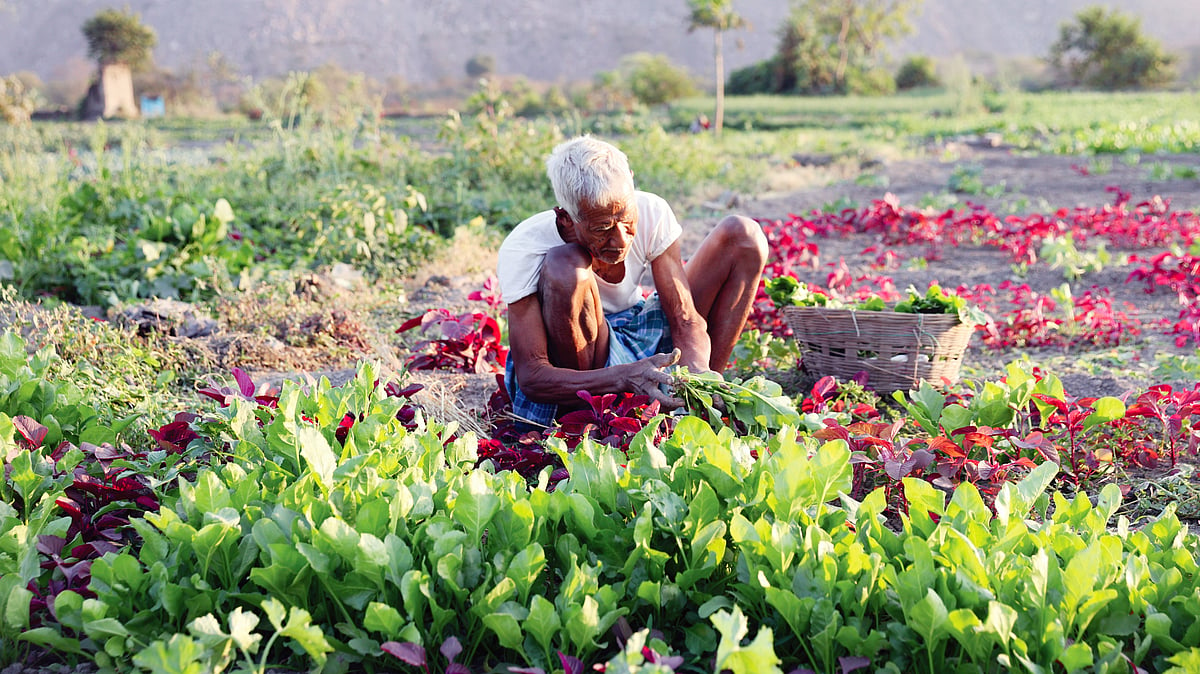
With the assembly elections to five states done and dusted, and Assam and West Bengal in the bag for the BJP, Prime Minister Narendra Modi decided it was time to ask Indians to brace themselves for price shocks and other crises emanating from the war in West Asia. As always, the onus of sacrifice was on citizens — don’t buy gold, use less oil, work from home... All too familiar exhortations to exercise restraint and discipline and take patriotic responsibility.
He had one for farmers too: to “move to 50 per cent organic farming”. But is the switch such a cinch?
It takes seven to ten years to move from chemical-intensive agriculture to organic — or sustainable — farming. The transition, as this writer has learnt in conversations with tens of thousands of farmers across the country, comes with big risks and massive shocks — sudden drops in production, spikes in labour wages, pest attacks, uncertain inputs...
The consensus is that while productivity stabilises over time, change requires constant guidance and services that are not available in the market. While India has some 400 definitions of organic farming in different regional languages, the agriculture science fraternity has not yet adopted it as a system of production.
By and large, organic farming has spread in India through community-based organisations, NGOs and, in some cases, highly motivated individual farmers, rarely through public institutions or universities.
At first glance, Modi’s proposal to make a big switch to organic farming may seem ecologically sound. The crisis in Indian agriculture is real — farmers have had it rough for decades. Excessive use of chemicals has irreparably degraded soils, contaminated groundwater, reduced biodiversity and trapped farmers in expensive input-intensive systems. Few serious environmentalists would deny the urgent need for more sustainable agricultural practices.
The latest 2026 report by the Research Institute of Organic Agriculture (FiBL) and IFOAM Organics International shows that organic agriculture spans nearly 99 million hectares in over 180 countries, involving 4.8 million producers. The global organic food market has grown to nearly 145 billion. India, with four million hectares, has one of the world’s largest numbers of certified organic farmers, topped by Australia with 53 million hectares.
The report does not consider farmers who practise organic farming but are not certified. In India, for instance, the Participatory Guarantee System (PGS) is used by millions of farmers as a process of certification for domestic consumption, in addition to the third-party certification usually required for export.
In India and worldwide, organic farming is a small fraction of the overall production ecosystem, but it is growing. For instance, India is a leader in organic cotton. Ditto for millets. Millions of small farmers in tribal and lagging geographies use less chemicals and are de facto organic, but not certified by any of the expensive and difficult certification systems.
Note the gap though, between the first and the second. Australia has a systemic approach; India does not. Our problem is policy — or the lack of it. Farmers want to switch away from chemicals, no one needs to preach at them. What they await is policy support to do so.
As G.V. Ramanjaneyulu of the Centre for Sustainable Agriculture (CSA) in Hyderabad, one of the most ardent advocates of sustainable farming practices, puts it: “Farmers have done everything in the past 20 years to increase their incomes and switch to sustainable practices.” They have tweaked their cropping choices, learnt organic practices, invested time and money and shouldered the risks during the transition.
With public institutions and systems overwhelmingly leaning on modern i.e. industrialised agriculture, organic farmers cannot compete in volatile markets.
“It is the Indian Council of Agriculture Research (ICAR) and agriculture universities that must be asked to institutionalise organic farming research and strategy,” he says. “Policy must support the farmers who practise non-chemical agriculture production systems.”
Over 25 years, the CSA has steadily organised farmers in Telangana and Andhra Pradesh under its cooperatives and farmers’ produce companies, helping them switch from chemical to organic or integrated pesticide management systems, under Sahaja Aharam, a brand of its own.
Yet, challenges remain: remunerative prices, access to markets, quality inputs, knowledge support and so on. Ramanjaneyulu says policy hasn’t evolved to support farmers who made the switch; prices, credit flows, input markets remain stagnant; and the science of organic farming has not yet been institutionalised.
“Chemical farming systems have all the pillars in place: public institutions push it, banks and financial institutions support it, and markets latch it up,” he says. For farmers to switch from one system to the other, they need similar pillars. “Who will provide those? What kind of knowledge systems are needed for the switch? These are critical issues that need government backing and strategy.”
A farmer cannot switch to organic farming or stop using chemicals because someone says so. Before the prime minister tells farmers to feel the moral obligation and bear the burden of the transition, he must put policy and systems in place.
The PM (and his cabinet) must answer some of these questions for farmers to practise what he preaches. What is the timeline for the transition? Under which procurement structures? Through what extension systems? What kind of financial support? How are they to absorb transitional yield losses? How will certification be managed? What happens to small cultivators already trapped in huge debt? How will states compensate for lower output during conversion years? Who will bear the economic risk of experimentation?
These are not technical details. They are the difference between grandstanding and implementation.
****
For a sobering lesson, we need look no farther than Sri Lanka. In 2021, the Sri Lankan government abruptly banned the import of chemical fertilisers and aggressively pushed the country towards organic farming. The decision was wrapped up in ecological jargon and national pride.
The results were disastrous. Crop yields fell sharply. Tea production suffered severe losses. Food shortages ballooned. Inflation spiralled. Rural distress deepened.
The lesson from Sri Lanka’s experiment with organic farming is not that it’s impossible or undesirable, but that agricultural practices cannot be altered overnight through executive fiat. These transitions require years of preparation, scientific planning, farmer consultation, market redesign, transition finance and decentralised adaptation to local ecological realities. Many organisations have done the spadework in India. We can learn from their experiences. Sikkim moved to a fully organic model, but farmers in the state did not benefit economically.
Ecological transitions are extraordinarily complex processes that cannot be reduced to moral exhortation from podiums. Agriculture is not theatre. Soil systems do not obey slogans.
Wars disrupt oil supplies, inflation rises, currencies weaken, uncertainty spreads across markets. Prudence, moderation, even austerity can become necessary. But what distinguishes democratic leadership from political theatre is whether sacrifice is evenly shared or selectively imposed.
By now, we know the most reliable way to understand this regime is not to listen to what it says but to observe what it does. For over a decade, structural crises in India have repeatedly been translated into moral obligations for citizens. Recall the prime minister’s exhortations during the demonetisation of 2016 and the COVID-19 pandemic of 2020.
Now, geopolitical instability is being converted into another sermon on austerity instead of a serious national conversation about sustainable agriculture, fossil fuel dependence, resource conservation and ecological repair. That responsibility cannot be delegated downwards to already vulnerable citizens.
Jaideep Hardikar is a senior Nagpur-based journalist and author of Ramrao: The Story of India’s Farm Crisis. Read more by him here
Join our official telegram channel (@nationalherald) and stay updated with the latest headlines