Opinion
The age of the angry young woman
She won’t give in, shut up or go away. She’ll fight back, stand up and be counted
There is an interesting story about Amit Shah’s first election victory, narrated by journalist Rajdeep Sardesai in his book 2024: The Election That Surprised India. Shah was then a student and an ABVP (Akhil Bharatiya Vidyarthi Parishad) candidate in a college election. His principal rival was a woman, and she was popular.
More importantly, the college had a sizeable number of women voters. Shah and his supporters feared that if the election became a straight contest, he would lose. That was when the young Shah apparently devised a strategy.
His associates obtained the telephone numbers of some of the girls’ homes. (Those were the days of the landline!) Their parents were telephoned and warned that on polling day there might be trouble on campus. The warning had the desired effect. Some parents apparently decided not to send their daughters to college that day. The number of women voters consequently fell and, in what was reportedly a close contest, Shah won.
Sardesai recounts the episode not as a moral lesson but as illustrative of the tactical mind of a man who would eventually become one of India’s most powerful politicians.
The attempt here is not to discuss the ethics of that particular victory but to imagine what would happen if such a manoeuvre were tried today. I suspect the result would be very different. If someone attempts to frighten her, today’s young woman will ask: Who is trying to frighten me, and why? And if someone tells her to stay away, she might do exactly the opposite!
The age of women who suffered quietly, went home crying, and tried to forget what made them cry is rapidly disappearing. The Indian woman, particularly the young Indian woman, is more confident, more conscious of her rights and much less prepared to accept intimidation as destiny.
We have enough examples of women who challenged male power. Jhansi’s Rani Lakshmibai fought the British to protect her kingdom. In Tamil literary tradition, Kannagi challenged a king and demanded justice for her wronged husband. Such women were exceptional because the society around them was overwhelmingly patriarchal. Today, the exception is becoming the norm.
That shift can be seen on the streets. When the Citizenship Amendment Act became a major political issue, women were at the forefront of protests across the country. Young women students from campuses such as Jamia Millia Islamia and Aligarh Muslim University confronted the police and refused to be silenced.
Then came Shaheen Bagh. Women, many of them elderly and from modest backgrounds, occupied a public space in Delhi and dug in for weeks. They faced criticism, vilification, threats. Yet they refused to move. The protest eventually had to be suspended because the Covid-19 pandemic brought the country to a standstill.
But by then something important had happened: Indian society had seen women occupying the centre of a political movement. The lesson was unmistakable: women would no longer retreat simply because men in authority told them to.
The farmers’ agitation reinforced the point. When farmers from Punjab and elsewhere were stopped at Delhi’s borders during their protest against the three farm laws, women stood right beside them, through scorching heat, rain and a bone-chilling winter. They were not decorative additions to a predominantly male movement. They were an integral part of it.
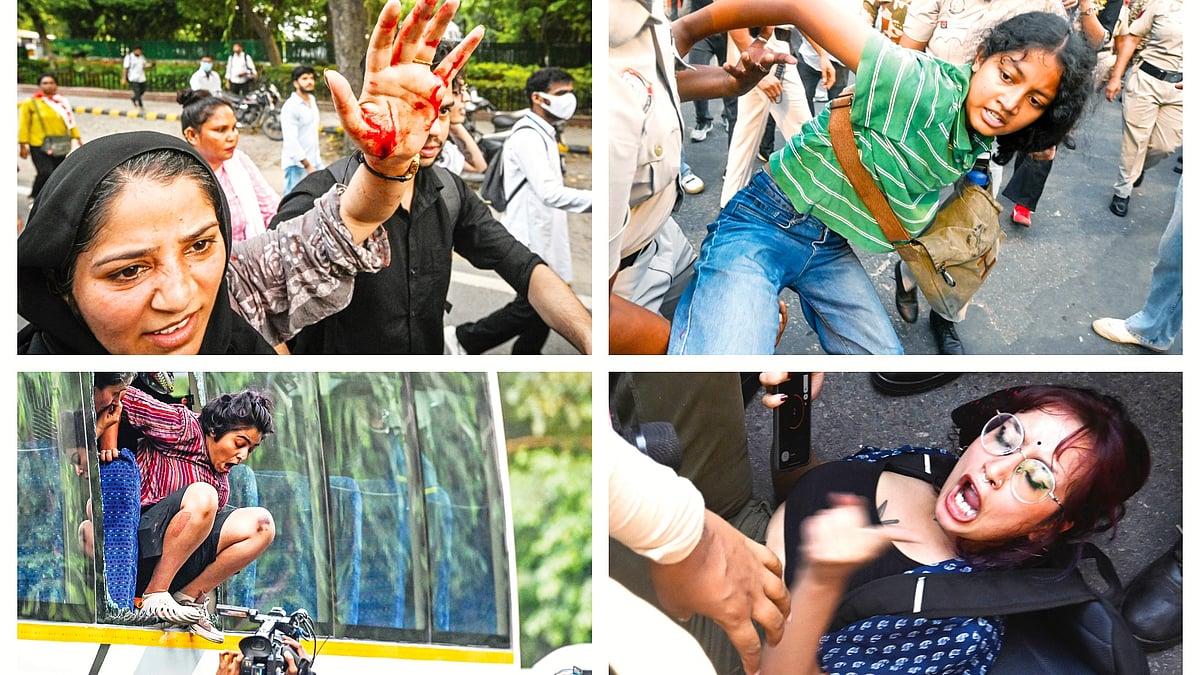
And then came the students. Their agitation demanding the resignation of Union education minister Dharmendra Pradhan revealed a new generation of young women, confronting barricades, resisting attempts at dispersal, laughing in the face of police force.
Initially, the government underestimated them. That was a costly mistake. As was the brutal backlash unleashed on peaceful protesters. The students returned, stronger than before. Dharmendra Pradhan resigned. Right now, we are witnessing another confrontation between the young and the establishment. This time the issue is the Election Commission of India and chief election commissioner Gyanesh Kumar.
The controversy over the Special Intensive Revision of electoral rolls has assumed enormous proportions. More than 13 crore names were dropped from draft electoral rolls across 30 states and Union Territories. Painted into a corner, the ECI has ordered special drives in 20 states and Union Territories to identify and enrol eligible voters who have been ‘left out’.
For the protesters, this is not a technical exercise in electoral housekeeping. It is a question of the fundamental democratic right to vote. And once again, the young women are at the frontlines.
What is striking about the videos and reels circulating is not merely their anger but their refusal to be intimidated by the uniform. Girls can be seen shouting back at policemen, refusing to move when ordered, demanding to know under what authority they are being pushed away.
Some hold their ground even when surrounded. Others record everything on their phones. They do not lower their voices. They do not avert their eyes. They reveal their belief that the uniform does not automatically confer moral authority. The police may have physical power, but the girls have the power of visibility, solidarity and public opinion.
They are not the clichéd embodiments of suffering and sacrifice portrayed in Indian cinema once upon a time. These women wear jeans, shorts. They carry smart-phones. They speak the language of constitutional rights. They know the camera is watching. They know that an act of police excess that might once have disappeared into a station diary can now become a national story within minutes.
One incident during the present agitation is a dramatic illustration. Rosy, an independent journalist, alleged that she was sexually harassed by an IPS officer during the protest. She publicly detailed her experience and demanded action. Other journalists subsequently went to the police station with her and pressed for an FIR. The police have denied some of the allegations, but the complaints have been forwarded for investigation.
There was a time when a woman subjected to such humiliation might have been told not to make a scene. Her parents might have worried more about the family’s reputation than about the conduct of the man who violated her dignity. She might herself have wondered whether speaking out would destroy her ‘character’.
Those days are going, going, gone. Today’s vocal woman is not merely defending herself. She is refusing to accept the old social contract in which women were expected to carry the burden of male misconduct in silence.
Interestingly, many of the young women appearing at the protests in Delhi are from neighbouring states like Uttar Pradesh, Haryana and Rajasthan. Many are accompanied by their parents. This is significant. They are not necessarily rebellious daughters who have escaped from home. They have the support of their parents. That means the transformation is deeper than a student movement. It is a social movement.
There is an unforgettable line in one of the videos circulating from the Delhi protests. A girl asks the policewomen who have told her to leave the protest site: “Who are you to remove me?”
After all, the land she stands on and the air she breathes do not belong to the police. They belong to all of us.
The police may wear the uniform. The government may control the machinery of the State. The Election Commission may hold constitutional authority. But none of them owns the Republic.
The Republic belongs to its citizens — this is what the young women are telling us. And that is why the story of Amit Shah’s first election is worth remembering.
A.J. Philip is a senior journalist and activist. Read more by this author
Join our official telegram channel (@nationalherald) and stay updated with the latest headlines