Opinion
The revolt of the Cockroaches
Even amidst a big media blackout, social media videos reveal how the movement is echoing across India
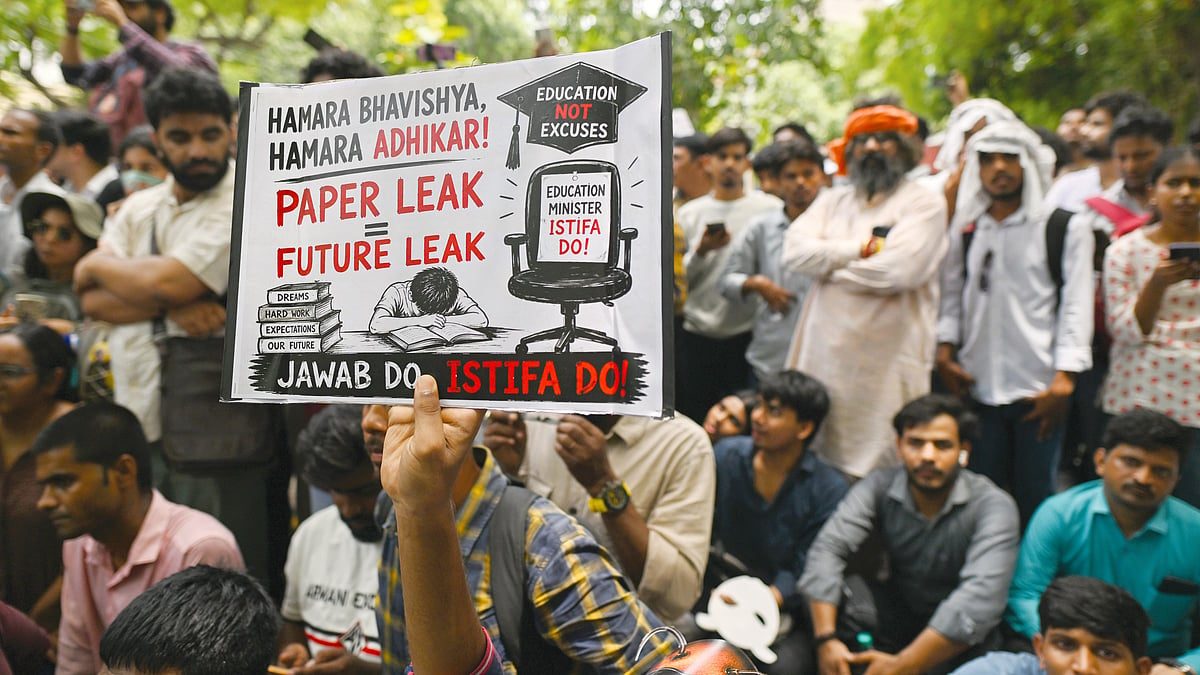
I don’t remember exactly when the viral phenomenon of the Cockroach Janta Party first caught my attention. Of course, I had been following the NEET paper leak crisis, like so many others. By then, we had already grown wearily accustomed to the recurring spectacle of paper leaks under the present regime. From 2014 onwards, India had witnessed dozens, perhaps over a hundred, reported incidents of exam paper leaks.
According to an analysis published in The Wire, there were 148 documented cases of exam fraud between 2015 and 2026, nearly double the rate seen before 2015. A Newslaundry analysis of suspected leaks, where FIRs were filed or examinations cancelled, estimated that these scandals had affected the lives of at least 6.5 crore candidates. But that particular wound came later.
What truly drew me in, almost at once, was something deeper. On their satirical website, founded after the Chief Justice of India had called activists ‘cockroaches’ and ‘parasites’ — an accusation he later denied — CJP founder Abhijeet Dipke had framed the movement as the ‘Voice of the Lazy & Unemployed’ and set out five demands.
I liked the irreverent cheek of throwing the insults right back at the powerful. These demands reached beyond exam scandals into something larger: the slow, almost imperceptible erosion of India’s liberal democratic order.
They pointed to the leanings of certain judges, the Election Commission’s conduct through the SIR process, the open trafficking of political turncoats by the ruling dispensation, the brazen partisanship of large sections of the media, and the sinister act of pushing for delimitation disguised as a 50 per cent women’s reservation in legislatures. In essence, they addressed the quiet unravelling of the country’s democratic institutions, a decay evident to anyone still possessed of honest judgment.
I was heartened, in a quiet way, to see so many young people converge, even if only virtually, around these concerns. When millions began following the Cockroach Janta Party on Instagram, a platform that belongs above all to the country’s youth, it felt significant. I found myself returning to their page from time to time, watching the numbers climb.
Still, like many others, I resisted reading too much into it. Such waves of online indignation, I told myself, tend to flare up brightly and then vanish, swallowed by the internet’s ceaseless tide.
When Abhijeet finally returned to India on 6 June, many of us feared for his safety. We had seen how activists linked to past protests had been targeted, detained, or silenced under one pretext or another. I remember watching him arrive at the airport, holding a copy of Ambedkar’s book in his hands — a Dalit student who had done well in his studies, deliberately invoking Ambedkar. The messaging was not very subtle, and I quite liked it for that very reason.
When he and a small band of his colleagues began their campaign from Delhi’s Jantar Mantar, surrounded among others by left-wing student activists, and demanded the resignation of education minister Dharmendra Pradhan over the NEET scam, I felt cautiously optimistic, but cautious nonetheless. Ours is a generation that has seen how meteoric rises of civil society protests can sometimes be co-opted by right-wing forces.
Many of my friends began comparing it to the Anna Hazare movement, viewing it as little more than a buffer. They had reason to be sceptical. Many had watched their hopes dashed after that earlier agitation, which in no small measure helped pave the way for the current dispensation.
But there was a marked distinction they seemed to overlook. The Anna Hazare movement could only benefit the BJP, as it was the principal opposition at the time. How could a movement directed against the BJP itself serve right-wing forces?
There was another crucial difference. I remember the Anna protests clearly. There was an element of stage management, the hand of RSS mobilisation plainly visible, the media pushing the narrative without pause. Here, however, the pliant mediascape was largely critical, even hostile, towards the CJP-led movement. Yet I remained sceptical, as anyone would be of a movement that seemed to emerge almost instantaneously, drawing widespread support while its principal players had been largely unknown only months earlier.
The growth was modest at first. Abhijeet drew decent crowds in the rallies and gatherings he joined across India, but nothing suggested the scale that would follow. From 20 June, he began an indefinite sit-in at Jantar Mantar with a small group of friends, comrades, and a motley gathering of people that steadily grew. By then, the protest was beginning to catch national attention, drawing a steady stream of visitors from opposition parties, civil society groups and ordinary citizens from around the country.
On 28 June, activist and educationist Sonam Wangchuk joined and began a hunger strike along-side left student leaders, which brought significantly larger crowds and made the movement increa-singly difficult to ignore. They had somehow touched a nerve.
But what happened after roughly one month changed everything. Thousands of students and youth joined the march towards Parliament on 20 July. School and college students had virtually laid siege to the capital. Videos emerging from across India revealed a movement of far greater scope and scale than the Anna Hazare agitation, persisting even amid a media blackout and systematic crackdown. Its quiet spread into small towns was unlike anything I had witnessed in a very long time.
The way protesters have remained camped in Delhi, even after brutal police crackdowns involving lathi charges, water cannons, tear gas and pellet guns, has led many to compare it with the youth-led protests in neighbouring countries like Bangladesh, Nepal and Sri Lanka. If spontaneity, scope and breadth are markers, the comparison is not far-fetched.
Yet in a vast country like India, it is unlikely that anything on the scale of our neighbours is possible. Although Abhijeet and others have consistently denied any intention of toppling the government through extra-parliamentary means, the comparison persists.
It is too early to predict the outcome of the protest or to draw exact parallels. But it is important to understand that the reason for its rise goes beyond its immediate demands. The protestors can perhaps see through the dichotomy of absolute right-wing dominance and the making of a demagogue out of Modi, even as the reality of their own lives sharply contradicts that image.
Here is a generation that has grown up with the internet and artificial intelligence, juggling precarity with a far broader knowledge of the world than any before it. And the erosion of liberal democratic institutions meant street protest opens up the only possible route out of the precarity of the situation.
Would I now allow myself to be optimistically hopeful about the protest? Would it end in a damp squib, be crushed by the might of the State, or fizzle out once its immediate demand is met? Would it surprise us in ways we cannot yet foresee? I do not think anyone has a clear answer. But one thing cannot be denied, even by the greatest naysayers: we are witnessing something historic.
Dwaipayan Banerjee is a documentary filmmaker, film festival organiser and educator
Join our official telegram channel (@nationalherald) and stay updated with the latest headlines