Opinion
The Vande Bharat paradox
The attempt to impose a modern superstructure on a crumbling infrastructure is not peculiar to the Railways alone, writes Avay Shukla
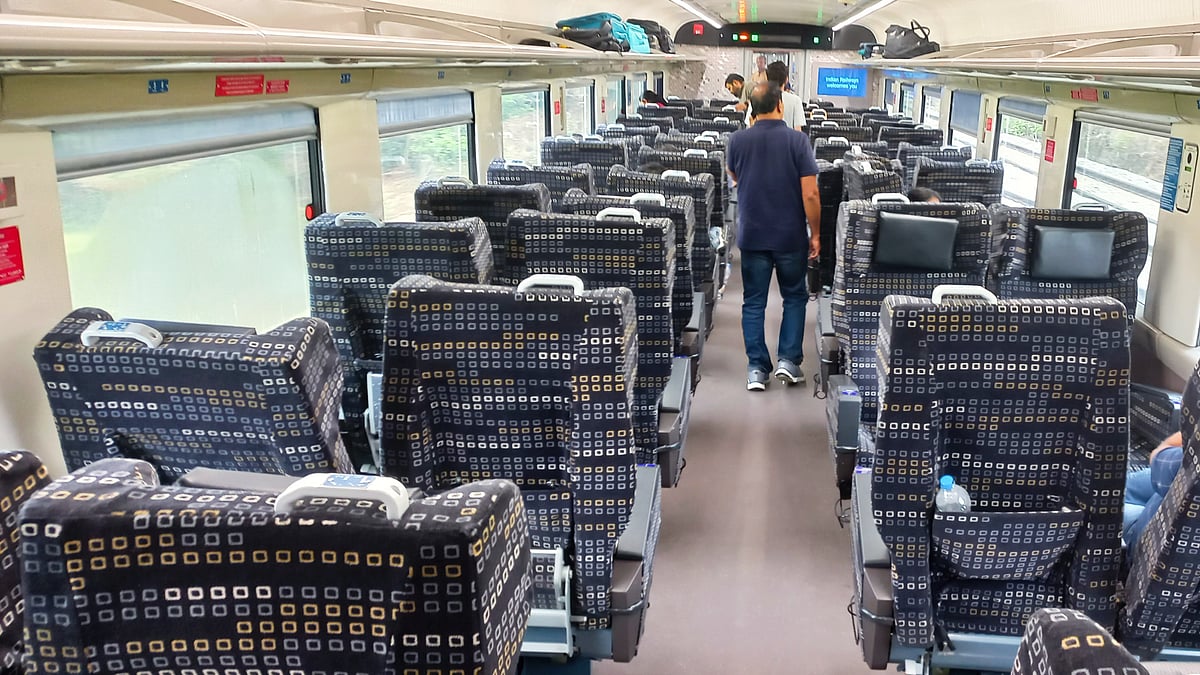
The Vande Bharat stable of trains is the pride of the Indian Railways, and deservedly so. Their coaches are state of the art, comprising the best in the world in technology and comfort, rivalling air travel at a fraction of the cost. Each set of 16 coaches costs about Rs 130 crore, ten times the cost of an average train; the Railways runs 75 pairs of these trains currently, but plans to raise that number to 4,500 by 2047.
However, the Vande Bharat has an Achilles heel — designed to run at 200 kmph, its average speed is only 76 kmph, no better than the Rajdhani or the Shatabdi of much more ancient vintage, negating its very purpose and expenditure.
Outdated track and signalling technology has simply not kept pace with the more modern rolling stock, not to mention poor maintenance and anti-collision systems and overloaded train schedules. Proof of this lies in the statistics: in the 11 years ending 2023, there were 678 train crashes, resulting in 1,061 deaths (ref. National Crime Records Bureau).
If one were to quantify all accidents — such as people falling off trains or walking on the tracks or mishaps at railway crossings etc. — the figure for just 2023 is a mind boggling 24,678 accidents and 21,835 deaths.
This is the Vande Bharat Paradox — the attempt to impose a modern superstructure on a crumbling infrastructure without proper preparation or 360º planning, driven by misplaced priorities and a publicity-seeking paranoia. And this is not peculiar to the Railways alone, it pervades all our development parameters and sectors.
Take our highways. At 146,204 km, India has one of the largest networks of national highways in the world, and this is expanding at 45 km per day, having increased by 60 per cent since 2015. Mr Gadkari boasts that by 2030, we will rival the USA.
In length perhaps, but not in quality, for the Vande Bharat paradox is at play here too. The groundwork for such rapid expansion has not been done: the roads are of poor quality, cars and drivers not suited for high-speed expressways, and enforcement wanting. The proof, again, lies in the statistics.
There were 1,72,000 deaths in accidents in 2024-25, with an astonishing AGR of 9.8 per cent. We record 2,247 deaths per million vehicles, as against 814 for China and 141 for the USA: our highways are corridors of death, not just transportation.
Reason? Development of associated but essential hard and soft infrastructure has not kept pace with the physical construction of roads — we are grossly deficient in road design and engineering, timely maintenance, enforcement of road discipline, international-level road and traffic signages, efficient highway patrol systems, availability of medical and trauma centres to provide 'golden-hour treatment' for accident victims, and our licensing regimes are riddled with corruption. As in the case of the Railways, we have put the cart before the horse here too.
Next, consider our education ecosystem. Here again, the statistics are impressive — a superstructure of 18,000 colleges and 800 universities, churning out 15 million graduates every year, including 1.50 million engineers and 1,80,000 doctors. Enough, one would think, to power us strongly to developed nation status.
But look closely and one finds the Vande Bharat paradox playing out here too. For barely 40 per cent of these youngsters are employable, such is the quality of our primary and higher education, thanks to poor regulation, corruption in the selection of teachers, persistent paper leaks, governments abdicating their responsibility and out-sourcing education to profiteering corporates.
The proof is not far away here either: the global QS World University Rankings (2026) saw all but one of India's top ten educational institutes slide sharply down the chart — IIT Bombay from 48 to 71, IIT Delhi from 44 to 59.
And worse is to come, for the BJP government at the Centre has an antediluvian concept of education, and is sparing no effort to hollow out the very foundations of our education system. It is turning our universities from centres of inquiry to centres of strait-jacketed conformism, repression and ideological brain-washing.
Vice-chancellors and directors (of IIMs and IITs) are chosen on the basis of loyalty and ideological compatibility, not scholarship or administrative experience, and their primary task is to crush the spirit of inquiry; in JNU alone, more than 500 cases have been filed in the Delhi High Court by students and faculty against such high-handedness.
Even worse is the manner in which the UGC and NCERT are mutilating syllabi for colleges and schools and embedding in them an unscientific and backward-looking political ideology. So the Mughals are largely deleted from history books, secularism and federalism as subjects from textbooks, Darwin's theory of evolution and the periodic tables from Class 10 textbooks.
This is an institutionalising of scientific illiteracy. A generation of "qualified quacks" is being created by integrating modern, science-based medicine with traditional systems and allowing homeopaths to practice modern pharmacology. In short, the very scientific temper which ensures real development is being eroded from under our educational institutions. The gleaming buildings are being hollowed out from within and the damage will be felt years down the line.
The Vande Bharat paradox pervades other areas of 'development' too, where all is not what it seems and contradictions are all too apparent: the fourth largest economy in the world with 300 million in poverty and free rations for 800 million; glitzy metros that have the highest pollution levels in the world; the Umar Khalid paradox where a young scholar is neither tried nor convicted but continues to languish in jail for five years; the GDP paradox where, though the government says we are growing at 7 or 8 per cent, the IMF cautions that the figures are doctored, the 'crime and reward' paradox where the crime is proved but the criminal is allowed to retain the proceeds of the crime.
The list is endless. We are living in an imaginary world where paradoxes reign supreme. To put it in the words of my late English teacher Prof. P. Lal: We are what we think, having become what we thought. The institutionalisation of delusion.
Views are personal
Avay Shukla is a retired IAS officer and author of Holy Cows and Loose Cannons — the Duffer Zone Chronicles and other works. He blogs at avayshukla.blogspot.com
Join our official telegram channel (@nationalherald) and stay updated with the latest headlines