Opinion
War or ‘limited strikes’? Trump’s Iran rhetoric exposes US strategic ambiguity
Demand for ‘unconditional surrender’ contrasts with official US insistence that it is not at war with Iran
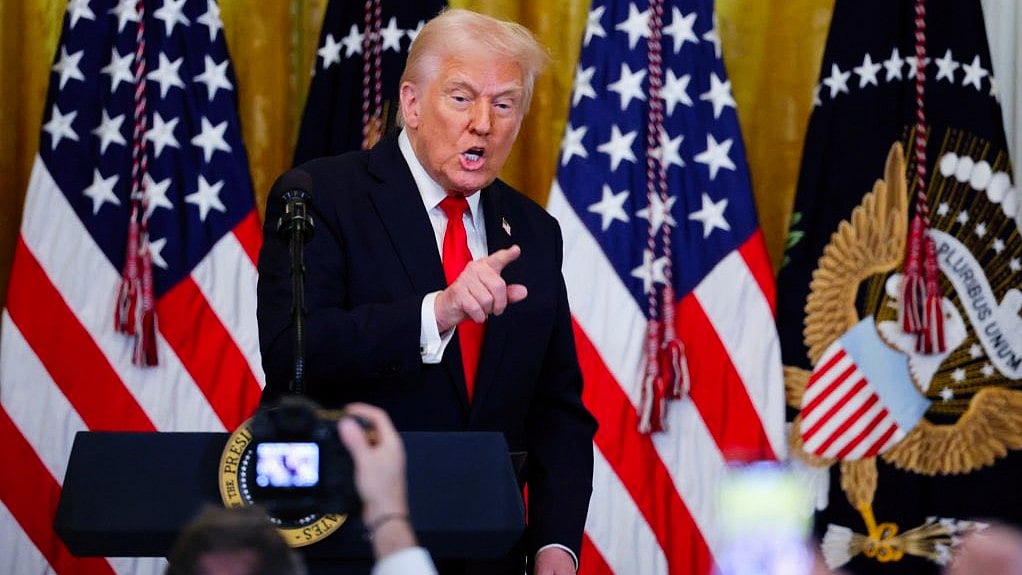
A social media post by US President Donald Trump demanding Iran’s “unconditional surrender” has sharpened questions about whether the United States is in a full-scale war with Iran — even as officials in Washington continue to insist that the conflict does not constitute a war.
In a post on Truth Social, Trump declared that there would be “no deal with Iran except UNCONDITIONAL SURRENDER”, adding that once new “acceptable” leadership emerged, the United States and its allies would help rebuild the country economically. The message concluded with a typically slogan-style flourish — “Make Iran Great Again (MIGA).”
The rhetoric is strikingly maximalist. Historically, the phrase “unconditional surrender” has been associated with decisive wartime outcomes, most famously during the Allied campaign against Axis powers in World War II. It implies not merely a ceasefire or negotiated settlement, but the complete capitulation of the opposing side and the imposition of a new political order.
That language sits uneasily alongside the official line from Washington that the United States is not engaged in a war with Iran, but rather conducting 'limited military actions'.
The contradiction reflects a deeper ambiguity in American policy: the gap between the political messaging coming from the White House and the legal and strategic framing adopted by US officials.
Under the US Constitution, the power to declare war rests with the United States Congress. If the confrontation with Iran were formally described as a war, it would likely trigger provisions of the War Powers Resolution, which requires congressional authorisation for sustained military operations.
For that reason, administrations have often avoided describing overseas military actions as wars, preferring terms such as 'operations', 'limited strikes' or 'self-defence'.
Yet Trump’s rhetoric points in the opposite direction. By demanding surrender and hinting at the selection of 'acceptable' leadership in Iran, the statement suggests a vision that goes beyond punitive strikes and moves closer to the idea of political transformation inside the country.
While the post stops short of explicitly calling for regime change, its logic strongly implies it. The sequence it outlines — military defeat, new leadership and economic reconstruction — mirrors the framework that has historically followed regime-changing conflicts.
The resulting messaging gap has created competing narratives in Washington. One strand of discourse, reflected in Trump’s statements, presents the confrontation as a decisive showdown in which Iran must capitulate. Another, articulated by administration officials, frames the situation as a contained military engagement designed to deter Iranian actions rather than overthrow its government.
Meanwhile, critics in Congress argue that if US forces are conducting sustained strikes against Iranian targets, the distinction between 'operations' and 'war' may be largely semantic.
Beyond the legal debate in Washington, the ambiguity carries wider geopolitical implications. Other countries — particularly energy-importing economies such as India — are watching closely to determine whether the crisis is likely to remain limited or escalate into a broader regional war.
The stakes are especially high because the conflict zone lies near the Strait of Hormuz, through which a significant share of the world’s oil shipments passes. Any prolonged escalation could disrupt energy flows, drive up global oil prices and ripple through the international economy.
For now, Washington’s stance appears deliberately ambiguous — combining hardline rhetoric with cautious legal language. Such strategic ambiguity can offer tactical flexibility, allowing policymakers to escalate or de-escalate without formally committing to war.
But as tensions intensify, the gap between rhetoric and policy may become harder to sustain. If military operations expand or political demands harden further, the question confronting Washington may no longer be whether this is a war in legal terms, but whether the conflict has already crossed that threshold in practice.
Join our official telegram channel (@nationalherald) and stay updated with the latest headlines