POLITICS
Is Assam ready for change?
Dissatisfaction with Himanta Biswa Sarma is palpable. The question is whether the Opposition can exploit the sentiment
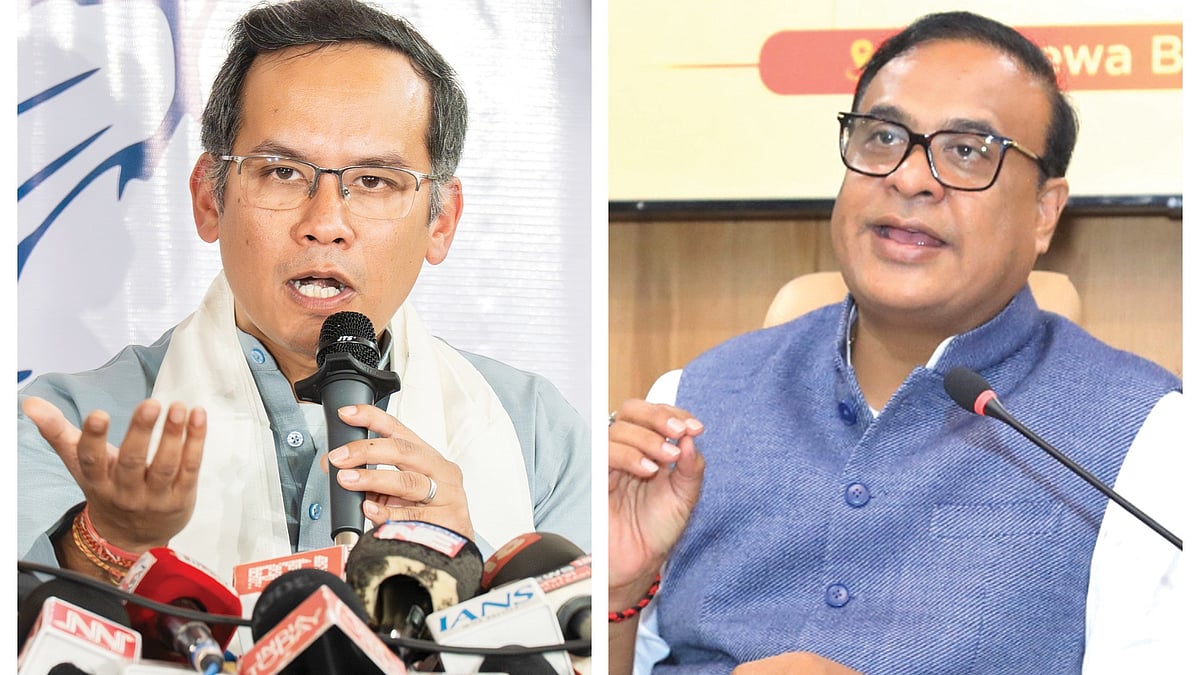
The government’s ‘anti-encroachment "Politics in Assam has never been so hateful,” says state PCC chief and member of Parliament Gaurav Gogoi. The northeastern state, which has set new standards in the politics of communal polarisation, is ready for change, he says.
Assam goes to polls on 9 April to elect a new 126-member Assembly. Counting day is 4 May. In the 2021 Assembly polls, the state had seen a voter turnout of 82.5 per cent.
Seemingly unfazed by high-profile defections on the eve of elections, Gogoi is addressing chief minister Himanta Biswa Sarma’s toxic politics. Interestingly, defections are not one-way traffic this time. Upset with Biswa Sarma’s decision to field even fresh defectors from the Congress — like Pradyut Bordoloi and Bhupen Bora — several BJP leaders have cast their lot with the Congress. Others have chosen to contest as Independents, complicating the poll arithmetic. With as many as 11 former Congressmen in the fray, dissatisfaction runs high among the BJP old guard.
BJP rebel Jayanta Das arrived surreptitiously to file his nomination as an independent candidate. Caution was necessary, he explained to media, as he was worried he’d be detained by the police, slapped with false cases and released only after the nominations were over. This will be the first time a constituency will have two Congress candidates, Das quipped (referring to recent defector Bordoloi and Mira Borthakur, the official Congress candidate).
In 2021, the BJP had bagged 60 seats. The BJP-led NDA secured 75 seats with a vote share of 44.5 per cent, narrowly ahead of the opposition Mahajot alliance which secured 43.7 per cent votes but won only 50 seats. The Congress tally of 29 pulled down the coalition.
Wiser this time, the Congress has stitched a six-party alliance with Asom Sonmilito Morcha (ASM), Raijor Dal, Assam Jatiya Parishad (AJP), CPI(M), CPI(M-L) Liberation and the All-Party Hill Leaders’ Conference (APHLC). “This alliance will effectively prevent a split in Opposition votes,” claims Congress leader Hafiz Rashid Choudhury.
The 2026 elections, however, are taking place under vastly different conditions. The BJP rolled out a delimitation exercise in 2023, effectively gerrymandering Muslim-dominated constituencies. As per the 2011 census, Muslims account for 34 per cent of the population. While they have swung results in 35 seats, post-delimitation, this is expected to go down to 25 seats.
Two of the Congress’s 2021 allies have moved on — the All India United Democratic Front (AIUDF) led by Badruddin Ajmal, and the Bodoland People’s Front (BPF) led by Hagrama Mohilary. As part of the Opposition alliance, the AIUDF had won nine per cent of the votes and the BPF three per cent.
The AIDUF’s failure to oppose the BJP government’s sustained attacks on Muslims has weakened it. A section of Muslim voters is moving towards the Congress to ensure a more viable ‘national’ challenge to the BJP. The BPF gravitated towards the NDA after winning the Bodoland Territorial Council (BTC) elections in 2025 September.
Following delimitation, the number of assembly seats in the Bodoland Territorial Region has gone up from 11 to 15 seats over which Mohilary and BPF have considerable influence.
Analysts are divided on the possible electoral impact of the Trinamool Congress going it alone in 22 constituencies and of the Jharkhand Mukti Morcha fielding 21 candidates in upper Assam.
****
In February, the BJP’s Assam unit posted an animation video depicting the chief minister shooting at two Muslim men, with on-screen text declaring ‘No mercy!’ and ‘foreigner-free Assam’.
The video provoked outrage and was deleted, but Sarma’s anti-Muslim rhetoric continues. Calling for the social and economic boycott of Miyas, he has brazenly said he is all for “troubling Miyas” if that would drive them out of Assam.
Days before the election was notified, the state government announced its decision to drop the name of former President of India Fakhruddin Ali Ahmed, the first and only Assamese to hold the position, from the Barpeta medical college earlier known as Fakhruddin Ali Ahmed Medical College.
The government’s ‘anti-encroachment drive’ openly targets Muslims, and continued during the month of Ramzan. Ahead of Eid, 566 families were evicted from Hasila Beel in Goalpara despite a high court order.
With the election notified and the model code of conduct in force, overtly bigoted messaging has taken a backseat, but there has been no let-up in attempts to polarise Assamese society. At a recent roadshow, Sarma was welcomed by BJP workers showering flowers on him from bulldozers lined up on both sides of the road.
Sarma’s hate speech and polarising tactics do betray an anxiety about the likely verdict on his governance record. According to the state’s own 2023-24 Economic Survey, nearly 10 lakh educated youth were jobless in Assam.
There’s also growing discontent among the state’s Scheduled Tribe (ST) communities. In November, the Assam cabinet proposed the creation of ‘ST (Valley)’, a new ST category that would include the Ahoms, Sutias, Moran, Matak, Koch-Rajbongshis and Adivasis.
Before this proposal, 10 per cent of reserved seats in public education and employment went to ST (Plains) communities and 5 per cent to ST (Hills) communities. The move to grant ST status to six more communities — especially Ahoms and Koch-Rajbongshis — has been strongly opposed by existing ST communities.
A recent wave of deadly violence between ethnic Karbi and Hindi-speaking Bihari communities in the Karbi Anglong district also exposed Assam’s tricky ethno-political landscape. The Karbi tribes claimed that Biharis were encroaching on their grazing reserves; they burned down the ancestral home of a BJP leader and the Kheroni market, and looted shops of Bihari residents while the police stood by and watched.
People don’t like what they see. The dissatisfaction with Himanta Biswa Sarma is real. A Guwahati-based social scientist said, on condition of anonymity, “there is a palpable undercurrent of inclusive sentiment in the state. But the question is can the opposition harvest that sentiment politically?”
Sourabh Sen is a Kolkata-based independent writer and commentator on politics, human rights and foreign affairs. More of his writing may be read here
Join our official telegram channel (@nationalherald) and stay updated with the latest headlines