POLITICS
Being a Muslim in new Bengal
Exclusion, expulsion, detention, communal provocation… Muslims in Bengal are waking up to the reality of living in a BJP-ruled state
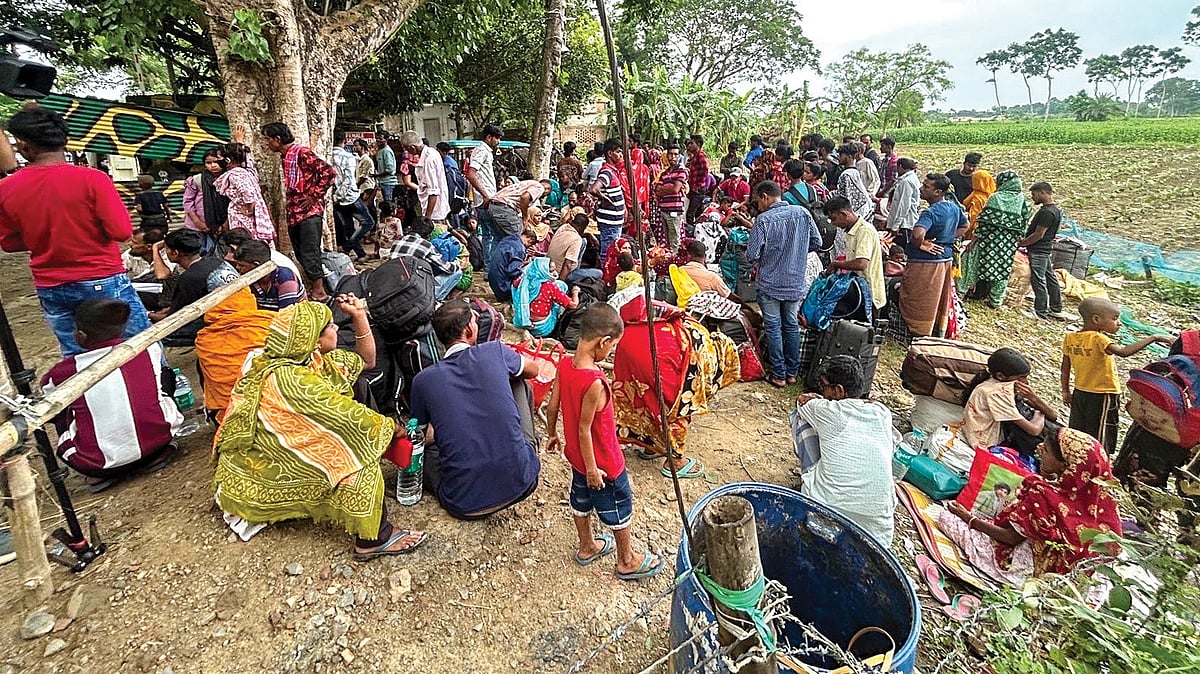
West Bengal chief minister Suvendu Adhikari’s claim on 23 June, on the floor of the state Assembly, that his government has already deported 10,000 Bangladeshis has gone largely unchallenged. There was no corroboration from New Delhi or Dhaka or the Border Security Force (BSF) and the claim has gone unquestioned by the state Opposition composed of rebel TMC leaders.
The Bangladesh Border Guards (BBG) revealed it had foiled at least 30 BSF attempts to push Indian Muslims into Bangladesh. Dhaka insisted that deportation requires identification and investigation, yet the state government seems unconcerned, unrestrained by official procedures laid out by the Union home ministry.
Who exactly were these “undocumented Bangladeshis”? Where did they live, work, and how did they acquire citizenship documents? These questions remain unanswered and Indian Muslims living in the state’s border districts are on tenterhooks.
Speaking to Scroll, 32-year-old Wasip Biswas from Murshidabad narrated the case of the 12 Muslims from Malda who were declared ‘Bangladeshis’ and sent off to a holding centre soon after Adhikari took over as chief minister on 9 May. “They are all from one family,” he said.
Biswas and his elder brother, who works in the BSF, are among the 27 lakh voters, a large number of them Muslims, whose names were struck off the voter rolls in the SIR (Special Intensive Revision). There is no update on their online appeals. In the interim, they live in terror of being cut off from welfare schemes and other benefits.
No one knows why their names have been deleted though the law mandates a written explanation and an opportunity to be heard before deletion. A 75-year-old Muslim lawyer from Murshidabad, dropped from the electoral roll, appealed to the Supreme Court, which conceded — only just about — that there was enough evidence he was a practising lawyer in Indian courts and ordered redress. What recourse would a less influential citizen have?
The protests have died down. Even in Kolkata. Prof. Quazi Mohmmad Alfred, who took part in demonstrations at the Park Circus Maidan till May, said, “It has become too risky. All activists have to think twice before doing anything now.”
Even well-heeled Muslims in West Bengal are feeling insecure. The case of retired high court judge Sahidullah Munshi is illustrative. He and his family members were dropped from the electoral rolls for ‘logical discrepancies’. His voting right was restored, though, within 48 hours of an interview to Bar & Bench. But Oxford-educated anthropologist Adil Hossain, who teaches in a private university and has a valid passport, has not been so lucky; his name has not been restored. “We don’t know what kind of rules they will make for people who do not have voting rights,” he told Scroll.
****
Muslims in Bengal admit they have never felt so unsafe. Memories of the 1946-47 riots, which had receded over generations, are back. The renaming of Suhrawardy Avenue, named after the first Muslim vice-chancellor of Calcutta University, to Gopal Mukherjee Road — a rioter lionised as a defender of Hindus — is one such step. The decision to celebrate the 125th birth anniversary of Syama Prasad Mookerjee, founder of Bharatiya Jan Sangh, for a year from 6 July is another.
The communal virus is spreading. Sheikh Ajijul (10) came home from school shaken — he was taunted by older schoolboys who called him a ‘traitor’ and a ‘Pakistani’. In Muslim neighbourhoods like Garden Reach, people speak in hushed tones of a new reality. Property papers and identity cards must be kept ready at all times for inspection. “Whenever a vehicle stops in our lane, everyone comes out to check who it is,” says an anxious resident. They spend sleepless nights fearing sudden eviction and forced displacement.
At a recent gathering, Muslim speakers agreed their community was waking up to the kind of life their brethren have already seen in other BJP-ruled states. There are rumours of demolition drives in the Muslim-dense localities of Tangra, Tiljala, Khidderpore, Ekbalpore, Garden Reach and Park Circus, even while irregular structures elsewhere remain untouched. Talk of ‘love jihad’, infiltration, UCC (uniform civil code) and arrests targeting ‘Muslim anti-socials’ keep the community on edge.
Meanwhile, police cyber cells are cracking down on critics of the government, while extremist communal voices run amok online, with no fear of punishment or reprisal. This epidemic of hatred is already poisoning everyday interactions and public discourse.
Their businesses have been hit as well. Manzar Jameel, a manufacturer of electrical components, reports plummeting orders and closed factory lines. “It’s not just Bengal,” he says, “…Muslims are being pushed to the margins everywhere in India”. The ban on street hawkers chokes small businesses, disproportionately affecting Muslim workers.
Park Circus in south Kolkata is a prominent, culturally vibrant neighbourhood, renowned for its iconic street food and buzzing cultural and political life. It has been home to many celebrities — sportspersons of note (Leander and Vece Paes and Akhtar Ali, for example), revered musicians (Bade Ghulam Ali Khan, Munawwar Ali Khan and the Dagar Bandhu, for instance) and politicians like the Suhrawardys, one of the most influential political families of undivided Bengal. (Yes, the very same Suhrawardy of the controversial road name).
On Eid mornings, the Park Circus seven-point crossing and surrounding streets used to look carnivalesque, but this time, the Eid celebrations of 28 May, barely three weeks after the elections results, were eerily muted. There were many restrictions, on ritual slaughter and public congregation for prayers. The city’s main, sprawling Eid namaz, which had been held on Red Road in central Kolkata for half a century, was also relocated to the Brigade Parade Ground a.k.a. Maidan.
The streets of Kolkata’s many Muslim-dense neighbourhoods, the small businesses that ply their trade in their lanes and bylanes and holes in the wall, the people who offer prayers in its many mosques are all in a defensive crouch today, dealing with the endless communal provocation, and living in mortal fear of exclusion, detention, expulsion or worse.
Join our official telegram channel (@nationalherald) and stay updated with the latest headlines