POLITICS
Gandhi’s ideals more relevant than ever, says German Chancellor amid MGNREGA controversy
As global leaders hail Gandhi’s legacy, debates continue at home over his place in public policy and political memory
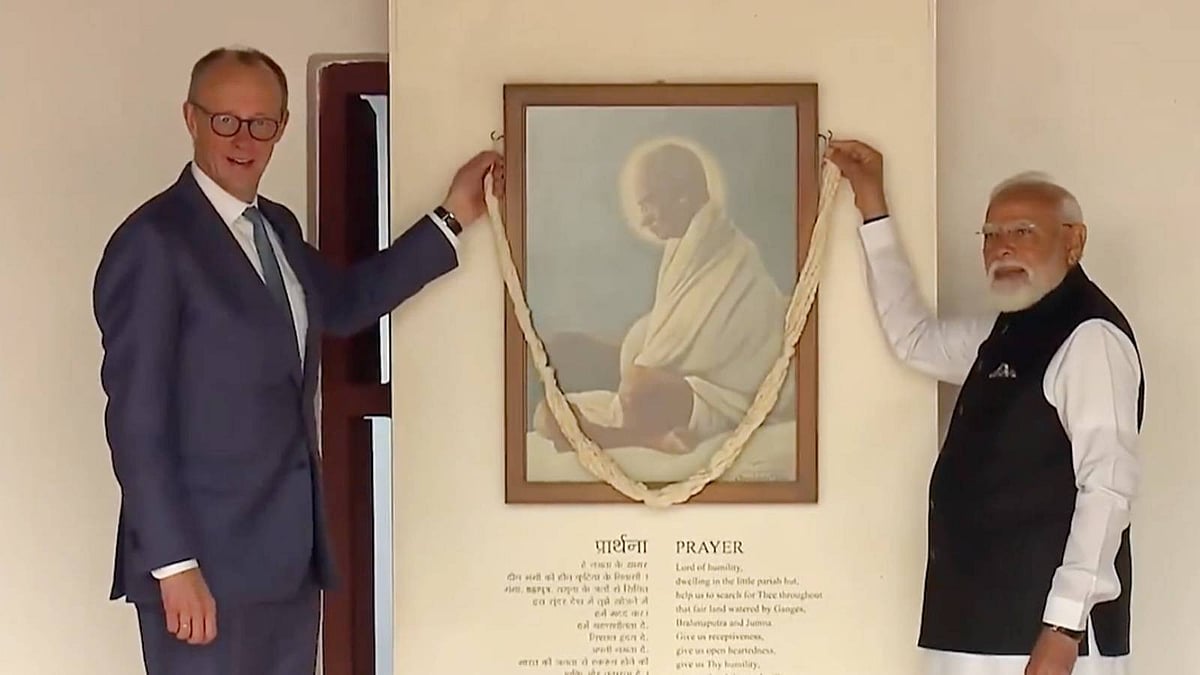
On his first visit to India, German Chancellor Friedrich Merz on Monday remarked Mahatma Gandhi’s teachings on freedom, dignity and non-violence are “more needed today than ever”, describing the legacy of the Father of the Nation as a bridge of friendship between India and Germany.
Merz made the remarks after visiting the Sabarmati Ashram with Prime Minister Narendra Modi posing beside him, where the two leaders paid floral tributes at Gandhi’s statue and toured Hriday Kunj, the room where Gandhi lived with Kasturba during India’s freedom struggle.
In a message written in the ashram’s visitors’ book, the German leader said Gandhi’s “unshakeable belief in the power of freedom and dignity of each and every individual inspires us to this day” and that this legacy “unites Indians and Germans as friends in a world that may more than ever be in need of Gandhi’s teachings”.
Merz also observed the spinning of khadi yarn on the charkha, a symbol of Gandhi’s campaign for self-reliance and village-based economic empowerment during the independence movement.
After the visit to the ashram, Modi and Merz proceeded to the Sabarmati Riverfront, where they inaugurated the International Kite Festival–2026. The two leaders interacted with women artisans involved in kite-making and later took part in kite flying at the venue.
According to a Gujarat government release, the festival has drawn kite flyers from 50 countries and nearly 1,000 enthusiasts from across India. It is being held in the run-up to Uttarayan or Makar Sankranti on January 14, marking the sun’s northward journey.
While Gandhi continues to be celebrated internationally as a global moral icon, his political and institutional legacy has increasingly become the subject of domestic political contestation in India.
Gandhi’s name removed from rural jobs law
One of the most prominent recent flashpoints has been the Union government’s decision to replace the Mahatma Gandhi National Rural Employment Guarantee Act (MGNREGA) with the Viksit Bharat–Guarantee for Rozgar and Aajeevika Mission (Gramin).
Opposition parties, led by the Congress, have argued that dropping Gandhi’s name from India’s largest rights-based welfare law represents a symbolic distancing from Gandhian values of dignity of labour and grassroots empowerment.
Congress leaders including Rahul Gandhi, Akhilesh Yadav and Bhupesh Baghel have repeatedly claimed that the move reflects an ideological attempt to dilute Gandhi’s imprint on public policy.
The government, however, has maintained that the change is administrative, aimed at restructuring implementation and expanding coverage, and not an attempt to erase Gandhi’s legacy.
Past criticism of Gandhi by BJP leaders
The debate over Gandhi’s place in contemporary politics has also been shaped by a series of remarks by BJP leaders over the years that critics describe as reflecting a revisionist approach to the freedom movement.
Among the most popular instances:
2014 Godse remark: BJP MP Sakshi Maharaj described Nathuram Godse, Gandhi’s assassin, as a “patriot”, sparking nationwide outrage. The party later distanced itself from the comment and reaffirmed its respect for Gandhi.
Patel versus Gandhi narrative: Senior BJP leaders, including Prime Minister Modi, have frequently highlighted the role of Sardar Vallabhbhai Patel, arguing that he did not receive due recognition in earlier Congress-led governments — a framing that critics say indirectly sidelines Gandhi’s central leadership role.
Questioning non-violence: Leaders associated with the broader Sangh Parivar have, at different times, criticised Gandhi’s emphasis on ahimsa, arguing that it weakened India during Partition and in dealing with hostile neighbours.
Curriculum and memorial debates: Changes in school textbooks and the relative emphasis on Gandhi in official commemorations have also drawn criticism from historians and Opposition parties, who see them as part of a wider reframing of nationalist history.
Political irony
This has produced a striking contrast:
Globally, Gandhi is invoked by leaders like Merz as a timeless symbol of peace, dignity and moral leadership.
Domestically, his legacy is increasingly filtered through contemporary political battles — from the renaming of flagship schemes to debates over historical interpretation.
For the Opposition, this contrast reinforces the argument that Gandhi’s ideals are being praised abroad while diluted at home. For the BJP, the counter-argument remains that honouring Gandhi does not require retaining his name on every institution and that revisiting history is part of presenting a broader national narrative that includes multiple freedom movement icons.
Join our official telegram channel (@nationalherald) and stay updated with the latest headlines