POLITICS
Israel used Modi's visit as shield for Khamenei assassination: Khera
Congress media & publicity dept chief invokes Knesset moment amid fallout from killing of Iran’s supreme leader
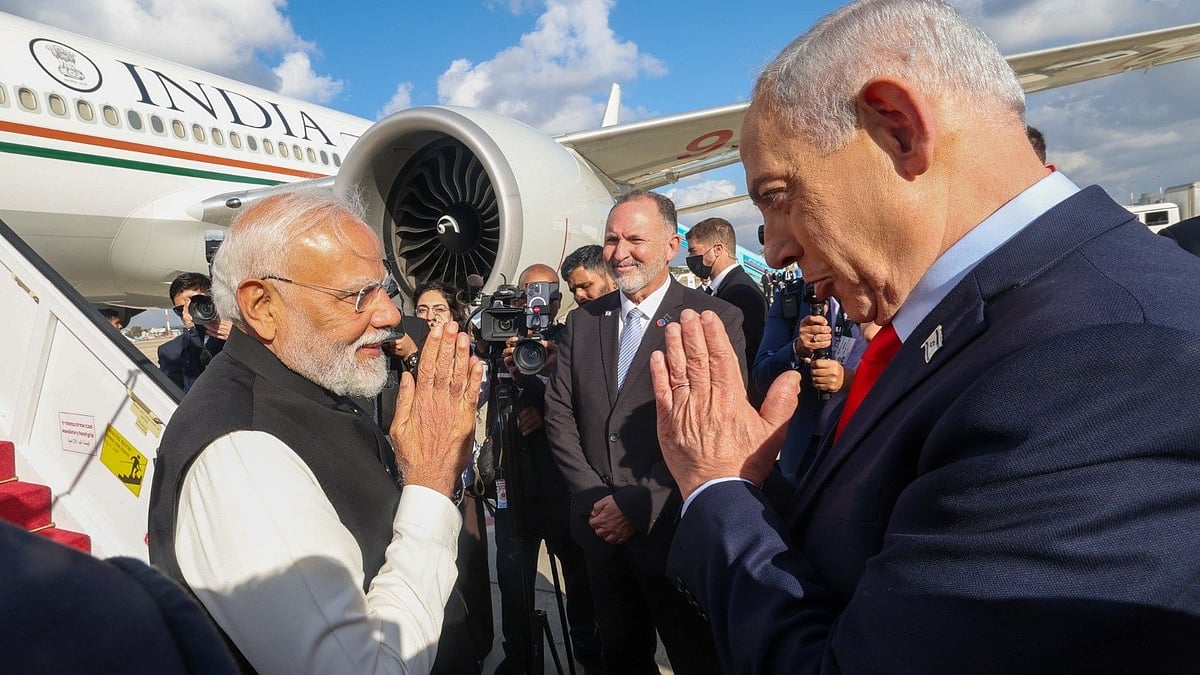
“Modi stood in the Knesset, giggling, accepting a non-existent fake award, and expressing his unconditional loyalty to his ‘friend’ and war criminal, Benjamin Netanyahu…”
With these words, Congress media & publicity department chief Pawan Khera launched a blistering attack on Prime Minister Narendra Modi’s West Asia policy — one that now unfolds against the backdrop of a seismic geopolitical event: the assassination of Iran’s Supreme Leader Ayatollah Ali Khamenei.
Khamenei was killed on 28 February in a coordinated US–Israeli strike on Tehran targeting the upper echelons of Iran’s leadership. Iranian authorities confirmed his death the following day, marking one of the most consequential acts of targeted state violence in modern history.
Unlike past covert eliminations of military commanders or non-state actors, this was the killing of a sitting sovereign leader — carried out without any formal declaration of war.
That distinction is crucial. For decades, even adversarial states largely avoided direct assassination of national leaders, recognising it as a red line that separated war from political decapitation. Khamenei’s killing represents a sharp break from that convention, signalling a shift towards overt leadership-targeting as a tool of statecraft.
It is against this altered global landscape that Khera’s reference to Modi’s Knesset appearance acquires political weight.
During his visit in late-February, Modi was presented with what Israeli officials framed as a 'special honour' during his address to the legislature. Critics have pointed out that the recognition was created specially for Modi, the first-ever recipient of the 'Medal of the Knesset', a point the Congress has repeatedly invoked to question the optics of that moment.
Khera tied this episode to what he described as Modi’s personal proximity to Israeli Prime Minister Benjamin Netanyahu. “…while Israel used his visit as a cover to plan the assassination of Iran’s Supreme Leader, the spiritual guide of millions of Shia Muslims across the world, and ‘India’s friend,’ Imam Khamenei,” he wrote.
The claim is political in nature. However, the underlying reality — that Khamenei has now been assassinated — has triggered global alarm.
World leaders and analysts have warned that eliminating a head of state outside a declared war fundamentally alters the rules governing interstate conflict. The act blurs the boundary between open warfare and targeted political killing, raising profound questions about sovereignty, escalation, and precedent.
Iran has declared national mourning, and the strike has plunged the region into uncertainty, fuelling fears of a wider confrontation.
“And now, Modi doesn't even have the decency to condemn the attack that has plunged West Asia — and the entire world — into darkness,” Khera said.
For the Congress, the issue is no longer merely about diplomatic optics but about India’s stance in the face of a moment that could redefine acceptable conduct between states. “There can be no clearer proof that Modi has no free will. He is a puppet of America and Israel — the PM is compromised,” Khera added. “We don’t know who will win this war. But Modi has already lost.”
Join our official telegram channel (@nationalherald) and stay updated with the latest headlines