POLITICS
A protest to stir anger, rattle the govt, and boost Opposition
The area near Parliament resembled a war security zone, with Delhi Police and RPF personnel stationed at key access points
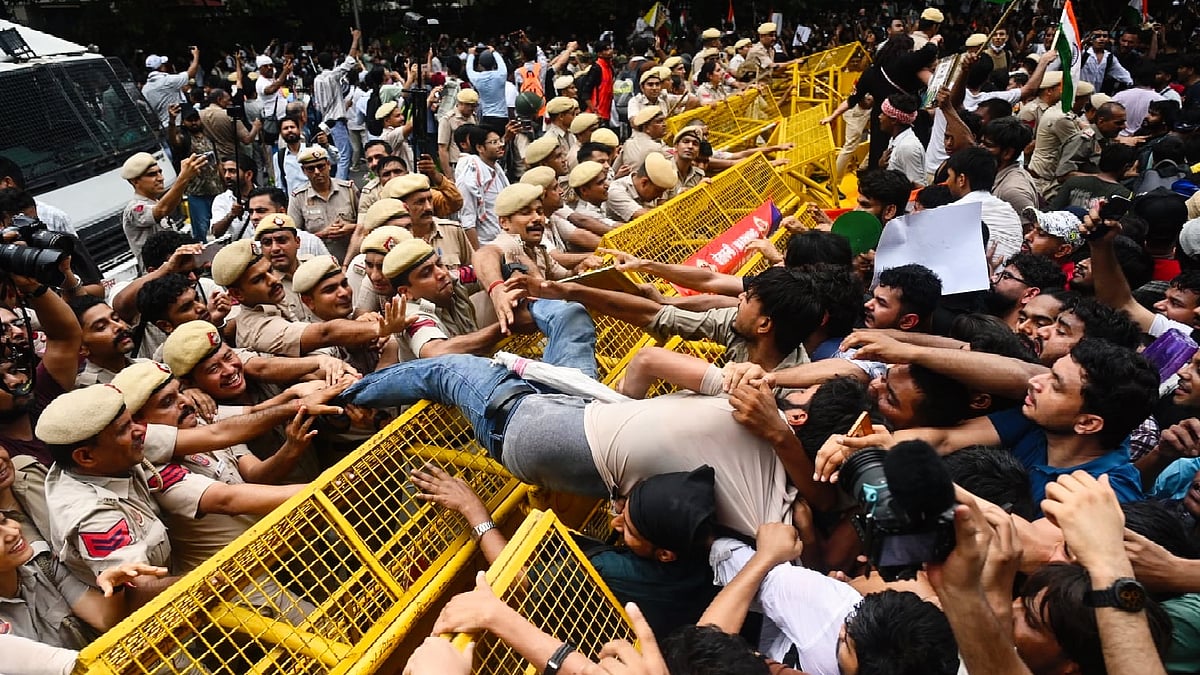
It was not a rally organised by a political party. Nor did it have the backing of a well-oiled organisational machinery. Yet, lakhs of people from different cities, social backgrounds and political persuasions converged at Delhi's Jantar Mantar on Monday, 20 July for the 'Sansad Chalo' march called by activist Sonam Wangchuk and the Cockroach Janta Party (CJP).
What unfolded in the heart of the capital was unusual. Jantar Mantar, the traditional site for protests in Delhi, has witnessed countless agitations over the years. But few in recent times have drawn such a diverse and emotionally charged crowd against the Narendra Modi government.
The movement, which began as a protest against paper leaks and irregularities in the NEET-UG examination, coupled with a demand for Union education minister Dharmendra Pradhan's resignation, has steadily grown over the past month into a broader expression of discontent.
Despite high humidity, heavy security deployment, multiple layers of barricades and the closure of nearby Metro stations, thousands made their way to the protest site. The area near Parliament resembled a war security zone, with Delhi Police and RPF personnel stationed across key access points.
Yet the crowds kept coming.
Students, young professionals, activists and ordinary citizens streamed in through narrow lanes leading to Jantar Mantar. Many beat drums, waved placards and raised slogans against Pradhan and the Modi government. Their anger appeared to stem not merely from the examination controversy but from what they saw as a larger failure of accountability.
One placard read: 'Tax do, chanda do, aur failed education system ki baat par chup raho (pay taxes, make donations and stay silent about a failed education system).'
"They are not listening to students, who are the future of the country. If they don't listen to us, who will they listen to?" asked a law student from Delhi University. She was not directly affected by the alleged paper leak. But that, she said, was not the point. "The future of the country cannot be left entirely to politicians," she said.
As the day progressed, it became evident that the protest was no longer confined to the demand for Pradhan's resignation. The slogans had widened in scope. Increasingly, they were directed at Prime Minister Narendra Modi.
Near Kerala House, a group of protesters sat on the road chanting: "Modi shahi nahi chalegi, Modi teri tanashahi nahi chalegi (Modi your dictatorship must end)."
A young man who had travelled from Bhiwani in Haryana shouted: "Jab-jab Modi darta hai, police ko aage karta hai (Modi pushes the police forward whenever he's scared."
Many protesters drew parallels between the government's handling of dissent and globally acknowledged authoritarian regimes. One participant described the present moment as "India's Tiananmen Square", invoking the Chinese government's crackdown on pro-democracy protesters in 1989.
Most participants appeared to be in their twenties. Many had little connection with organised politics. Yet they spoke in the language of rights, accountability and democratic participation.
A group of IIT graduates from south Delhi said they had joined the protest because they believed Wangchuk had been unfairly targeted. "He has worked selflessly for society. Yet he has been branded a traitor and a Pakistani agent. Anyone who criticises the government is labelled anti-national. Enough is enough," one of them said.
At the centre of the mobilisation remained Wangchuk himself. Taken away by Delhi Police from Jantar Mantar and later admitted to Safdarjung Hospital, Wangchuk agreed to end his fast only after receiving assurances that MPs would raise the issue during the monsoon session of Parliament — which began today, 20 July — and that the Centre would address the controversy.
Meanwhile, three All India Students’ Association (AISA) activists ended their 23-day indefinite hunger strike following an appeal from a delegation of Opposition legislators, civil society members and eminent personalities. The delegation assured the students that their demands would be raised inside Parliament during the monsoon session and pursued through political and public campaigns.
Among protesters, however, a recurring question surfaced: what happens after Wangchuk ends his fast? "The fast may end. The protest will not," said a student from a Dalit family.
Arya, a student at Lady Hardinge Medical College, described the mobilisation as a turning point. "There was anger beneath the surface for a long time. This protest has brought it out in the open," she said. Asked what comes next, she pointed towards the Opposition. "The anger is real. Whether it can be converted into a political movement is now up to the Opposition."
The agitation has already spread beyond Delhi. Demonstrations in support of Wangchuk and the CJP have been reported in at least nine cities across the country including Mumbai and Hyderabad.
"We are witnessing a historic moment. Today, young people have occupied every road leading to Parliament. After nearly five decades, they have reminded the country of a fundamental democratic truth — the road to Parliament runs through the streets," said activist Yogendra Yadav, who was leading a group of protesters near Le Meridien hotel.
Police resorted to tear-gas shelling and lathi-charges to disperse the crowd, but the protesters held their ground and continued their march towards Parliament, eventually reaching its gates.
What stood out was the relative absence of organised political cadres. While several Opposition parties have publicly backed the movement, their workers were largely missing from the ground.
For a government that has often dismissed protests as politically motivated or externally driven, the spontaneous turnout could prove more difficult to counter.
Even some people associated with the ruling establishment privately acknowledged surprise at the scale of participation. "We did not expect this kind of turnout, particularly from urban youth," said an RSS activist, familiar with discussions within the ruling camp. The unease, some suggested, was visible beyond the protest site.
"There is a crowd on the streets, but the heat is being felt inside Parliament," remarked a senior journalist covering the session.
Whether the movement sustains itself beyond the immediate controversy remains uncertain. Protests often lose momentum once a central figure steps back or public attention shifts elsewhere.
Yet the 'Sansad Chalo March' has delivered a message that will be difficult to ignore: despite growing political polarisation and shrinking space for dissent, public anger can still find collective expression. And if the Modi government continues to ignore the concerns of students, who constitute nearly 23 per cent of India's population, it may ultimately have to pay a political price.
Join our official telegram channel (@nationalherald) and stay updated with the latest headlines