POLITICS
In SC, Tushar Mehta contradicts Delhi Police on Jantar Mantar de-notification
Solicitor-general says decision followed MHA committee report, contradicting Delhi Police’s earlier submission to the high court
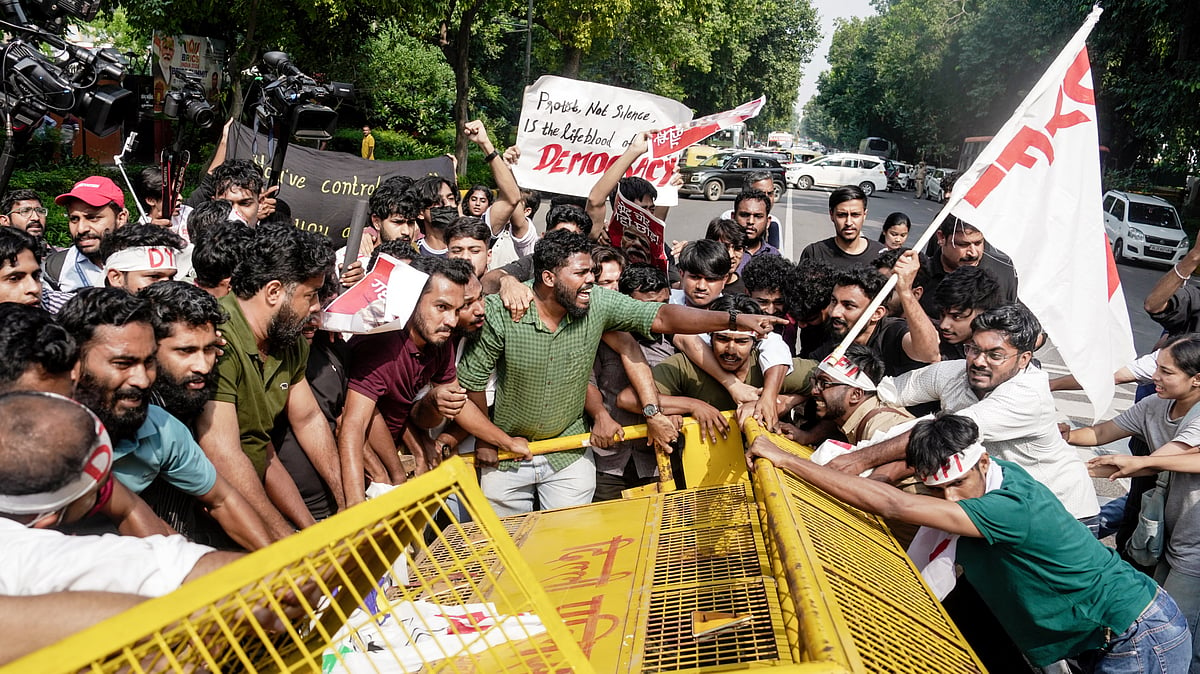
Supreme Court seeks responses from Centre and Delhi Police over Jantar Mantar’s de-notification as a designated protest site.
Solicitor-general Tushar Mehta attributes decision to MHA committee report, contradicting Delhi Police’s earlier submission to the high court.
Petition challenges alternative venues, citing costs, accessibility and potential impact on right to peaceful protest.
The Supreme Court on Thursday, 15 October, sought responses from Delhi Police and the Union ministry of home affairs (MHA) to petitions seeking the restoration of Jantar Mantar in New Delhi as a designated protest site.
In a dramatic contradiction of Delhi Police’s earlier stand, solicitor-general Tushar Mehta denied that the de-notification had anything to do with the Supreme Court’s oral observations during a hearing on 9 October. Delhi Police had earlier informed the Delhi High Court that the de-notification followed the Supreme Court’s directions.
Mehta, however, claimed that the MHA had constituted a committee which submitted a report on the basis of which the decision to de-notify Jantar Mantar was taken. He also said reasons had been recorded for the decision.
The responses of Delhi Police and the government of India will hopefully clear the air and answer several questions. When was the committee constituted? Who were its members? When did it submit its report? Did it consult stakeholders?
If Delhi Police’s submission is taken at face value, the committee would have been formed no earlier than 10 October, since the Supreme Court’s observation that the government could explore other sites was made on 9 October. The committee would then have submitted its report with remarkable speed, within just two days.
Jantar Mantar became Delhi’s designated protest venue in 1993, after authorities restricted demonstrations at the Boat Club lawns near India Gate on security and public-order grounds. The shift created a designated space where citizens could assemble and protest while limiting disruption in the central administrative district. As recently as 28 April 2022, Delhi Police standing order no. L&O/48/22 recognised Jantar Mantar as the designated protest site and laid down operating conditions for demonstrations there.
However, a standing order signed by Delhi Police commissioner Anurag Kumar on 11 October 2026 de-notified Jantar Mantar as a designated protest site. The decision was made public on 12 October. Three alternative venues were designated: Ramlila Ground, C.B.D. Ground in east Delhi and a ground at Burari, all between 4 and 15 km from central Delhi.
Moreover, using Ramlila Ground and C.B.D. Ground requires permission from municipal authorities and payment of various fees amounting to Rs 1.25 lakh a day.
Ramlila Maidan is said to have a capacity of 50,000 people, while C.B.D. Ground in Shahdara can accommodate 15,000 and the ground at Burari, controlled by the Delhi Development Authority (DDA), reportedly 80,000. All three grounds, however, are paid venues, and Ramlila Ground is booked for events almost throughout the year. Connectivity is also an issue, and a large crowd would find it difficult to gather at short notice without weeks of planning and substantial financial resources. Flash protests would be virtually ruled out.
While the new venues can accommodate much larger gatherings, they are farther from Delhi’s political centre and require considerably larger crowds before a protest appears visually significant. An Indian Express analysis, for instance, noted that to create the same “full ground” visual effect as 3,000 people at Jantar Mantar, a protest at Burari would need tens of thousands of participants.
The petition has been filed by advocate Swati Singh, who argues that relocating protests to distant, outlying areas may render the fundamental rights to peaceful assembly and freedom of expression ineffective.
The petition contends that the right to protest is not merely a right to gather somewhere, but also a right to be heard by the government and the public. Moving demonstrations to peripheral locations, it argues, could weaken the exercise of the constitutional rights to free speech and peaceful assembly. Jantar Mantar’s proximity to Parliament, ministries and the media gives protests greater visibility and impact.
The petition also points out that peaceful protests are not always planned in advance and may arise in response to sudden government decisions.
It further argues that the de-notification order is arbitrary and procedurally deficient, particularly because revised standard operating procedures governing the newly designated venues have yet to be issued. This, it says, leaves the framework for exercising the right to protest uncertain and incomplete.
The Supreme Court on Thursday issued notice to the Union of India and Delhi Police, saying it would examine whether the decision to de-notify Jantar Mantar as a protest site had been taken after due application of mind.
Justice Joymalya Bagchi, who had famously observed that voters excluded from electoral rolls through the Special Intensive Revision could hope to vote "in the next election", was virtually trolled in court on Thursday.
When he reminded the petitioners that, in the age of digital technology, distance should not matter and voices could be heard from faraway places, an advocate retorted: “If that is so, what are we doing in Delhi? We might as well be in Kerala.”
Join our official telegram channel (@nationalherald) and stay updated with the latest headlines