POLITICS
The poorest MLA in India’s richest state
Vinod Nikole, a Warli Adivasi from Palghar district, proves that money does not always talk
He didn’t even have a bank account when he realised he was contesting Maharashtra’s Assembly elections. His wife, a teacher in an Adivasi residential school, lent him Rs 15,000. His party workers contributed whatever they could, and he managed to put together a sum of Rs 52,000 before filling up the election form.
“My cousin brother later loaned me 70,000 rupees...” he says with a wry smile, sitting on a plastic chair outside his office in Dahanu, in the tribal-dominated district of Palghar. “That was the only cash I had ahead of the elections.”
The odds couldn’t have been stacked worse against CPI(M) member Vinod Nikole. His primary challenger was Dhanare Paskal Janya, a sitting BJP MLA, who won from Dahanu in 2014 with a margin of over 16,000 votes. (The BJP officially admitted to spending over Rs 82 crore in the Assembly elections that year.) Yet, when the results came in, Nikole won with a margin of nearly 5,000 votes.
It seems like a story from an India that doesn’t exist anymore. But it happened in 2019, and again in 2024. At a time when politics seems like a game that can’t be won without vulgar expenditure, Nikole, 48, is comfortably into his second term. This, in a state where 93 per cent of legislators are crorepatis (millionaires), as per an analysis of the outgoing 2024 Maharashtra Assembly by the Association of Democratic Reforms (ADR).
****
Born to brick kiln workers in the village of Waki, four km from Dahanu town, Nikole is the poorest MLA in Maharashtra, where the richest MLA declared assets worth Rs 500 crore. He can’t hand out money before elections, nor can he hire social media teams to push his agenda. His capital comes from being on the ground and staying accessible to ordinary people, mainly tribal farmers and labourers.
“That’s the only way I can win elections,” he says. “Every morning after 10 you can find me at my office. Anyone can walk in and talk to me.”
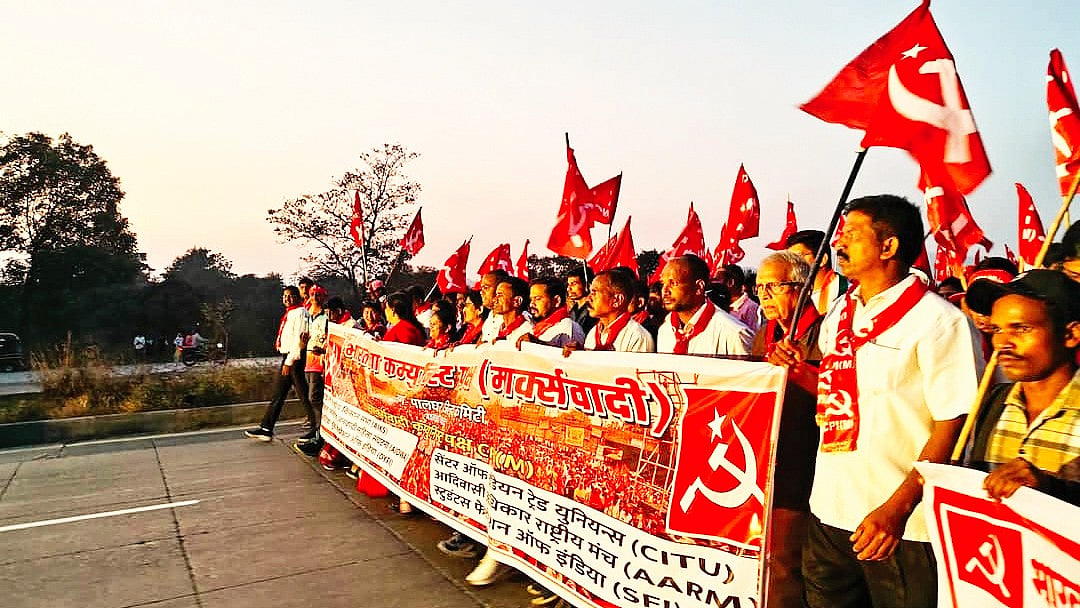
In January, the CPI(M)-affiliated All India Kisan Sabha (AIKS) organised two massive protest marches of Adivasi farmers in the tribal belt of Palghar, Nashik and Ahilyanagar (formerly Ahmednagar). Nikole, himself a Warli Adivasi, was at both rallies. He walked with farmers, slept on the floor and ate the food they ate.
“One of his strengths is that he sees himself as part of a collective leadership and united movement,” says AIKS president Ashok Dhawale.
“You don’t see that nowadays,” says Ishwati Gahala, a Warli Adivasi who participated in one of the protest marches. “It makes you feel you are properly represented and heard.”
The day I met Nikole in Dahanu, he had just arrived from Boisar after addressing a meeting of contract labourers. “We managed to increase their monthly salaries from 12,000 to 13,050 rupees,” he tells me.
“The two most important issues here are worker rights and land rights. We have unions in 50-60 companies here, and we regularly negotiate with them for better wages.” His party has a union at the Adani thermal power plant as well. “Unions become ineffective when leaders sell out. That will never happen to us.”
Suresh Jadhav, 54, a contract worker at the thermal plant, says his salary was Rs 2,600 in 2010 when they first unionised. “Today, we make 28,000 rupees a month.” That’s a pay-rise of almost 1,000 per cent over 16 years — unimaginable for workers back in the day.
Jadhav says their voices automatically carry more weight because the MLA is on their side. “It was easier to ignore us before 2019,” Jadhav says. “Our demands are taken more seriously now.”
After dropping out of college due to financial difficulties, Nikole was working in a canteen in Dahanu serving food and cleaning utensils when a senior CPI(M) leader convinced him to join the party.
“The membership fee was Rs 5 at the time,” Nikole recalls. He asked the senior leader: “You had breakfast at my canteen and I’m supposed to give you five rupees? Shouldn’t it be the other way round?” After he cut the receipt for Rs 5, the leader replied, “You are now a party member.”
“I didn’t understand what it meant at the time,” Nikole says. “But he took me under his wing, and I started working for the party.”
When he became an MLA in 2019, he started getting a monthly salary of Rs 1.5 lakh. For the first time in his life, at the age of 41, he could count on a steady income. Even today, he donates half his monthly salary (now Rs 2 lakh) to the party.
When Nikole submitted his election affidavit for his second run in 2024, his declared assets were worth Rs. 87 lakh — most of it from the 0.25 acre of land he bought and the modest house he built on it.
After the 2024 Assembly elections — which the BJP swept — the ADR’s report found that 157 out of the 279 crorepati winners analysed won with a vote share of 50 per cent and above.
Opposition parties have credibly pointed out that the BJP starts every election with a clear advantage because of the huge gap in resources. In 2024-25 alone, the BJP drew donations of over Rs 6,000 crore nationally — 12 times more than the largest Opposition party, the Congress. A level playing field simply does not exist. Even in Maharashtra’s civic polls, Rs 55 crore was spent on online advertisements alone in less than a month.
But even this massive disadvantage, Nikole says, can be mitigated if you “make a home in the hearts and minds of voters. You have to earn their trust. Then, when others try to throw money at them, the voters won’t sell their vote.”
Article courtesy: People’s Archive of Rural India
Join our official telegram channel (@nationalherald) and stay updated with the latest headlines