POLITICS
Detention centres in disguise: TMC slams Bengal’s new 'holding' centres
Holding centres for suspected Bangladeshis and Rohingyas raise questions over process, detention powers and oversight
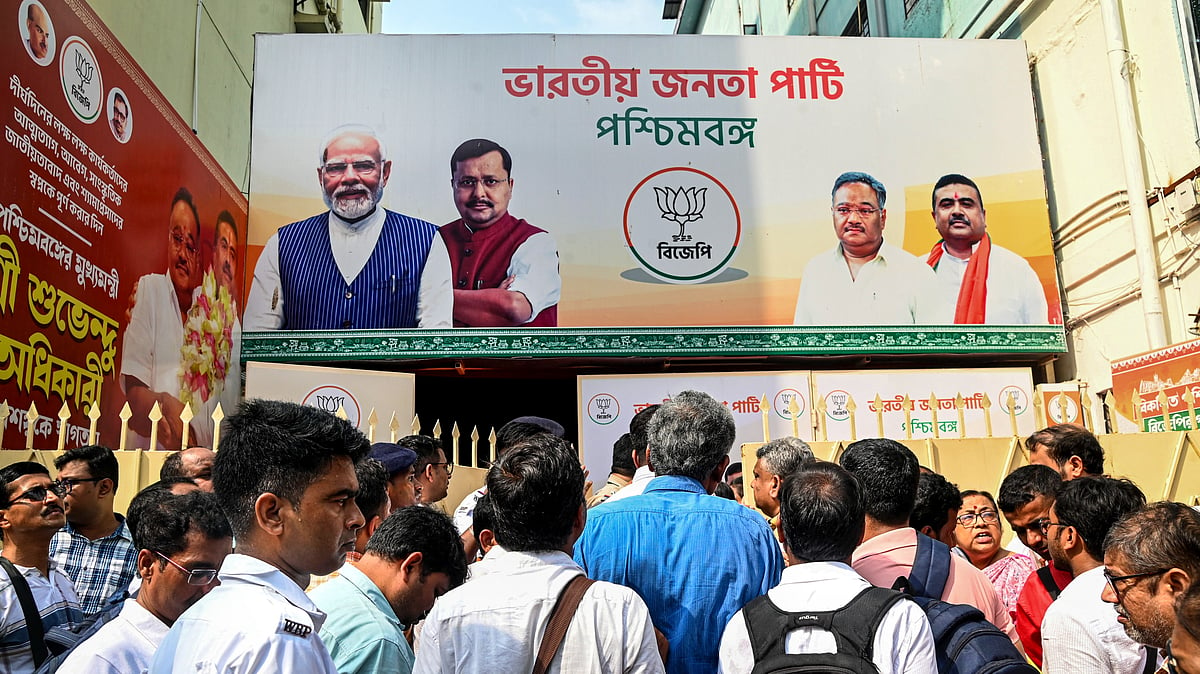
The West Bengal government’s rollout of 'holding centres' for suspected Bangladeshi nationals and Rohingyas has triggered a fresh political and legal controversy, with mounting questions over how detainees are being identified, what legal safeguards apply, and how the new system will function in practice.
Days after chief minister Suvendu Adhikari publicly endorsed the BJP’s 'detect, delete, deport' policy, the first holding centre became operational in Lalgola in Murshidabad district. Three men suspected of being Bangladeshi nationals are currently being held under tight security on the third floor of Padma Bhavan, a government-owned building originally built to accommodate local fish traders.
The move stems from a directive issued by the home department’s foreigners’ branch, which instructed district administrations to establish holding centres “with wartime urgency” for suspected infiltrators and foreign nationals awaiting deportation. The order followed a 2 May 2025 advisory from the Union Ministry of Home Affairs concerning the repatriation of undocumented Bangladeshi nationals and Rohingyas.
However, the government has not publicly spelt out several aspects of the process, including the precise legal framework governing detention, the standards of verification being applied, the duration of custody, or the mechanisms through which suspected foreign nationals would be screened before deportation.
Those questions have become central to the political backlash surrounding the move.
Trinamool Congress leader Kunal Ghosh launched a sharp attack on the BJP government, arguing that the centres amounted to detention facilities under another name.
“No matter how euphemistically the chief minister and his administration describe this as a ‘holding centre’, in reality it is nothing but a detention centre,” Ghosh said at a press conference in Kolkata. “After Assam, they are now bringing the same divisive politics into Bengal. We opposed such inhumane detention centres from the very beginning and we will continue to oppose them.”
Ghosh also questioned the legality and transparency of the process, arguing that under Indian law, allegations of illegal infiltration ordinarily require arrest, production before a court, and processing through established judicial and diplomatic channels before deportation can occur.
“What is happening now is completely different. People are being detained merely on suspicion and locked away without judicial scrutiny. Who can guarantee that genuine Indian citizens will not be falsely branded as Bangladeshis for political reasons?” he asked.
The TMC leader further questioned the role of the Border Security Force. “If infiltration has happened, then the responsibility lies with the Central government and the BSF, whose duty is to guard the border. The state police are not responsible for border security,” he said.
Former BJP Union minister and now TMC leader Babul Supriyo also criticised the BJP leadership at the Centre and in the state. “How can people be detained simply on suspicion or by force?” he asked. “The BSF’s jurisdiction has already been extended 50 km inland. Now there is a so-called double-engine government in both Delhi and Kolkata. If that is the case, how is infiltration still happening?”
The debate is unfolding in the absence of any clear, publicly available estimate of the number of undocumented Bangladeshi nationals or Rohingyas living in West Bengal. While the Union government and BJP leaders have periodically cited large national figures on illegal immigration, no authoritative, state-specific dataset exists for Bengal.
Official data in the public domain tends instead to consist of border apprehensions, arrests, deportations and enforcement actions, rather than verified estimates of resident undocumented populations.
The lack of a transparent baseline has added another layer of controversy to the rollout of holding centres, with critics questioning the criteria being used to identify suspected foreign nationals and supporters arguing that enforcement cannot wait for perfect data.
The controversy widened after reports emerged that similar holding centres had also been established in Birbhum and Malda districts. In Malda’s English Bazar area, nine Bangladeshi nationals — including six minors and three women — are reportedly being held after being detained in Gazole.
Outside the Lalgola facility, security has been tightened, with civic volunteers guarding the premises. A local food supplier told reporters that he had been instructed by the block development office to provide meals twice daily to the detainees. “Those whose homes are in Bangladesh are being kept here. I have been asked to provide food for them, though I do not know for how long,” he said.
Political observers believe the issue could trigger a prolonged legal and constitutional contest in Bengal, particularly at a time when both the Calcutta High Court and Supreme Court are closely monitoring matters related to alleged 'pushbacks' and citizenship verification.
The BJP, however, has strongly defended the policy, describing it as necessary for national security. Union home minister Amit Shah had earlier declared that the BJP government would pursue a policy of “zero tolerance towards infiltration”.
“Through the strategy of ‘Detect, Delete, Deport’, we will identify and expel every infiltrator from Bengal,” Shah had said during the recent Assembly election campaign in the state.
BJP MP from North Malda Khagen Murmu also defended the government’s approach. “Any individual who is not an Indian citizen must return to their own country,” Murmu said. “Our objective is to secure both the state and the nation. For years, the Trinamool Congress allowed Bengal to become a corridor for Rohingyas, terrorists and jihadists.”
Critics, however, argue that such rhetoric risks deepening communal tensions and creating fear among vulnerable communities, particularly migrants and Bengali-speaking Muslims.
Civil rights activists have also raised concerns over the apparent lack of judicial oversight and the possibility of wrongful detention. Many fear that the rapid rollout of holding centres across districts could mirror the controversial detention infrastructure that emerged in Assam following the NRC process.
For now, the newly operational centres in Murshidabad, Malda and Birbhum have become the latest flashpoint in Bengal’s increasingly polarised political climate, with unresolved questions over detention powers, verification procedures and citizenship enforcement moving once again to the centre of public debate.
Join our official telegram channel (@nationalherald) and stay updated with the latest headlines