Sports
Is cutting-edge VAR taking the fun out of the beautiful game?
Overruling of Croatian equaliser against Portugal in thriller highlights inconsistencies again
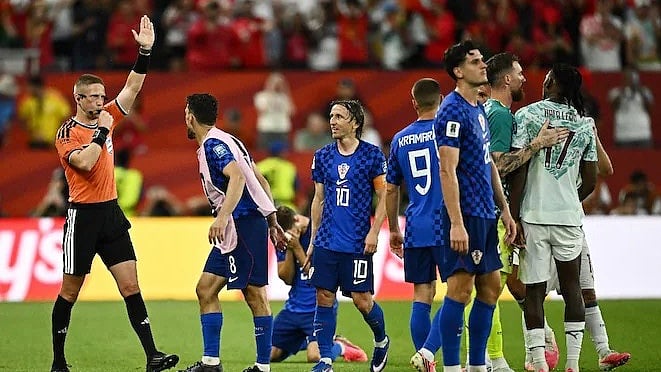
The video-assisted referee (VAR), now three World Cups old, has always had its share of critics, but the storm it has whipped up in the ongoing one has been cause for concern. The latest dig, albeit in a veiled manner, came from usually reticent Croatia coach Zlatko Dalic after a stoppage-time equaliser by Josko Gvardiol was ruled offside as the ball apparently touched teammate Igor Matanovic’s head to set up a goalbound movement.
Sounds confusing? That’s the way the new offside rule works, and it has been playing havoc with a number of goals being disallowed after VAR checks for fractional impingements. The introduction of the Snickometer in the broadcast of the game a la cricket and in vogue in Qatar as well, features a microchip fitted inside the Trionda ball which sends out signals when the ball has been touched.
Jarred Gillett, a Premier League official who was the video referee, ordered for a goal-check even as the jubilant Croats started celebrating, and with the scoreline reading 2-2 for a brief while, extra time looked on the cards.
The goalkeeper stood on the field and it appeared from TV replays that Matanovic had missed the header as he attempted to switch the ball over, which would have meant Mario Pasalic was onside before setting Gvardiol for the goal. However, Norwegian referee Espen Eskas was sent to the VAR monitor and the Snicko technology showed there was a faint edge from Matanovic, which built up a new movement and Pasalic was offside.
The question is: was the VAR replay conclusive despite the response courtesy Snicko? Experts have been polarised in their opinions as former England defender Matt Upson said on 5 Live that it was hard to tell in real time whether Matanovic touched the ball on the way to his teammate. ‘’Has he definitely touched that? The spin on the ball doesn’t change, that's all I know. I don't think he touches that ball. That's the first angle I've seen of that and I'm not convinced he touches that ball at all.’’
However, former Premier League assistant referee Darren Cann disagreed: ‘’He (Gvardiol) was offside when the ball was last played by a teammate and the ball was deflected by the defender and not deliberately played, so the offside stands. Snicko... that 100 per cent proves that he touched it with the flick-on.’’
The Croatian coach, understandably bitter as the aggrieved party, said: ‘’VAR kills emotions, it kills everything within you. We have gone too far with VAR.’’ The cutting edge technology to eliminate offsides, however well-meaning when it comes to making key decisions mistake-free, has its faultlines, as the case in point shows.
Of course, VAR cannot be blamed for every controversy as its remit is limited to four categories: goal-checks (offsides and crossing the goal line), penalty decisions, red cards and mistaken identity. The current World Cup has been privy to VAR the arbiter on the first three — with England captain Harry Kane being disallowed a penalty against Congo while Germany had a goal disallowed for a so-called foul on Paraguay goalkeeper Orlando Gill.
Earlier in the group stages, US goal-getter Folarin Balogun was handed marching orders against Bosnia-Herzegovina for serious foul play (SFP) after a VAR check, though the referee initially considered it an innocuous foul.
The refinement of technology in football means that going forward, it will be sensors, frame-by-frame analyses and the fine print calling the shots rather than spur-of-the moment decisions. However, the biggest source of frustration for fans and players alike is the ambiguity on how different decisions are processed after VAR rulings. Offsides are factual — utilising automated systems and connected ball technology to map players’ positions in real-time and then chalking goals off for fractional margins.
Conversely, fouls and penalties remain subjective and are only overturned if there is a ‘clear and obvious error’. This leads to inconsistencies where highly contested, close penalty shots are upheld because the referee’s on-field judgment takes precedence.
The other jarring note was when during the group stage match between Switzerland and Qatar, FIFA’s automated onside animation graphics experienced a temporary technical outage and did not display a penalty awarded. The lack of transparency and visual evidence left fans and pundits such as Gary Neville highly critical of the governing body’s handling of the technology.
It’s quite a conundrum, and finding the right balance so as not to hamper the fluidity of the game can be quite a challenge for FIFA.
Join our official telegram channel (@nationalherald) and stay updated with the latest headlines