


Global markets fall as oil surges after Trump signals prolonged Iran conflict
Investors react nervously as US president warns of further military action, fuelling fears over energy supplies and economic slowdown
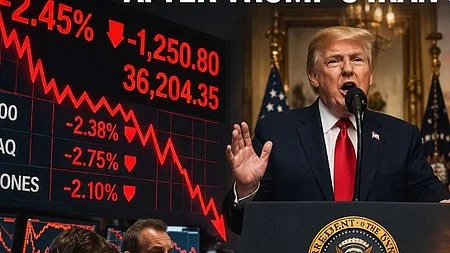


Global financial markets retreated while oil prices surged after US President Donald Trump indicated that the conflict with Iran could continue for several more weeks, heightening concerns about energy supply disruptions and wider economic consequences.
US stock futures declined following Trump’s address, reflecting unease among investors. Futures linked to the S&P 500 slipped by around 0.8 per cent, while Nasdaq futures dropped roughly 1 per cent. Dow futures also fell sharply, shedding about 350 points.
The negative sentiment extended to Asia, where early trading saw notable losses. South Korea’s Kospi index fell by more than 2 per cent, and Japan’s Nikkei also moved lower, as markets reacted to growing uncertainty over the stability of global oil supplies.
Oil prices rose significantly during and after the speech, as traders responded to Trump’s warning that the United States could intensify its military actions against Iran within the next two to three weeks if no agreement is reached. The global benchmark climbed by more than 3 per cent, with Brent crude rising above $105 per barrel in Asian trading.
Investors had been hoping for signals that tensions might ease or for a clearer path towards de-escalation. Instead, although Trump suggested the conflict could be nearing its end, he also pointed to the likelihood of further strikes, adding to uncertainty over how long the situation may persist.
Attention remains firmly on the Strait of Hormuz, a vital corridor for global oil shipments that has been disrupted during the conflict. Analysts warn that continued instability in the area could further restrict supply and sustain elevated energy prices.
Economic forecasts are already being revised in response to the situation. According to estimates cited from Oxford Economics, the conflict has created a significant gap between global oil supply and demand, raising the possibility of shortages and logistical strain, particularly in emerging markets.
Rising energy costs are also intensifying inflationary pressures. In the United States, petrol prices have climbed above $4 per gallon, increasing the financial burden on households and businesses.
While Trump acknowledged the increase in fuel costs, he described the impact as temporary and expressed confidence that markets would stabilise once the conflict concludes. However, economists remain cautious, warning that a prolonged war could dampen growth and increase the risk of a broader economic slowdown.Global financial markets retreated while oil prices surged after US President Donald Trump indicated that the conflict with Iran could continue for several more weeks, heightening concerns about energy supply disruptions and wider economic consequences.
US stock futures declined following Trump’s address, reflecting unease among investors. Futures linked to the S&P 500 slipped by around 0.8 per cent, while Nasdaq futures dropped roughly 1 per cent. Dow futures also fell sharply, shedding about 350 points.
The negative sentiment extended to Asia, where early trading saw notable losses. South Korea’s Kospi index fell by more than 2 per cent, and Japan’s Nikkei also moved lower, as markets reacted to growing uncertainty over the stability of global oil supplies.
Oil prices rose significantly during and after the speech, as traders responded to Trump’s warning that the United States could intensify its military actions against Iran within the next two to three weeks if no agreement is reached. The global benchmark climbed by more than 3 per cent, with Brent crude rising above $105 per barrel in Asian trading.
Investors had been hoping for signals that tensions might ease or for a clearer path towards de-escalation. Instead, although Trump suggested the conflict could be nearing its end, he also pointed to the likelihood of further strikes, adding to uncertainty over how long the situation may persist.
Attention remains firmly on the Strait of Hormuz, a vital corridor for global oil shipments that has been disrupted during the conflict. Analysts warn that continued instability in the area could further restrict supply and sustain elevated energy prices.
Economic forecasts are already being revised in response to the situation. According to estimates cited from Oxford Economics, the conflict has created a significant gap between global oil supply and demand, raising the possibility of shortages and logistical strain, particularly in emerging markets.
Rising energy costs are also intensifying inflationary pressures. In the United States, petrol prices have climbed above $4 per gallon, increasing the financial burden on households and businesses.
While Trump acknowledged the increase in fuel costs, he described the impact as temporary and expressed confidence that markets would stabilise once the conflict concludes. However, economists remain cautious, warning that a prolonged war could dampen growth and increase the risk of a broader economic slowdown.Global financial markets retreated while oil prices surged after US President Donald Trump indicated that the conflict with Iran could continue for several more weeks, heightening concerns about energy supply disruptions and wider economic consequences.
US stock futures declined following Trump’s address, reflecting unease among investors. Futures linked to the S&P 500 slipped by around 0.8 per cent, while Nasdaq futures dropped roughly 1 per cent. Dow futures also fell sharply, shedding about 350 points.
The negative sentiment extended to Asia, where early trading saw notable losses. South Korea’s Kospi index fell by more than 2 per cent, and Japan’s Nikkei also moved lower, as markets reacted to growing uncertainty over the stability of global oil supplies.
Oil prices rose significantly during and after the speech, as traders responded to Trump’s warning that the United States could intensify its military actions against Iran within the next two to three weeks if no agreement is reached. The global benchmark climbed by more than 3 per cent, with Brent crude rising above $105 per barrel in Asian trading.
Investors had been hoping for signals that tensions might ease or for a clearer path towards de-escalation. Instead, although Trump suggested the conflict could be nearing its end, he also pointed to the likelihood of further strikes, adding to uncertainty over how long the situation may persist.
Attention remains firmly on the Strait of Hormuz, a vital corridor for global oil shipments that has been disrupted during the conflict. Analysts warn that continued instability in the area could further restrict supply and sustain elevated energy prices.
Economic forecasts are already being revised in response to the situation. According to estimates cited from Oxford Economics, the conflict has created a significant gap between global oil supply and demand, raising the possibility of shortages and logistical strain, particularly in emerging markets.
Rising energy costs are also intensifying inflationary pressures. In the United States, petrol prices have climbed above $4 per gallon, increasing the financial burden on households and businesses.
While Trump acknowledged the increase in fuel costs, he described the impact as temporary and expressed confidence that markets would stabilise once the conflict concludes. However, economists remain cautious, warning that a prolonged war could dampen growth and increase the risk of a broader economic slowdown.
With IANS inputs
Join our official telegram channel (@nationalherald) and stay updated with the latest headlines