


How green was my Aravalli
Protests intensify in Rajasthan but there’s no end to illegal mining, writes Rashme Sehgal
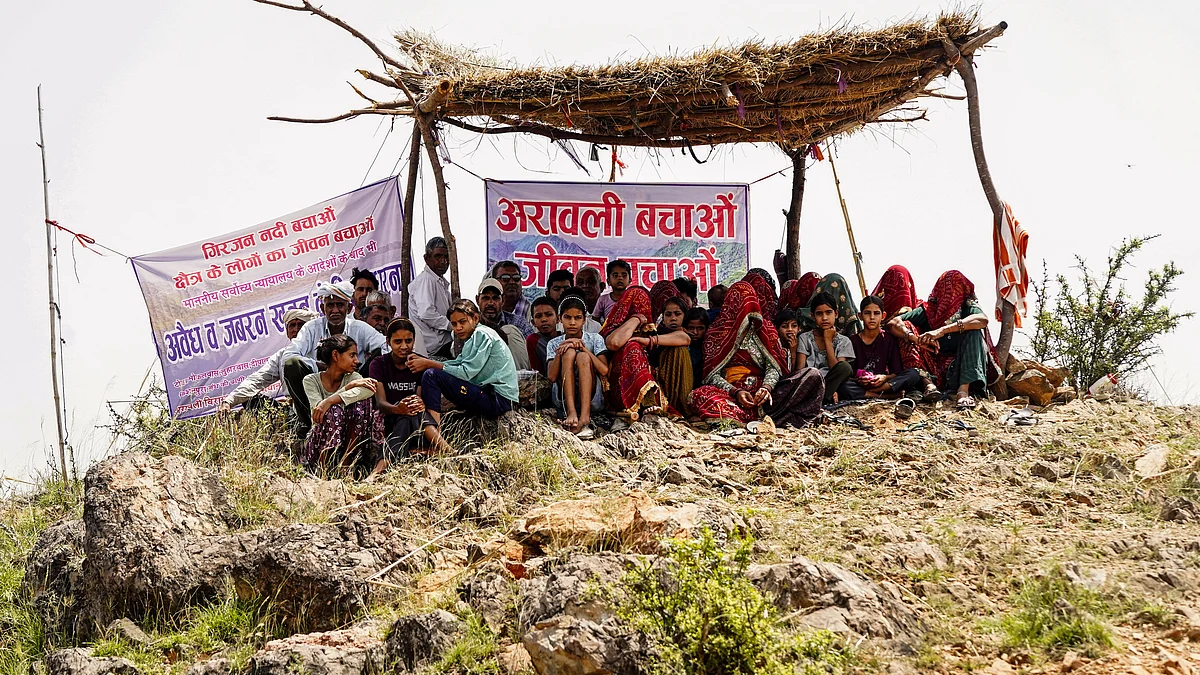


For the last three years, women in the village of Prempura in Rajasthan’s Sikar district have been protesting against unabated — and illegal — mining in their area. In the village of Deepawas, also in Sikar, the women are sitting round the clock, in determined relay groups. Frequent blasts from multiple mines nearby have caused huge cracks in their homes, endangering lives. Flying debris has scared their children off going to school and injured their cattle. A pall of dust covers the vegetation around their houses and water levels have plunged to below 1,000 feet since mining began.
In 2024, Ojwasi Marbles Pvt Ltd cordoned off 180 acres, of which 140 acres is designated forest land. Environment activist Kailash Meena from Sikar says the villagers’ prime concern is that mining will destroy the Girijan river, their sole source of water. Most of the rivers in the region have faced the same fate.
“There are forty villages with a population of over 60,000 people who are dependent on this river,” Meena says. “The villagers filed a petition against Ojwasi in the Supreme Court, arguing that the area falls within the definition of the Aravalli hills as per the Forest Survey of India report of 2010. The SC ordered that mining be halted, but unfortunately, it has not.”
In Rajasthan’s Kotputli-Behror district, another long-standing protest is on against the Aditya Birla-owned UltraTech cement company in Mohanpura-Jodhpura village. Their demand: closure of the plant and rehabilitation of hundreds of affected villagers.
Also Read: After Maoism, the mines
Captain Vinod Singh (retd), a member of the Jodhpura Sangarsh Samiti, which has been spear-heading this agitation for several years says, “Round-the-clock heavy blasting destroyed 150 of our houses and 80 tubewells. We complained to the NGT, and on 3 November last year, it ordered that no blasting should take place within a half-kilometre radius of our village.”
The Rajasthan government was directed to constitute a committee to rehabilitate victims of pollution (caused by proximity to limestone mining with crushers) within three months, to pay compensation of Rs 50,000 to the villagers whose homes suffered structural damage and Rs 20,000 to the 109 villagers suffering from diseases caused by pollution. This, says Singh, is yet to be implemented.
For over 300 days, the residents of Ajitpura-Kujeta (Kotputli-Behror district) have been protesting illegal limestone mining and deep-hole blasting by the National Limestone Company Pvt Ltd near residential settlements. On 29 May, the police forcibly removed the protesters’ tents, claiming they blocked traffic. After locals gathered to submit a memorandum to resume their protest, a group of armed assailants opened fire at them, wounding several villagers.
Nagpur Rashtriya Loktantrik Party MP Hanuman Beniwal blames the BJP top brass for allowing the mining mafia to flourish across Rajasthan. He says, “These limestone mines were bought 40 years ago and left idle. Now that their value has gone up, goons are being brought in from different parts of Rajasthan and Gujarat to attack our local people.”
The impunity with which the mining mafia is operating is evident. Last month, a group of gangsters landed up at Shatru ki Dhani village and beat up the women involved in anti-mining demonstrations. Om Prakash, a villager, says, “Six women were injured. One had her teeth broken, the other her arm. The gangsters came in the morning, knowing the men would be away at work.”
The Rajasthan Pollution Board has not issued any show cause notices to these mining companies since 2008. Identifying serious irregularities in quarry leases for metal mining in Dhansura block of Aravalli District in Gujarat, the Mines and Geology Department has imposed fines worth more thanRs 63 lakh on 54 quarries. The inspectors found irregularities under 12 criteria, with each infraction at each site bearing a fine of Rs 10,000. This was the first such inspection since 2014, when the lease was issued.
Multiple hills with lush forests have been reduced to rubble. Entire rivers along with their ecosystems have dried up and an already water-scarce area has been left gasping. The recent corporate rush to claim vast stretches of land rich in minerals like copper, zinc, lead, iron ore, limestone, marble, gold and silver must be seen in this light.
Sujata, of the Adivasi Jan Adhikar Ekta Manch, points out that the Vedanta group, through its subsidiary Hindustan Zinc, operates some of the world’s largest underground mines and smelting complexes near Udaipur.
The group operates Zawar, Sindesar Khurd, Rajpura Dariba and the Kayad mines to extract zinc and iron ore. “Many of these are underground mines; our water sources have dried up completely,” says Sujata.
The Adanis recently entered the fray, drilling for gold in the villages of Banswara, Ghatola and Jalora. Sujata adds: “In the villages of Pharara, there has been drilling for iron and copper. The tribals have received notices through the forest department, which has its own serious implications.”
The 2023 CAG reports confirm the presence of illegal mining in 122 cases, using remote sensing data and GIS techniques. Neelam
Ahluwalia, founder of the People for Aravallis group, says, “It is shocking how compensatory afforestation for forests being cut in Nicobar are taking place in a 500-acre stretch in Mahendargarh district of Rajasthan!”
The construction industry particularly covets the Aravalli’s granite deposits. Though these comprise less than 3 per cent of the terrain, they are the real goldmine for material-hungry developers looking to cash in on the Delhi-NCR construction boom.
Lawyer Hansraj observes, “The rush for green marble, white marble, soapstone, zinc and other minerals is so intense in Dungarpur that our entire ecosystem has been affected. The Jhakham river, which originates in the Sita Mata Wildlife Sanctuary and is its largest water body, is no longer accessible to local Adivasis. But water is being given to those who are mining.”
The Aravallis, one of the oldest mountain ranges in the world, estimated to be between two- to three billion years old, stretches from Gujarat to Haryana, acting as a climate regulator.
With unregulated mining now the norm across the Aravalli belt, the recent Supreme Court judgment permitting a narrow, elevation-based definition would have given a free hand to the very people who are destroying this mountain chain.
Massive protests erupted against the verdict that redefined these hills. Following the outcry, the court stayed its own order and directed the formation of a new committee. Sadly, this comprised only of government officials with no independent members. Activists and environmentalists have urged the Chief Justice of India to constitute a fresh independent committee to define the Aravalli hills. The deadline to submit a report on the definition of the hills is 31 August.
The Modi government seems perfectly immune to the destruction of ecosystems across three states and the exposure of millions to respiratory disease, silicosis and pollution-related illnesses. Anything to keep the mining and real estate lobby happy.
Join our official telegram channel (@nationalherald) and stay updated with the latest headlines