


Bangladesh: Rising anti-India sentiment poses fresh challenge to New Delhi
Violent unrest over Osman Hadi’s assassination exposes deep distrust of India’s role in Bangladesh, complicating New Delhi’s strategic ties and election hopes
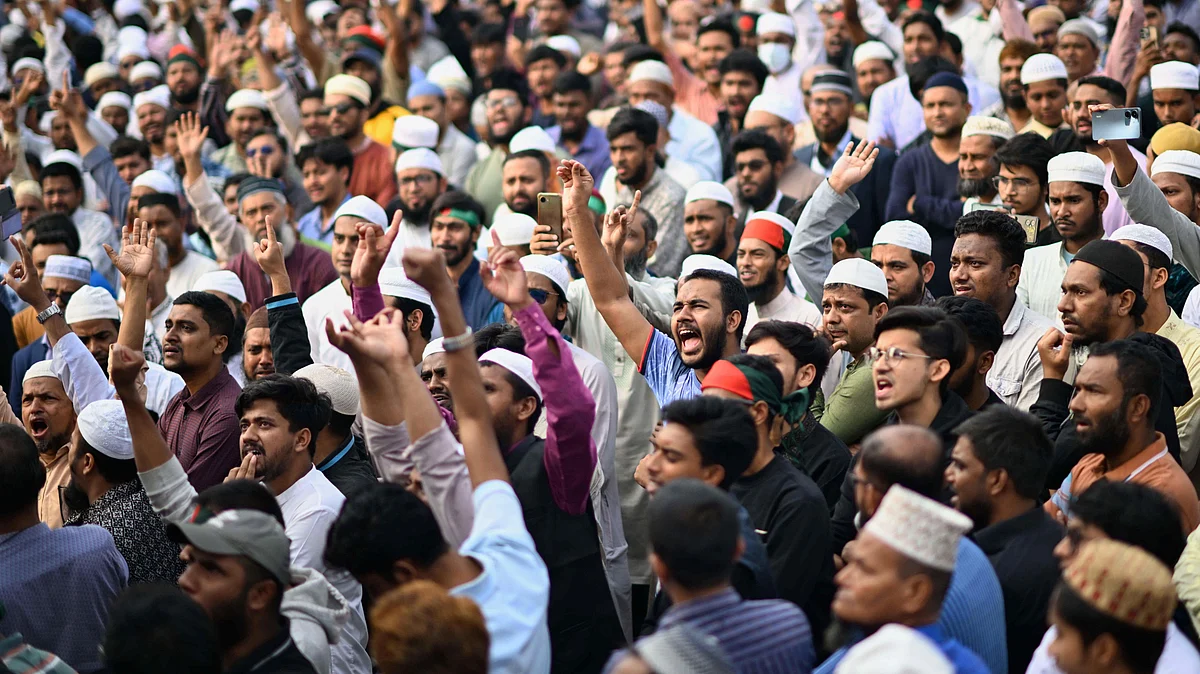


The assassination of Osman Hadi, a prominent critic of India’s influence in Bangladesh, has sparked a surge of anti-India sentiment across the country, presenting a fresh diplomatic challenge for New Delhi. Hadi, who was preparing to contest the February 2026 national assembly elections as an independent, was gunned down on 12 December 2025 in Dhaka. His killing has not only destabilised Bangladesh’s interim government but also intensified nationalist backlash against India’s perceived interference.
Hadi’s funeral was attended among others by the chief adviser of the interim government Mohammad Yunus. At a public meeting that followed, Inquilab Mancha, of which Hadi was the spokesperson, warned the interim government that it had 24 hours to arrest the killers or to tell the nation about the progress made since Hadi was shot in the head in Dhaka by two gunmen on a motorcycle.
Hadi was going to contest as an independent candidate from Dhaka and several observers in Bangladesh believe he was killed to disrupt or defer the election and unleash violence and chaotic scenes. Their prime suspect, not surprisingly, is the Awami League which has been banned from taking part in the election. India is widely suspected to have given shelter to the killers—the rumour primarily based on New Delhi having given shelter to the deposed prime minister Sheikh Hasina.
There are other suspects too who, it is believed, do not want to election to be held on schedule. Even Md Yunus, it is being said, is not in favour of an early election. A section of the army and the ‘deep state’ too are being singled out for retaining their loyalty to the Awami League. The Bangladesh Nationalist Party (BNP) is also not being spared since Tariq Rahman, son of Begum Khaleda Zia, has made reconciliatory statements towards India from London. Rahman, due to return to Bangladesh after 17 years in exile on 25 December 2025, is expected to lead the party’s charge in the election even as Begum Zia is on a ventilator in a hospital in Dhaka.
An interview of Osman Hadi is doing the rounds in which he explains his stand on India. India is ‘our neighbour’ but not ‘our master’, he says. The Awami League, he adds, gave too much importance to India and allowed New Delhi to interfere in the affairs of Bangladesh. He blamed India for discriminatory trade practices and unequal media access, citing how Indian channels dominate Bangladeshi airwaves while Bangladeshi broadcasts are banned in India’s West Bengal. His social media campaigns and public statements highlighted widespread resentment toward India’s role in shaping Bangladesh’s domestic affairs. “If 10 Indian channels are shown here, why shouldn’t 10 Bangladeshi channels be allowed to be shown in India,” he asked.
India is treating Bangladesh like a colony and that is not acceptable, he went on to declare. “Our life and relations are dictated by India…if India allows us to drink a cup of tea, we can drink a cup of tea; if India allows us to have a relationship with Sri Lanka, Pakistan or Nepal then we can have a relationship with them but otherwise not,” he went on to elaborate.
In a Facebook post days before he was gunned down, he posted a distorted map of India showing Jharkhand and parts of West Bengal, Bihar and Assam as parts of ‘Greater Bangladesh’.
Zafar Sobhan, editor of Counterpoint and founding editor of Dhaka Tribune, in a conversation with Suhasini Haidar, Diplomatic Editor of The Hindu, blamed sections of Indian media, political parties and social media chatter in India for vitiating the Indo-Bangladesh relations.
India now faces increased pressure to balance its strategic priorities in Bangladesh—supporting a stable electoral process while addressing growing anti-India narratives that could alienate a significant portion of Bangladesh’s population and political spectrum. New Delhi’s call for inclusive elections, ideally involving the Awami League, is at odds with the hostile environment exposed by Hadi’s murder and ensuing violence, raising concerns over Bangladesh’s political stability and the future of Indo-Bangladesh relations.
As Bangladesh grapples with maintaining order and timely elections, the deepening distrust toward India underscores the delicate nature of bilateral ties, signaling a need for nuanced diplomacy amid escalating regional tensions.
Join our official telegram channel (@nationalherald) and stay updated with the latest headlines