


Trump seeks 'legacy of peace' as Iran war widens under his ‘peacemaker’ watch
US president repeats claims he “stopped eight wars” even as American forces are killed and wounded in expanding conflict
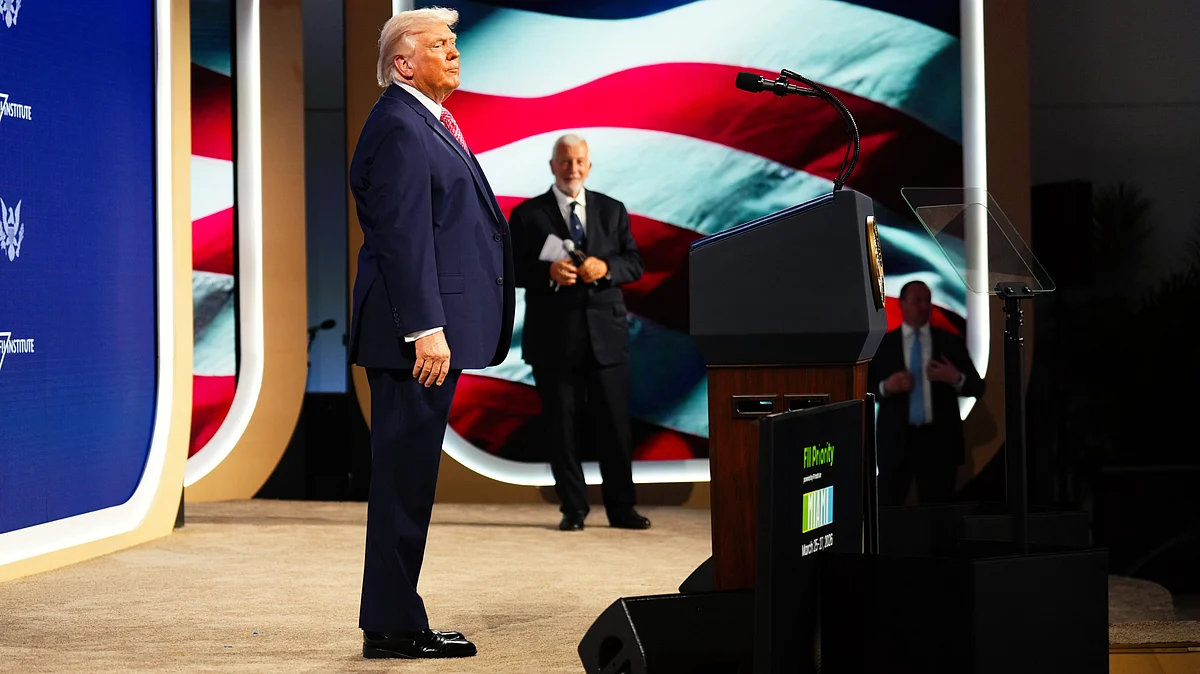


Even as American troops are being killed and wounded in retaliatory strikes across West Asia following US-Israeli attacks on Iran, US President Donald Trump repeats his insistence that he would like to be remembered as a “great peacemaker”.
Speaking at the Saudi-backed Future Investment Initiative (FII) Priority Summit in Miami, Florida, Trump presented himself as a dealmaker-in-chief whose legacy, he hopes, will be defined not by the widening Iran conflict but by the wars he says he personally stopped.
"I would love my legacy to be made as a great peacemaker because I really believe I am a peacemaker," Trump said, even as US service members continue to face casualties in a conflict triggered by strikes ordered by his administration. "It doesn't seem like it right now, but I think I am a peacemaker."
That caveat — “it doesn't seem like it right now” — is doing unusually heavy lifting.
Iranian retaliatory strikes across the region have already injured American personnel and damaged military aircraft stationed in the Gulf, underscoring the growing risks of deeper US involvement even as the White House continues to avoid calling the confrontation a war, preferring the term “military operation”.
Trump nevertheless used the Miami platform to reiterate that reopening the Strait of Hormuz — the artery through which roughly one-fifth of global oil flows — would be a precondition for any understanding with Tehran.
"We're negotiating now, and it would be great if we could do something, but they have to open it up," he said, linking the prospect of de-escalation to restoring oil shipments disrupted by the very conflict now drawing in US forces.
Also Read: Has Donald Trump met his Waterloo?
The president also repeated his claim that he has already stopped eight wars worldwide — a list that has grown over time and tends to include disputes that were simmering, frozen, or diplomatically managed long before Trump discovered them.
"I even stopped India and Pakistan, and they were going at it for a week.. nine planes already shot down," Trump said. "How did I stop them? I said, if you keep fighting, I'm going to put a 250 per cent tariff on each one. No, no, no, you cannot do that. I said, I'm doing it. All right, we won't fight anymore." The telling of this episode tends to become more vivid with each retelling.
Trump also credited himself with halting conflicts involving Armenia and Azerbaijan, the Democratic Republic of the Congo and Rwanda, Cambodia and Thailand, Egypt and Ethiopia, Serbia and Kosovo, and Israel and Hamas.
Fact checks suggest the picture is less cinematic. Several of the situations cited were not active wars but prolonged disputes, fragile ceasefires or diplomatic stand-offs that remain unresolved. Some later saw renewed violence, while in other cases the countries involved have publicly downplayed Washington’s role in de-escalation.
India, for instance, has consistently rejected the suggestion that outside mediation played any decisive role in easing tensions with Pakistan.
Likewise, tensions between Rwanda and the Democratic Republic of Congo have repeatedly resurfaced despite diplomatic interventions, while disagreements between Egypt and Ethiopia over the Grand Ethiopian Renaissance Dam remain unresolved years after negotiations began.
Even the Israel–Hamas ceasefire often cited by Trump continues to be punctuated by cycles of violence.
Trump, however, appeared more interested in branding opportunities than geopolitical nuance. At one point he jokingly referred to the Strait of Hormuz as the 'Strait of Trump' — before clarifying that the remark was not entirely accidental.
The strategic waterway has become a focal point of the current crisis, with disruptions threatening global energy markets already unsettled by strikes on Iranian nuclear infrastructure carried out under Operation Epic Fury.
"For 47 years, Iran has been known as the bully of the Middle East, but they are not the bully any longer. They're on the run," Trump said, describing the US-led strikes as a decisive blow to Iran’s leadership, armed forces and nuclear programme.
"If we didn't knock the hell out of them, they would have had a nuclear weapon within two to four weeks," he added, despite earlier assessments suggesting such operations typically delay rather than eliminate nuclear capability.
Trump has continued to resist describing the confrontation as a war even as US forces take casualties and the conflict expands across multiple theatres.
He also used the speech to once again criticise the North Atlantic Treaty Organization (NATO), suggesting the alliance would not support the United States in a major conflict. "NATO is a paper tiger," Trump said. "We help NATO, but they never help us."
The president also hinted at potential future targets. "And Cuba is next by the way, but pretend I didn't say that," Trump said. "Please, please, please, media, disregard that statement. Thank you very much. Cuba’s next."
Whether history ultimately records Trump as a peacemaker or as a president who rebranded military escalation as dealmaking may depend less on the slogans than on the consequences now unfolding across West Asia.
With PTI inputs
Join our official telegram channel (@nationalherald) and stay updated with the latest headlines